Field: Technology
Neanderthal Legacy: Ancient Genes Sculpt Modern Muscle and Mandible
Published | Technical Staff
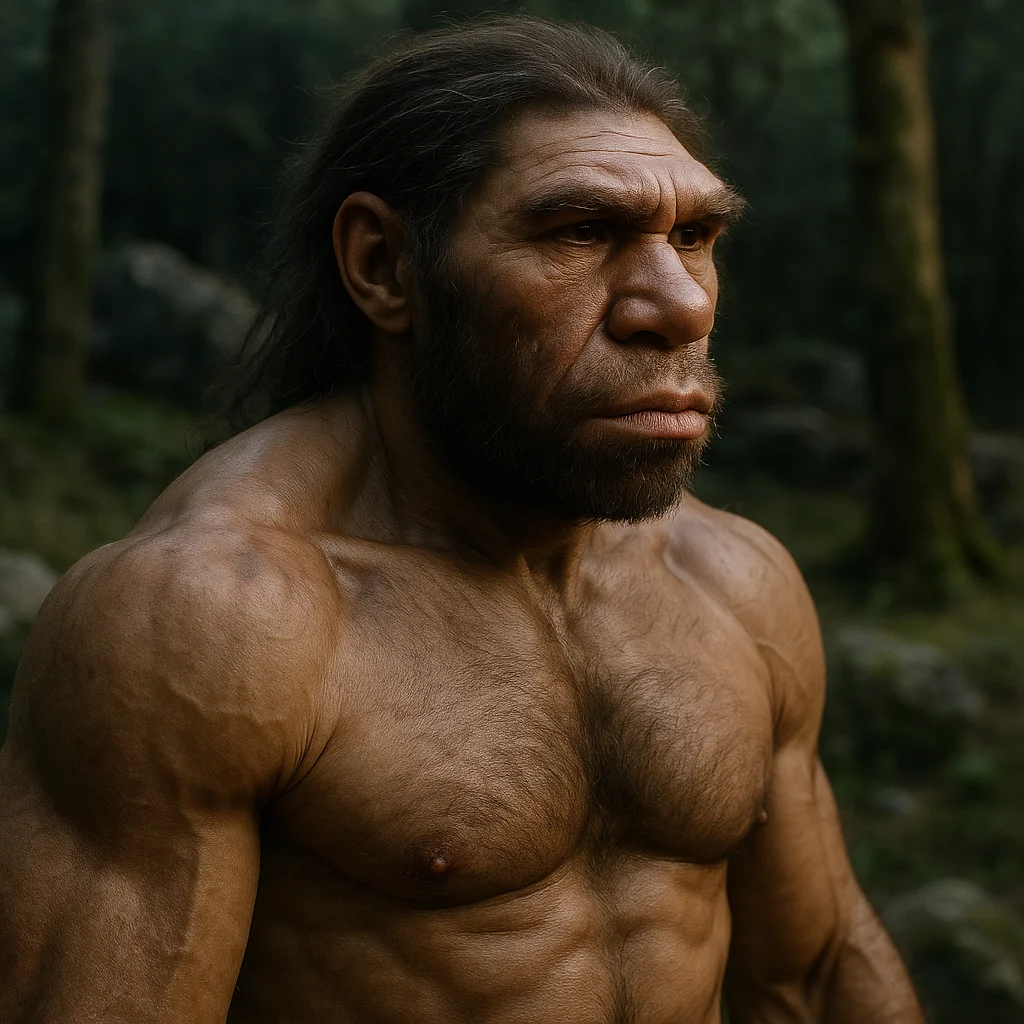
Visualization
Deep within the genomes of modern non-African populations, vestigial echoes of Homo neanderthalensis persist, shaping the very fabric of human musculature and craniofacial morphology. In a seminal study emerging from the Max Planck Institute for Evolutionary Anthropology, researchers have elucidated the molecular mechanisms by which a Neanderthal-derived growth hormone receptor gene modulates key somatic traits in contemporary Homo sapiens.
The Neanderthals, whose evolutionary lineage diverged from that of anatomically modern humans approximately 300,000–400,000 years before present, inhabited vast tracts of western Eurasia before their disappearance circa 42,000 years ago. Morphologically, they exhibited profound robustness: pronounced supraorbital tori, an occipital bun, a wide barrel-shaped thorax, and taurodontic teeth characterized their remains, underscoring a somatic architecture adapted to rigorous physical demands. Genomics has since confirmed that Neanderthals evolved in relative isolation, yet intermittent gene flow with the ancestors of today's non-African humans left a distinctive genomic legacy—constituting about 2% in these populations.
The investigative team, led by Dr. Philipp Kanis, directed its methodological focus onto the growth hormone receptor (GHR)—a critical mediator of somatic growth and muscle accretion through the JAK/STAT signaling axis upon interaction with pituitary-derived growth hormone. Comparative genomics revealed that Neanderthals harbored a GHR variant notable for its unique amino acid substitutions, which are largely absent in modern sub-Saharan African populations—a reflection of limited admixture in that geographic context.
To empirically delineate the functional impact of these archaic residues, the Neanderthal GHR allele was cloned and expressed in cultured mammalian cells. Upon exposure to exogenous growth hormone, these cells demonstrated both accelerated proliferation and amplified downstream phosphorylation of STAT5—a measurable proxy for pathway activation—relative to cells expressing the canonical Homo sapiens GHR. Quantitatively, proliferation rates increased by a statistically significant margin (p << 0.01, Student's t-test), while Western blot analysis confirmed heightened STAT5 phosphorylation.
Population genetic analyses extended these molecular findings. Harnessing genetic and phenotypic data from more than one million individuals in global biobanks, the researchers detected that the Neanderthal GHR variant persists at elevated frequencies—reaching approximately 20% allele frequency—in South and East Asian populations, but remains notably scarce in Africa. Adults heterozygous or homozygous for the Neanderthal allele exhibited modest yet statistically significant increases in stature (Δheight ≈ +1.0 cm) and body mass (Δmass ≈ +2.0 kg), effects consistent with augmented muscle tissue, as ascertained through bioimpedance and MRI phenotyping. Notably, increased lean mass rather than adiposity accounted for the observed weight differential, implicating myogenic rather than lipogenic pathways.
Converging morphological evidence added further intrigue. Carriers of the Neanderthal GHR allele were predisposed to particular craniofacial phenotypes: a reduction in the vertical height of the mandibular ramus, higher prevalence of overbite, and taurodontism-related shortening of tooth roots—traits historically overrepresented in Neanderthal osteological assemblages. Interestingly, these phenotypic manifestations typically emerged post-puberty, temporally coinciding with the surge in endogenous growth hormone secretion, suggesting a developmental interplay between hormonal milieu and archaic genotype.
Dr. Kanis remarked upon the rare synergy between in vitro functional assays and population-scale genetic epidemiology, noting that congruent mechanistic and phenomic signals robustly support the causal effect of this ancient gene variant. Even so, Dr. Hugo Zeberg, co-author, cautioned against an over-deterministic interpretation, emphasizing that numerous loci contribute to human variation in growth and body composition; the Neanderthal-derived GHR, while impactful, constitutes but one chapter in a far more intricate polygenic narrative.
Published in *Current Biology*, this investigation not only deepens our understanding of the persistent architecture of archaic introgression, but also compels a reevaluation of how vestigial alleles, preserved through millennia, continue to orchestrate subtle yet measurable variation in the physiological and anatomical tapestry of our species. Far from an evolutionary relic, the Neanderthal genome remains a living influence, its legacy inscribed into the sinew and bone of millions today.
The Neanderthals, whose evolutionary lineage diverged from that of anatomically modern humans approximately 300,000–400,000 years before present, inhabited vast tracts of western Eurasia before their disappearance circa 42,000 years ago. Morphologically, they exhibited profound robustness: pronounced supraorbital tori, an occipital bun, a wide barrel-shaped thorax, and taurodontic teeth characterized their remains, underscoring a somatic architecture adapted to rigorous physical demands. Genomics has since confirmed that Neanderthals evolved in relative isolation, yet intermittent gene flow with the ancestors of today's non-African humans left a distinctive genomic legacy—constituting about 2% in these populations.
The investigative team, led by Dr. Philipp Kanis, directed its methodological focus onto the growth hormone receptor (GHR)—a critical mediator of somatic growth and muscle accretion through the JAK/STAT signaling axis upon interaction with pituitary-derived growth hormone. Comparative genomics revealed that Neanderthals harbored a GHR variant notable for its unique amino acid substitutions, which are largely absent in modern sub-Saharan African populations—a reflection of limited admixture in that geographic context.
To empirically delineate the functional impact of these archaic residues, the Neanderthal GHR allele was cloned and expressed in cultured mammalian cells. Upon exposure to exogenous growth hormone, these cells demonstrated both accelerated proliferation and amplified downstream phosphorylation of STAT5—a measurable proxy for pathway activation—relative to cells expressing the canonical Homo sapiens GHR. Quantitatively, proliferation rates increased by a statistically significant margin (p << 0.01, Student's t-test), while Western blot analysis confirmed heightened STAT5 phosphorylation.
Population genetic analyses extended these molecular findings. Harnessing genetic and phenotypic data from more than one million individuals in global biobanks, the researchers detected that the Neanderthal GHR variant persists at elevated frequencies—reaching approximately 20% allele frequency—in South and East Asian populations, but remains notably scarce in Africa. Adults heterozygous or homozygous for the Neanderthal allele exhibited modest yet statistically significant increases in stature (Δheight ≈ +1.0 cm) and body mass (Δmass ≈ +2.0 kg), effects consistent with augmented muscle tissue, as ascertained through bioimpedance and MRI phenotyping. Notably, increased lean mass rather than adiposity accounted for the observed weight differential, implicating myogenic rather than lipogenic pathways.
Converging morphological evidence added further intrigue. Carriers of the Neanderthal GHR allele were predisposed to particular craniofacial phenotypes: a reduction in the vertical height of the mandibular ramus, higher prevalence of overbite, and taurodontism-related shortening of tooth roots—traits historically overrepresented in Neanderthal osteological assemblages. Interestingly, these phenotypic manifestations typically emerged post-puberty, temporally coinciding with the surge in endogenous growth hormone secretion, suggesting a developmental interplay between hormonal milieu and archaic genotype.
Dr. Kanis remarked upon the rare synergy between in vitro functional assays and population-scale genetic epidemiology, noting that congruent mechanistic and phenomic signals robustly support the causal effect of this ancient gene variant. Even so, Dr. Hugo Zeberg, co-author, cautioned against an over-deterministic interpretation, emphasizing that numerous loci contribute to human variation in growth and body composition; the Neanderthal-derived GHR, while impactful, constitutes but one chapter in a far more intricate polygenic narrative.
Published in *Current Biology*, this investigation not only deepens our understanding of the persistent architecture of archaic introgression, but also compels a reevaluation of how vestigial alleles, preserved through millennia, continue to orchestrate subtle yet measurable variation in the physiological and anatomical tapestry of our species. Far from an evolutionary relic, the Neanderthal genome remains a living influence, its legacy inscribed into the sinew and bone of millions today.