Field: Technology
NASA's Perseverance Mars rover makes history with record-breaking interplanetary driving
Published | Technical Staff
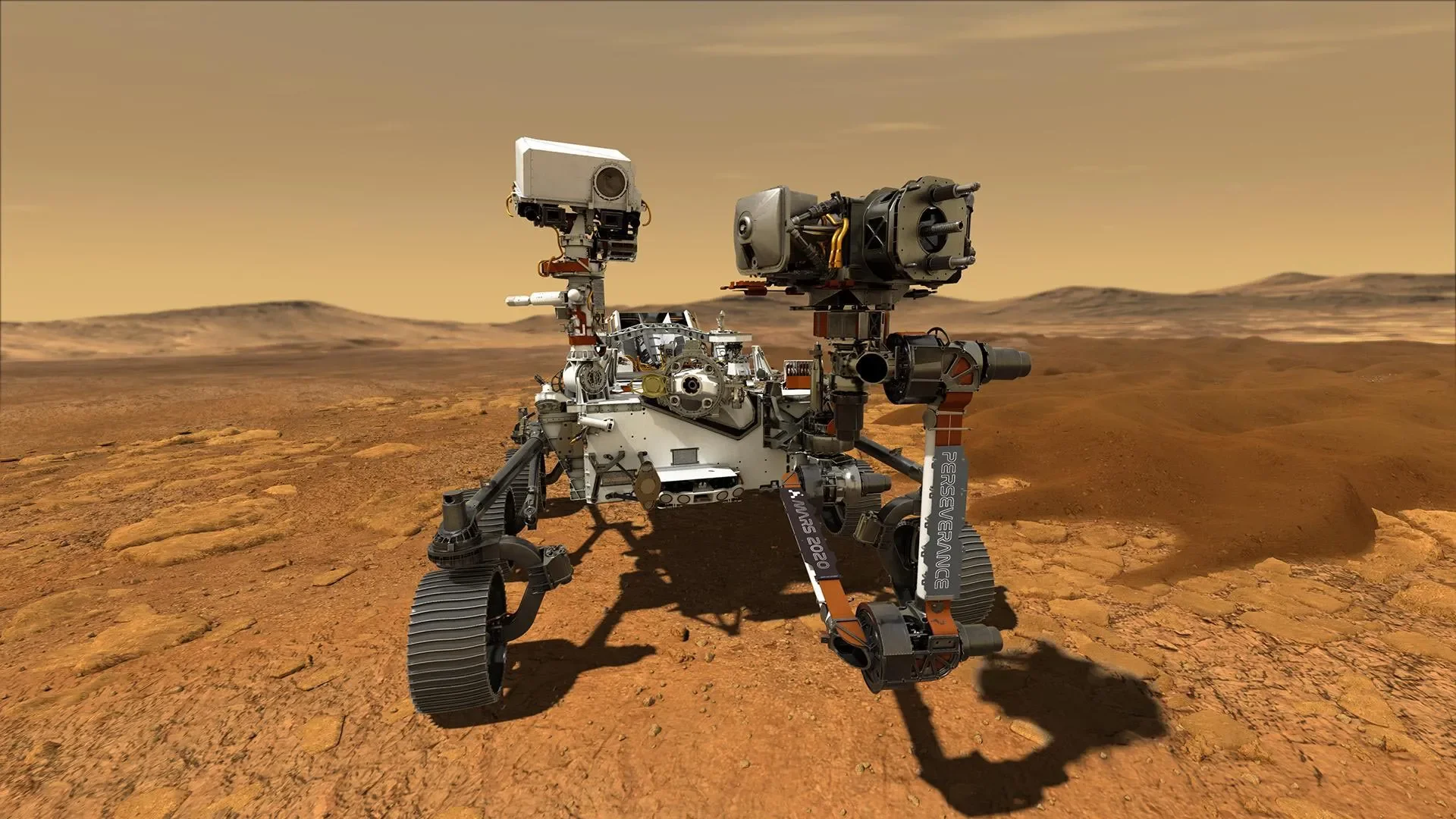
Visualization
In a remarkable achievement that encapsulates nearly three decades of Martian exploration advancements, NASA's Perseverance rover has officially surpassed its predecessor, Opportunity, by claiming the title for the farthest distance traveled on extraterrestrial terrain. On October 11, 2026, Perseverance's odometer clocked 28.10 miles (45.22 kilometers), eclipsing Opportunity’s erstwhile record of 28.06 miles (45.16 kilometers) which stood since 2018. The milestone, reached on the rover’s 2,006th sol—Martian day—reflects not only a new standard in off-world mobility but also highlights the evolution of autonomous robotic technology.
This driving feat was achieved in an impressive timeframe, with Perseverance completing the journey in a mere five-and-a-half years, a stark contrast to the nearly 15 years it took Opportunity to reach its record. The rover was navigating toward an intriguing geological feature known as "Idubi," situated within a region called "Lac de Charmes," beyond the western rim of Jezero Crater. This locale houses some of the oldest geological formations in the solar system, potentially preserving vital evidence of ancient environments that could have harbored life.
The exploration area of Idubi, marked by rocks that have resisted the erosive forces common on Earth, is of extraordinary scientific interest. Whereas terrestrial geological formations have gradually dissipated due to active geological processes such as plate tectonics—absent on Mars—these Martian rock outcrops remain intact, offering a snapshot into the planet’s distant hydrological past. Scientists anticipate finding remnants of ancient hydrothermal systems, where heated water circulated through the lithosphere, creating conditions conducive to life.
A cornerstone of Perseverance’s unparalleled mobility lies in its sophisticated autonomous navigation system—referred to as AutoNav. This advanced technology empowers the rover to traverse the Martian landscape largely independent of real-time directives from mission control. As Perseverance strolls across the dusty expanse, it captures thousands of images of its surroundings, employing machine learning algorithms to construct a three-dimensional terrain map. Integrating this vast data—an astounding 600,000 measurements per segment—the rover autonomously calculates a safe route to its next waypoint. This leap in technology represents a significant advance over the early navigation systems used by Opportunity and its twin, Spirit, which relied on rudimentary obstacle assessment and were confined to evaluating only a fraction of the terrain—approximately 5% of their overall travel distance.
Steven Lee, project manager for both the Curiosity and Perseverance missions at NASA’s Jet Propulsion Laboratory, expressed pride in witnessing this progress in Martian exploration. Initially, the mission planners aimed for a mere 12.4 miles of driving, yet Perseverance's capabilities have propelled it well beyond expectations. Motivated by favorable extended-ground-life test outcomes, NASA has greenlit an extension of Perseverance's mission, enabling it to continue its scientific inquiries through late 2028.
The trajectory of Mars rover exploration began back in 1997 with the launch of Sojourner, a pioneering robotic traveler that traversed a modest 330 feet (100 meters) during its operational span. With Spirit and Opportunity's advent in 2004, NASA achieved a monumental escalation in mission parameters as both rovers vastly outperformed their initial design expectations. While Spirit managed 4.8 miles (7.7 kilometers) before its mission concluded in 2010, Opportunity became a record-breaking machine, operating for an astounding 5,111 sols and executing a marathon of 26.2 miles (42.2 kilometers) in its final tally.
Curiosity, which has been active in Gale Crater since 2012, lays another layer of accomplishment with over 23.65 miles (38.07 kilometers) mapped. Yet, Perseverance not only holds the record for driving distance on Mars, but it has also eclipsed previous lunar vehicles. Early in its journey, it surpassed both the 22.2 miles (35.7 kilometers) traversed by Apollo 17's astronauts and the Soviet Lunokhod 2's record of 24.2 miles (39 kilometers) set in the early 1970s.
In the pursuit of continual technological advancement, NASA engineers are devising improvements to Perseverance's navigational competencies. The rover's ability to make autonomous decisions during travel has positioned it as an increasingly adept driver. Upcoming updates to its software aim to reduce excessive steering maneuvers while enhancing its capacity to cross-check its location with orbital data mid-journey. Furthermore, mitigating issues associated with glare hindering its cameras during sunlit conditions remains a pinnacle challenge, promising extended operational hours for future exploration.
Beyond the impressive numbers of kilometers traveled lies the mission’s core objective: to investigate ancient Martian landscapes that could unveil secrets about its geologic and environmental history. The quest poses tantalizing questions about Mars as a potential ancient cradle for life, as Perseverance continues its exploration through a terrain that evolved from ancient lakebeds to remnants of river systems that once flowed with water and sediment into Jezero Crater.
With each mile traversed and every rock analyzed, Perseverance is not just writing records but etching a narrative of Martian history—a story rich with implication about the origins of life itself, embodying humanity's quest for understanding life beyond our home planet.