Field: Technology
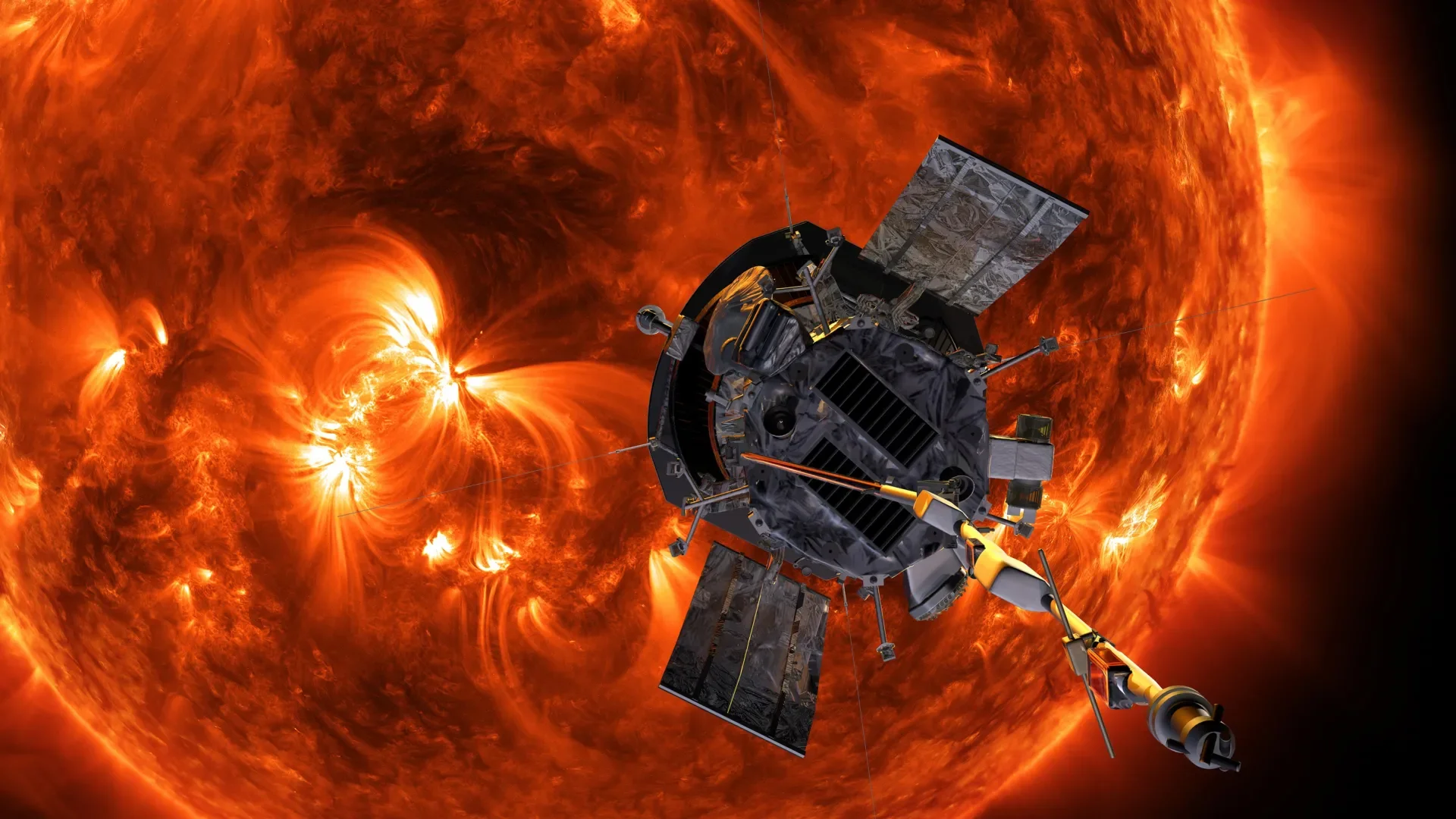
NASA’s Parker Solar Probe unveils a stunning order within solar magnetic chaos.
Published | Technical Staff
Visualization
The Parker Solar Probe, a collaborative endeavor launched by NASA, has recently unearthed a profound and unexpected phenomenon within the tumultuous magnetic landscapes of our nearest star, the Sun. Scientists have long grappled with the unpredictable nature of turbulence in space—a complex interplay that remains poorly understood when compared to terrestrial fluid dynamics. However, the Parker Solar Probe's latest findings indicate that even amidst apparent disorder, there exists an underlying structure to solar wind turbulence, marked by a surprising reversal in the rotation of turbulent magnetic fields at exceedingly small scales.
An intricate tapestry of solar plasma defines the environment surrounding the Sun, bearing sharply contrasting characteristics from the turbulence familiar to us on Earth, where air and water dominate. Unlike these terrestrial fluids, space is abuzz with plasma, a state of matter wherein charged particles interact vigorously with magnetic and electric fields. This coupled interplay generates turbulence markedly dissimilar in nature; particles traverse vast distances with little interaction, complicating any established understanding of energy distribution and turbulence dynamics.
The groundbreaking research, featuring contributions from an international consortium of scientists from institutions like the Technische Universität Braunschweig, the University of Tokyo, and others, revealed a remarkable finding: within chaotic solar plasma, magnetic fields do not simply fluctuate but exhibit a defined reversal in their direction of rotation—a phenomenon revealed through meticulous measurements of particle interactions and magnetic field fluctuations.
The study’s key revelation lies in its observation of magnetic structures organized according to their scale of turbulence. The research team demonstrated that at larger spatial scales—defined by the collective dynamics similar to fluid flow—magnetic fields generally rotate counterclockwise when observed outward from the Sun. Yet, as the scale diminishes, particular ranges of wavelengths witness a reversal, with magnetic fields transitioning to a clockwise rotation. This critical transformation occurs at the juncture where plasma behavior shifts from collective fluid-like flow to a regime dominated by individual particle motions. This dual behavior suggests that the chaotic dance of plasma may not be as random as previously posited.
Dr. Masatomi Iizawa, the study’s principal author, notes a clear magnitude of order within turbulence—an exciting discovery that marks the first identification of such a magnetic reversal within the realm of space turbulence. The study, which has been published in The Astrophysical Journal Letters, could illuminate not only fundamental plasma physics but also the astrophysics governing solar phenomena. Notably, as the solar wind extends its reach away from the Sun, the observed reversal of magnetic rotation becomes increasingly pronounced, highlighting the nuanced interplay between turbulent forces and solar dynamics.
The implications of this finding ripple across the astrophysical landscape, particularly concerning the predictability of space weather events, including geomagnetic storms. The turbulence inherent in the solar wind, driven largely by the Sun’s various eruptions, holds the keys to understanding phenomena that disrupt satellite communications and infrastructure on Earth. Harnessing insights into the orderly yet chaotic behavior of plasma turbulence may offer pathways to refining existing models used for forecasting these disruptive events.
Thus, the Parker Solar Probe's revelation points to a critical evolution in our understanding of the magnetic structures that shape solar emissions. As scientists investigate further, elucidating how a seemingly organized magnetic pattern arises from the transition between fluid-like dynamics and particle-controlled behavior, they draw closer to untangling the enigmatic forces at play in the solar wind and extending their grasp on the complexities of space weather.
The Parker Solar Probe continues its mission, charting new territories in the vast, turbulent forests of stellar plasma. As researchers delve deeper into the hidden symmetries within space turbulence, the implications could well redefine our comprehension of astrophysical processes, leading to a renaissance in our ability to predict and understand the solar dynamics that govern not only our own planet but the solar system as a whole.