Field: Technology
NASA's Juno Unveils the Complex Dynamics of Jupiter's Shield Against Solar Wind
Published | Technical Staff
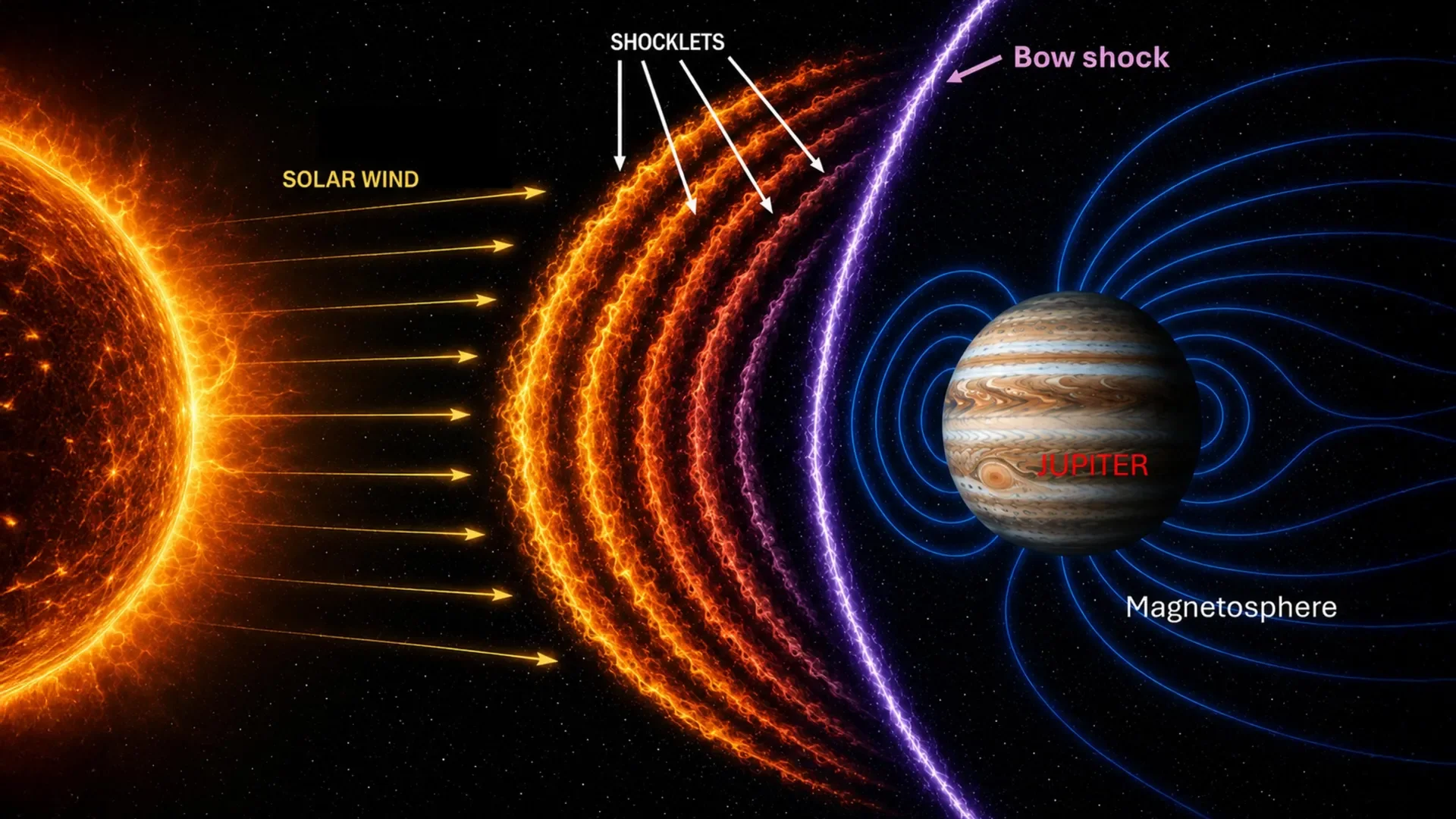
Visualization
In a groundbreaking revelation, NASA's Juno spacecraft has provided an intricate view into Jupiter’s formidable defenses against the solar wind, exposing a defense mechanism far more sophisticated than that of Earth. Utilizing advanced instrumentation and analysis techniques, researchers, led by the University of Iowa, have illuminated the details governing the interactions between Jupiter's powerful magnetic environment and the continuous stream of charged particles emitted by the Sun.
The solar wind, primarily composed of high-energy electrons and protons, streams through space at astonishing velocities, frequently surpassing even the speed of sound within the surrounding plasma medium. Upon approaching a planetary body with a magnetic field, these energetic particles encounter a boundary known as the bow shock. This boundary serves as a crucial protective layer, converting kinetic energy from solar particles into thermal energy, effectively slowing and redirecting the incoming streams before they can impact the planet.
Earth's response to solar wind primarily revolves around a singular bow shock, which efficiently redirects the incoming solar onslaught. However, what Juno's measurements have unveiled is the presence of a distinctive and layered defense strategy unique to Jupiter, characterized by multiple shock regions and a symphony of plasma waves.
Crucial to understanding Jupiter's effectiveness is the role of plasma waves manifesting at diverse frequencies, or harmonics. The research indicates that these harmonics create a complex resonance structure within Jupiter's magnetosphere, facilitating a more elaborate interaction with solar wind particles. This multi-frequency arrangement can be likened to a musical composition; while a single frequency produces a basic tone, multiple frequencies organized in harmonics cultivate a richer auditory experience. In the same vein, the variegated plasma waves increase the capacity to absorb energy from incoming particles, heating them significantly and decelerating their passage, enhancing the overall protective effect of Jupiter's bow shock.
“In contrast to Earth, which utilizes a singular primary frequency to manage solar wind encounters, Jupiter has evolved a multi-faceted approach with plasma waves that resonate at different frequencies," notes Jayasri Joseph, a postdoctoral researcher at the University of Iowa and chief author of the study. "This enables greater heating of solar particles, thereby improving the deflection mechanisms."
Furthermore, the research uncovered an additional layer of defense unique to Jupiter: smaller shock structures referred to as 'shocklets.' These intermediate shock regions engage the solar wind prior to its confrontation with the primary bow shock, catalyzing a more gradual deceleration of particles. This two-tiered defense mechanism reflects the massive gravitational and magnetic forces at play around Jupiter, allowing it to manage the intense impact of solar forces—a vast leap in complexity compared to Earth's comparatively straightforward protective schema.
Bill Kurth, a veteran research scientist involved with Juno since its inception in 2011, emphasized the significance of these findings. “Jupiter employs these supplemental shock structures because the forces it faces are exponentially greater than those encountered by Earth, necessitating a more intricate system of energy management."
The implications of this research extend far beyond the confines of our solar system, encompassing systems that govern the universe at large. Shock waves are prevalent in astrophysical phenomena, especially in the aftermath of supernovae—cataclysmic events where massive stars explode, generating extraordinarily powerful shock waves. While the energies at play in such occurrences dwarf those of Jupiter, the fundamental physical processes that dictate how energy is transferred through plasma manifest in shared mechanics. By meticulously studying Jupiter's bow shock, scientists are afforded a rare opportunity to examine energy flow and heat transfer mechanisms that inform our understanding of far-flung cosmic events.
“Jupiter’s bow shock serves as a nearby natural laboratory,” explains Joseph. “It provides crucial insights into energy conversion processes that are vital for comprehending the dynamics of shock waves in more energetic environments like those surrounding supernova remnants.”
The pivotal observations made by Juno were facilitated during its monthly orbits, coinciding with a key set of measurements recorded in December 2024. The Juno Waves instrument—an innovative piece of technology developed at the University of Iowa—empowers researchers to measure electrical and magnetic wave activities, illuminating the nature of plasma flux around the gas giant.
Where previous missions yielded only fragments of data regarding Jupiter's bow shock, Juno’s contributions have culminated in a comprehensive understanding of its complex wave structures. Such revelations were documented in a recent study published in *Nature Communications*, marking a significant advancement in planetary science.
Contributions from the University of Iowa’s research team, including Allison Jaynes and other supporting staff, reflect a collaborative effort that underscores NASA's commitment to unraveling the intricacies of planetary environments. As the exploration of Jupiter continues, the findings not only enhance our knowledge of the largest planet in our solar system but also promise to elucidate the universal phenomena that govern the dynamics of energy and plasma in astrophysics.