Field: Technology
NASA Unveils 16 Galaxies Illuminating Cosmic Chaos
Published | Technical Staff
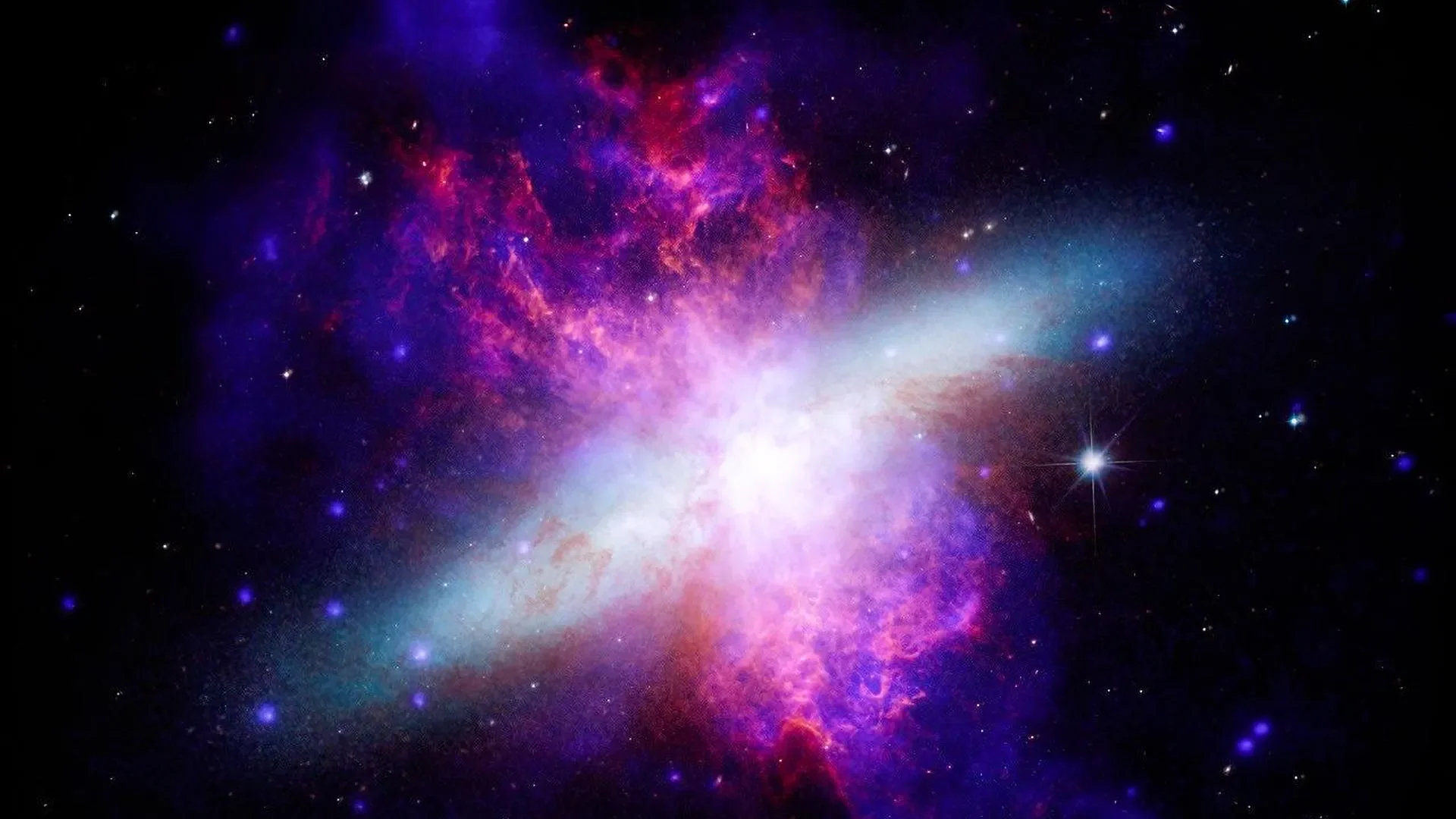
Visualization
In a breathtaking revelation, NASA has unveiled a gallery of 16 galaxies that not only captivate with their mesmerizing forms, but also embody the dynamic and tumultuous processes shaping the cosmos. This astonishing compilation derives its insights from a multi-wavelength approach, leveraging observations from the Chandra X-ray Observatory, the James Webb Space Telescope, and the venerable Hubble Space Telescope, among others. The synergy of these observational powerhouses allows astronomers to dissect the hidden forces at play within these astronomical structures, offering a profound glimpse into the evolutionary narrative of our own Milky Way galaxy.
The newfound collection presents galaxies that are analogous to intricate gemstones, each multifaceted and rich with temporal history. Typically classified into three principal types—spiral, elliptical, and irregular—these constituents of our universe reveal an array of cosmic phenomena. Spiral galaxies, like our Milky Way, exhibit gracefully extending arms, whereas elliptical forms are often the remnants of galactic mergers, containing predominantly older stellar populations. Irregular galaxies, characterized by their chaotic morphology, exhibit a variety of energetic activities, fueled by gravitational interactions and internal dynamics.
At the heart of this exploration is the breathtaking imagery procured from Chandra, whose X-ray capabilities uncover phenomena hidden from optical telescopes. X-ray emissions provide a unique lens into extreme events, such as colossal stellar winds and the effusive activity of supermassive black holes. These bursts of energy not only shape the immediate galactic environment but also contribute to the dispersion of elements critical to planetary formation, and ultimately, to the biochemistry underpinning life.
Among the galaxies highlighted in this visual symphony, some are recognized for their vigorous star-forming activity. The observations of Messier 33 and NGC 3938, obtained from a vantage point almost directly above, reveal sweeping spiral arms cradling nascent stellar pairs alongside the remnants of supernovae. Furthermore, barred spiral configurations like NGC 1672 and NGC 1385 demonstrate how elongated structures act as conduits, channeling gas inward and igniting fervent star formation. NGC 4725 serves as an illustration of how earlier gravitational interactions can perturb gas reservoirs and kickstart new stellar births.
The collection also encapsulates the striking phenomena observed in NGC 4631, known as the Whale Galaxy, and the Cigar Galaxy (Messier 82). These galaxies, viewed edge-on, showcase expansive galactic halos and superheated gas winds propelled by cataclysmic stellar explosions. Such outflows transport materials thousands of light-years beyond their galactic disks, facilitating the intergalactic redistribution of chemical elements necessary for building subsequent generations of stars and planetary systems.
At the intersection of chaos lies the enigmatic realm of supermassive black holes, whose voracious appetites render them the engines of extreme galactic dynamics. Active galactic nuclei, the luminous cores of these galaxies, emit jets of high-energy particles that extend far into the cosmos. Centaurus A is a vivid case in point, revealing through Chandra and IXPE observations an energetic outflow traveling tens of thousands of light-years from its epicenter. Similarly, Messier 106 illustrates how these jets transform the surrounding gaseous environment, leading to the development of unusual spiral configurations, deviating from the classical arm structures observed in typical spiral galaxies.
While the beauty of the cosmos can be tranquil, its mechanics can also be profoundly violent. The gallery captures galactic collisions, which signify not only cataclysmic encounters but crucial evolutionary milestones. The aftermath of the Arp 143 collision unfolded as a monumental ring structure, indicative of how merging galaxies trigger cascading star formation events across the galactic landscape. Observations of NGC 3256 and II Zw 096 further elucidate the chaotic aftermath of galactic mergers, offering pivotal insights into the gravitational interactions that once dominated the early universe.
As we advance our understanding of these encounters, scientists glean new perspectives regarding the fate of our own Milky Way galaxy. Our impending union with the Andromeda galaxy, projected to unfold over the next several billion years, dramatically parallels the galactic fates encapsulated in this collection. By scrutinizing the evidence of colliding galaxies, astronomers can refine their models of such catastrophic transmutations, elucidating the processes that could shape our cosmic neighborhood.
Among the other intriguing systems included in the gallery, NGC 1569 provides a nearby case study of intense historical star formation, hinting at the conditions prevalent in the young universe. Meanwhile, NGC 660’s unique polar ring structure offers a rare glimpse into the diverse morphological adaptations galaxies can exhibit, showcasing orbital dynamics that defy the conventional expectations established by their primary axes.
In unveiling this assortment of galaxies, NASA not only enriches our cosmic tableau but simultaneously underscores the intricate and often unpredictable narratives that govern the architecture of the universe. Through the marriage of observational data and theoretical models, we continue to peel back the layers of galactic complexity, revealing the multifaceted forces that have shaped—and will continue to shape—our place among the stars.