Field: Technology
NASA smashed into an asteroid. Now Hera has revealed a strange new world.
Published | Technical Staff
Visualization
In a dramatic evolution of our cosmic understanding, the European Space Agency's Hera spacecraft has unveiled astonishing imagery of the Didymos binary asteroid system, mere months after NASA's pioneering asteroid deflection experiment with its Double Asteroid Redirection Test (DART) mission. As Hera sets the stage for an in-depth analysis of the colossal collision, the intricacies of our planet’s defense against potential celestial threats are gradually coming to light.
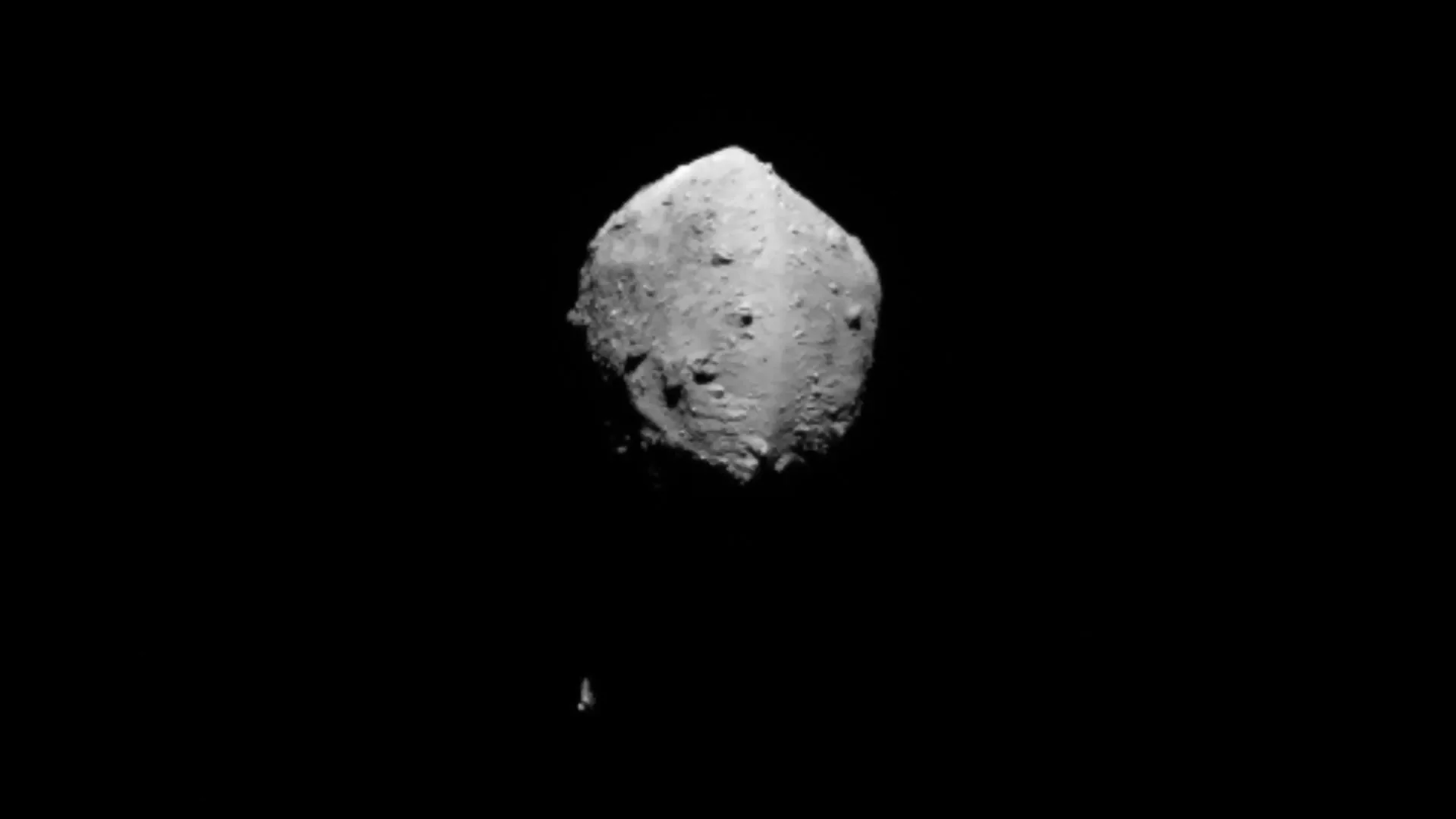
Hera’s first close-up observation of the Didymos system yields significant revelations. The spacecraft utilized its monochromatic Asteroid Framing Camera from an impressive altitude of 600 kilometers, delivering a striking perspective of the larger Didymos, while its smaller counterpart, Dimorphos, lay largely shrouded in shadow. The juxtaposition between the two asteroids raises intriguing questions about their geology and the aftermath of such a transformative impact. Didymos, with a diameter of approximately 780 meters, remains a captivating subject of study as Hera's vantage point presents a side of the asteroid previously unseen.
Patrick Michel, Principal Investigator of the Hera mission and Director of Research at CNRS / Observatoire de la Côte d'Azur, expressed his exhilaration upon examining the new data: “The first thing we said was wow! This is the other side of Didymos from the one that DART's camera showed us shortly before impact, so this feels like looking at a whole new world.” Further analysis showcases a plethora of boulders, craters, and distinctive patterns of grooves or ridges, offering a fresh canvas that complements earlier findings. The surface characteristics of Didymos as captured by Hera call into question the asteroid's geomorphology, prompting speculation regarding whether the DART-induced impact may have disseminated material across the void of approximately one kilometer that separates the two bodies.
When NASA’s DART spacecraft collided with Dimorphos at a staggering velocity of approximately 6.1 kilometers per second, it not only altered the trajectory of the smaller asteroid but also marked a milestone in human history: Dimorphos became the first celestial object to have its orbit decisively manipulated by anthropogenic actions. Pre-collision, Dimorphos completed its orbit around Didymos in 11 hours and 55 minutes; post-collision measurements indicate a reduction of its orbital period by approximately 33 minutes, a deviation that surpassed expectations and underscored the feasibility of the kinetic impact deflection strategy.
As debris from the impact dispersed, some particles may have traversed the intervening space to adhere to Didymos, suggesting that Hera's mission could unravel whether the physical features observed on its surface resulted from DART's collision or arose through other geological processes. ESA's Hera mission scientist, Michael Kueppers, notes the potential of the ejected material to contribute to Didymos’ surface morphology, stating, “We expect a lot of impact-ejected material to have made it across the approximately 1 km of space…some of these characteristics originate from this transport of material."
Following its extensive journey spanning nearly two years, Hera's current trajectory places it at a crucial juncture for conducting a comprehensive 'crash site investigation' aimed at decoding the implications of the DART experiment. While DART successfully demonstrated that a deliberate impact could be an effective means of solar system defense, Hera is set to delve deeper into the physics underpinning this intervention, collecting data that promises to refine models of asteroid dynamics and optimize future deflection missions.
The implications of Hera’s findings extend far beyond this singular event. By meticulously charting the geomorphological signatures of both asteroids, scientists aim to transform kinetic impact deflection from a successful demonstrative experiment into a standardized planetary protection strategy. As humanity stands on the precipice of a potential asteroid threat, these explorations might very well serve as a cornerstone in devising countermeasures against objects discovered on a collision trajectory with Earth.
As excitement builds among the international scientific community, Ian Carnelli, Hera mission manager, succinctly articulates the sentiment shared by many: “Seeing this image is a hugely exciting moment for the whole Hera family...the adventure is only beginning!” The mission’s next wave of revelations, anticipated on November 25, promises to deliver higher-resolution imagery of both Didymos and Dimorphos, allowing for an even closer examination of the dynamic duo that have ushered in a new era of asteroid exploration and planetary defense.