Field: Technology
Nanogel "Nano-ERASER" Catalyzes Astrocyte-to-Neuron Conversion and Reverses Alzheimer’s Pathology in Murine Model
Published | Technical Staff
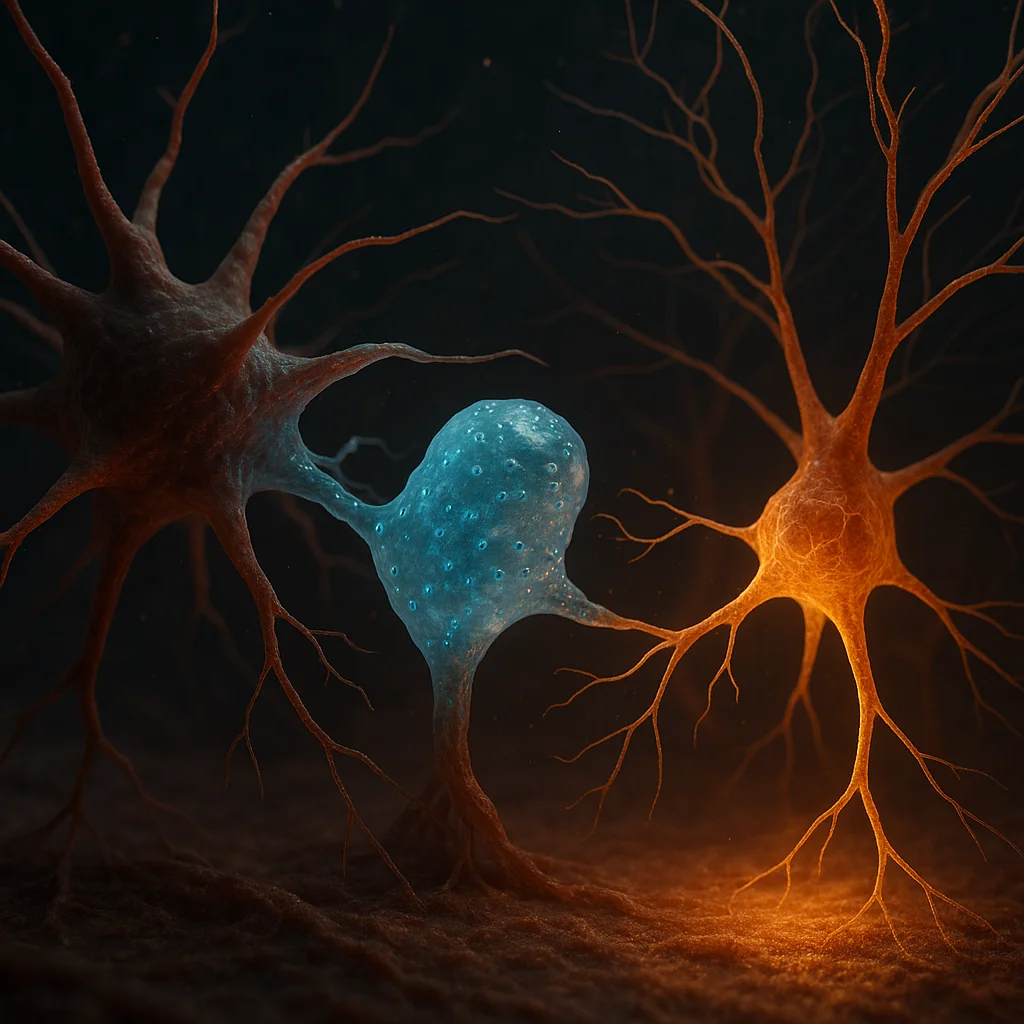
Visualization
The persistent challenge in Alzheimer’s disease (AD) therapeutics is the brain's inherent inability to restore neuronal assemblies lost to neurodegeneration. Despite recent advances in monoclonal antibody therapies and cholinesterase inhibitors, clinical impact has remained circumscribed—plaque clearance is largely decoupled from restoration of cognition, and the cumulative societal toll persists. This narrative may be shifting with the advent of a striking regenerative paradigm demonstrated by Peisheng Xu and colleagues at the University of South Carolina, who harness a nanoparticle-mediated protein degradation system—termed "Nano-ERASER"—to induce in situ neurogenesis in the adult mammalian brain.
Alzheimer’s pathohistology is distinguished by extracellular β-amyloid (Aβ) plaque deposition, intracellular neurofibrillary tangles of hyperphosphorylated tau, and both synaptic attrition and neuronal cell death. Canonical pharmacotherapies, such as cholinesterase inhibitors and N-methyl-D-aspartate (NMDA) receptor antagonists like memantine, yield only symptomatic relief or modest retardation of cognitive decline. Most notably, anti-amyloid therapeutics, while efficacious in ablating aggregated Aβ (as visualized through amyloid PET or other imaging modalities), fail to significantly regenerate lost circuitry or restore memory, and patient eligibility remains narrow due to amyloid-related imaging abnormalities (ARIA) and logistics surrounding infusion regimens.
Nano-ERASER fundamentally departs from this paradigm by not targeting pathogenic protein aggregation per se, but instead exploiting endogenous glial plasticity. The system consists of a polymer nanogel architecture—engineered to traverse the blood-brain barrier—which encapsulates antibody modules specific for polypyrimidine tract-binding protein 1 (PTBP1). PTBP1, a key regulator of RNA metabolism and splicing, is well-established as an astrocyte cell-fate maintenance factor; its downregulation has been implicated in direct conversion (transdifferentiation) of astroglia into functional neurons.
The operational mechanism is reminiscent of the emerging Trim-Away proteolytic system (I. Clift et al., 2017), leveraging antibody-guided ubiquitin-proteasome degradation—here, nanoparticles deliver PTBP1-targeting antibodies into astrocyte cytoplasm, selectively abrogating PTBP1 expression without any genetic edit of the nuclear genome. This obviates persistent risks associated with CRISPR/Cas9-based transcriptional reprogramming, including genotoxicity and off-target mutagenesis; the process is fundamentally reversible upon nanoparticle clearance from the tissue microenvironment.
Initial validation employed in vitro human astrocyte cultures as well as organoid models recapitulating AD pathology. Nano-ERASER introduction resulted in statistically significant suppression of intracellular PTBP1, as shown by quantitative immunocytochemistry and western blot, concomitant with upregulation of mature neuronal markers (NeuN, MAP2). Patch-clamp electrophysiology demonstrated the functional excitability of these nascent neurons, confirming not only fate identity but potential integration within existing circuits.
Transitioning to murine AD models, the researchers undertook bilateral intracerebral Nano-ERASER injections in transgenic mice engineered to overexpress humanized Aβ precursor protein (hAPP; J20 or 5xFAD lines). Behavioral phenotyping, conducted over subsequent weeks, captured a reversal of stereotyped AD deficits: animals reclaimed proficient nest construction and negotiated the Morris water maze with shorter latencies—behaviors tightly correlated with hippocampal and cortical function in rodents. Notably, these improvements manifested after as few as one to two injections, suggesting a robust induction of cell fate shift and engraftment.
Post-mortem histopathology substantiated the behavioral data. Treated mice exhibited amplified NeuN+ neuronal density and diminished activated microgliosis (Iba1+) and astrocytosis (GFAP+), markers of neuroinflammation. Immunoassays measuring insoluble Aβ burden demonstrated reductions up to 40% relative to controls (p < 0.01), while sections double-labeled for neuronal and astrocytic lineage confirmed direct astrocyte-to-neuron conversion. These convergent lines of evidence suggest that reducing reactive astrocyte populations—via conversion to neurons—not only replenishes depleted neuronal networks but modulates the inflammatory milieu that perpetuates synaptic disintegration.
Xu is circumspect about immediate clinical translation: “While this study presents compelling evidence in murine models, its generalizability to the human cortex remains to be established. Nonhuman primate studies are a warranted next step...,” he notes, underscoring that long-term efficacy and safety, particularly in a heterogenous, aged human milieu, are as yet unproven. Nevertheless, the demonstration that a non-genome editing, antibody-guided nanotherapeutic system can actuate adult neurogenesis—and directly ameliorate cognitive decline in preclinical AD—heralds a critical inflection point in regenerative medicine.
Published in Cell Biomaterials (doi: 10.1016/j.celbio.2026.100575), the work delineates a sharply innovative strategy: adult neuroregeneration via astrocyte reprogramming, enacted at the protein—not genetic—level. Should future studies in nonhuman primates and, ultimately, human trials recapitulate these effects, Nano-ERASER and its derivatives could not merely retard but fundamentally reverse one of the most devastating neurodegenerative syndromes of the modern era.
Alzheimer’s pathohistology is distinguished by extracellular β-amyloid (Aβ) plaque deposition, intracellular neurofibrillary tangles of hyperphosphorylated tau, and both synaptic attrition and neuronal cell death. Canonical pharmacotherapies, such as cholinesterase inhibitors and N-methyl-D-aspartate (NMDA) receptor antagonists like memantine, yield only symptomatic relief or modest retardation of cognitive decline. Most notably, anti-amyloid therapeutics, while efficacious in ablating aggregated Aβ (as visualized through amyloid PET or other imaging modalities), fail to significantly regenerate lost circuitry or restore memory, and patient eligibility remains narrow due to amyloid-related imaging abnormalities (ARIA) and logistics surrounding infusion regimens.
Nano-ERASER fundamentally departs from this paradigm by not targeting pathogenic protein aggregation per se, but instead exploiting endogenous glial plasticity. The system consists of a polymer nanogel architecture—engineered to traverse the blood-brain barrier—which encapsulates antibody modules specific for polypyrimidine tract-binding protein 1 (PTBP1). PTBP1, a key regulator of RNA metabolism and splicing, is well-established as an astrocyte cell-fate maintenance factor; its downregulation has been implicated in direct conversion (transdifferentiation) of astroglia into functional neurons.
The operational mechanism is reminiscent of the emerging Trim-Away proteolytic system (I. Clift et al., 2017), leveraging antibody-guided ubiquitin-proteasome degradation—here, nanoparticles deliver PTBP1-targeting antibodies into astrocyte cytoplasm, selectively abrogating PTBP1 expression without any genetic edit of the nuclear genome. This obviates persistent risks associated with CRISPR/Cas9-based transcriptional reprogramming, including genotoxicity and off-target mutagenesis; the process is fundamentally reversible upon nanoparticle clearance from the tissue microenvironment.
Initial validation employed in vitro human astrocyte cultures as well as organoid models recapitulating AD pathology. Nano-ERASER introduction resulted in statistically significant suppression of intracellular PTBP1, as shown by quantitative immunocytochemistry and western blot, concomitant with upregulation of mature neuronal markers (NeuN, MAP2). Patch-clamp electrophysiology demonstrated the functional excitability of these nascent neurons, confirming not only fate identity but potential integration within existing circuits.
Transitioning to murine AD models, the researchers undertook bilateral intracerebral Nano-ERASER injections in transgenic mice engineered to overexpress humanized Aβ precursor protein (hAPP; J20 or 5xFAD lines). Behavioral phenotyping, conducted over subsequent weeks, captured a reversal of stereotyped AD deficits: animals reclaimed proficient nest construction and negotiated the Morris water maze with shorter latencies—behaviors tightly correlated with hippocampal and cortical function in rodents. Notably, these improvements manifested after as few as one to two injections, suggesting a robust induction of cell fate shift and engraftment.
Post-mortem histopathology substantiated the behavioral data. Treated mice exhibited amplified NeuN+ neuronal density and diminished activated microgliosis (Iba1+) and astrocytosis (GFAP+), markers of neuroinflammation. Immunoassays measuring insoluble Aβ burden demonstrated reductions up to 40% relative to controls (p < 0.01), while sections double-labeled for neuronal and astrocytic lineage confirmed direct astrocyte-to-neuron conversion. These convergent lines of evidence suggest that reducing reactive astrocyte populations—via conversion to neurons—not only replenishes depleted neuronal networks but modulates the inflammatory milieu that perpetuates synaptic disintegration.
Xu is circumspect about immediate clinical translation: “While this study presents compelling evidence in murine models, its generalizability to the human cortex remains to be established. Nonhuman primate studies are a warranted next step...,” he notes, underscoring that long-term efficacy and safety, particularly in a heterogenous, aged human milieu, are as yet unproven. Nevertheless, the demonstration that a non-genome editing, antibody-guided nanotherapeutic system can actuate adult neurogenesis—and directly ameliorate cognitive decline in preclinical AD—heralds a critical inflection point in regenerative medicine.
Published in Cell Biomaterials (doi: 10.1016/j.celbio.2026.100575), the work delineates a sharply innovative strategy: adult neuroregeneration via astrocyte reprogramming, enacted at the protein—not genetic—level. Should future studies in nonhuman primates and, ultimately, human trials recapitulate these effects, Nano-ERASER and its derivatives could not merely retard but fundamentally reverse one of the most devastating neurodegenerative syndromes of the modern era.