Field: Technology
Mysterious Gas over Mars’ Alba Mons Could Hint at Volcanic Activity
Published | Technical Staff
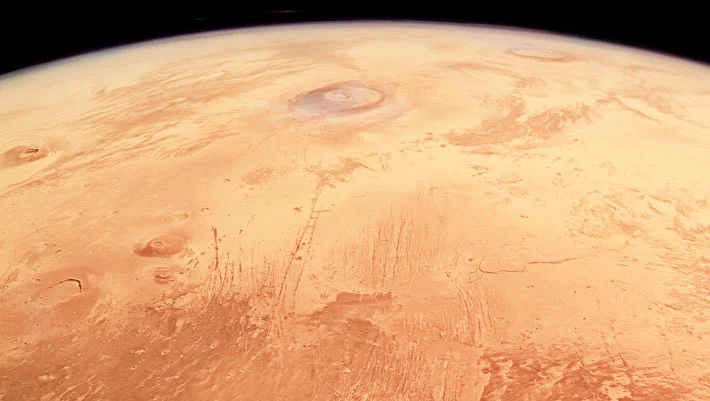
Visualization
Mars, long regarded as a geologically quiescent body, teeters on the edge of a potential renaissance in our understanding of its volcanic activity. New findings presented by a team of researchers from Universität Bern indicate that hydrogen chloride (HCl), a gas typically associated with volcanic degassing, has been detected in unexpected concentrations during Mars' cold aphelion season. This discovery raises questions about whether the Martian interior is indeed less dormant than previously thought.
The meticulous analyses were conducted using the Atmospheric Chemistry Suite aboard the European Space Agency's Trace Gas Orbiter. The researchers uncovered hydrogen chloride at concentrations measured in parts per billion, pinpointing the Alba Mons region as a significant site for these readings. Intriguingly, these measurements were not merely anomalous; they were found to exceed expected levels for this seasonal phase, suggesting a possible escape route from the planet's interior to its thin atmosphere.
The implications of this finding are profound. On Earth, the chlorine cycle operates within a framework of active tectonics, where volcanic eruptions mobilize chlorine, enabling its subsequent recycling through water bodies, sediments, and permafrost. Conversely, the Martian geological environment, characterized by a lack of plate tectonics, limits this recycling. Nicolas Thomas, one of the study's authors, posits that, “In the absence of active tectonic processes, the volcanic source becomes the primary contributor to the surface-atmosphere system on Mars.”
Crucially, the researchers did not confine themselves solely to atmospheric data. High-resolution imaging from the HiRISE, CaSSIS, and CTX cameras provided a complementary approach, leading to the identification of previously unseen geological features near the HCl detection sites. Narrow fissures, measuring merely centimeters in width and aggregating into swarms stretching tens of kilometers, suggest tectonic and potentially volcanic activity already etched into the Martian landscape. These fractures may function as conduits through which hydrogen chloride rises, possibly facilitated by interactions with ice-rich permafrost situated within the crust.
This hypothesis posits a covert geothermal mechanism at work, one that does not necessitate a pronounced thermal signature—an aspect that hitherto has rendered traditional heat-based searches for active volcanism largely unfruitful. Given the estimated atmospheric lifetime of hydrogen chloride on Mars, calculated to be around one sol, the study deduces a seepage rate of less than 3 kilograms per second. Such a flux aligns with the lower spectrum of values found at earthly volcanoes, which can range from mere kilograms to well over a hundred kilograms per second.
Notably, during the warmer perihelion season, Mars exhibits a more substantial seasonal release of hydrogen chloride, estimated at around 180 kilograms per second. However, the researchers clarify that this elevated outgassing is likely not directly volcanic in nature. Rather, it could suggest a cyclical journey of chlorine between atmospheric and surface reservoirs, including salts such as perchlorates and ice.
The presence and fluctuation of hydrogen chloride in Mars' atmosphere thus encapsulate a complex interplay between episodic volcanic activities and the atmospheric and geological processes unique to the Martian environment. This emerging narrative of Mars as a potentially active planet continues to evolve, challenging our preconceived notions and urging deeper exploration into its geological past. The study, titled "Enigmatic HCl detections as a potential signature of igneous activity on Mars," was published in the journal Science Advances, marking a significant milestone in planetary science, as researchers seek to decode the vestiges of geologic activity preserved within the Martian crust.