Field: Technology
Mysterious gas leaks suggest Mars may still be volcanically alive
Published | Technical Staff
Visualization
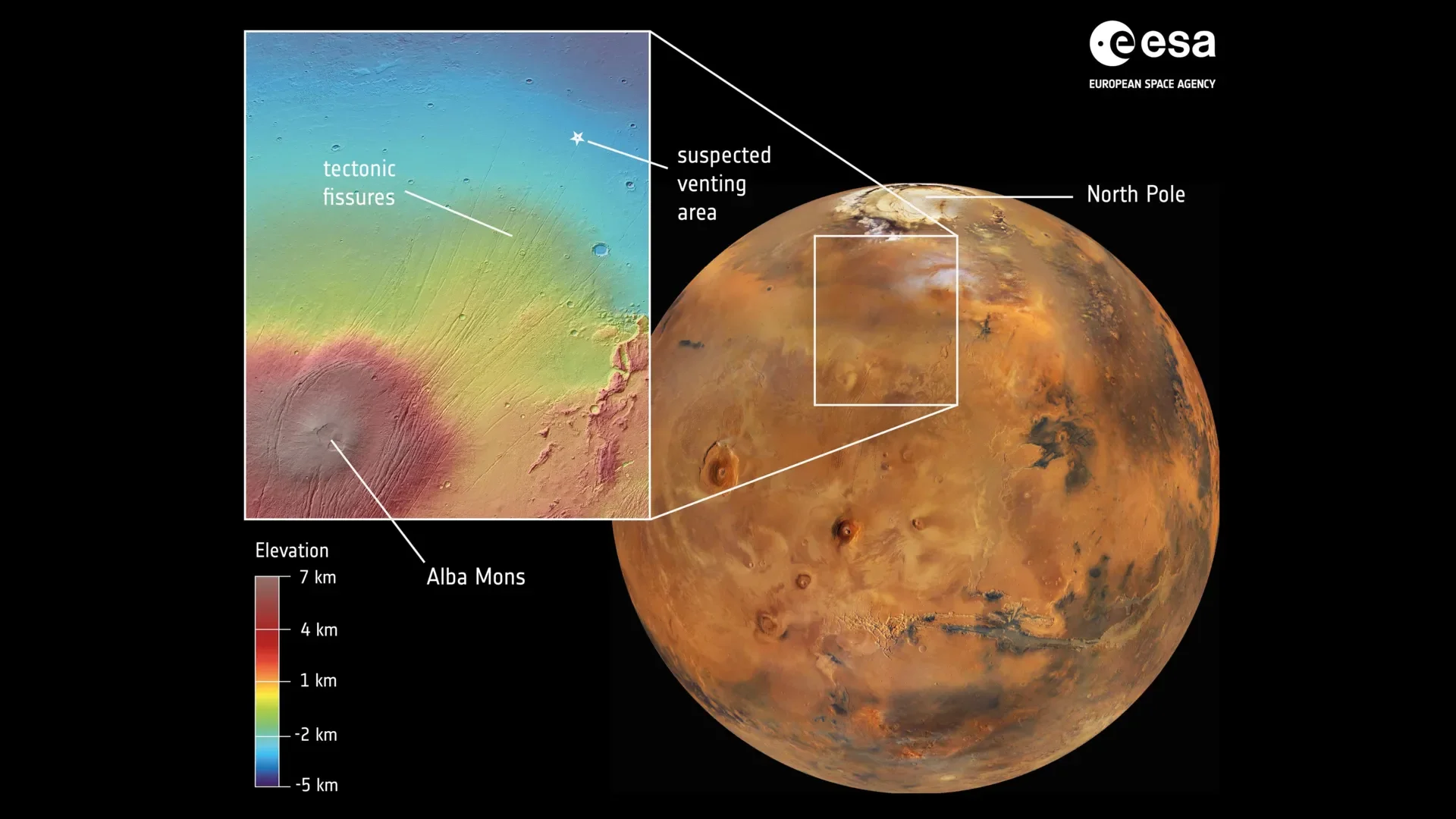
Mars, the enigmatic red planet that has captivated scientists and enthusiasts alike, appears to harbor secrets beneath its dusty exterior. Emerging evidence from an international research team led by Alexander Trokhimovskiy indicates that geological processes may still be alive and well on Mars, specifically in the Alba Mons volcanic region. This groundbreaking work reframes our understanding of Martian dynamics, suggesting that not only is the planet not as geologically inert as previously thought, but it may also possess a geologically active interior capable of supporting life.
In an intriguing twist that challenges long-held assumptions, researchers have detected elevated concentrations of hydrogen chloride (HCl) gas escaping through fissures scattered across the slopes of Alba Mons. This discovery first emerged from data collected by the European Space Agency’s ExoMars Trace Gas Orbiter (TGO), which identified hydrogen chloride in the Martian atmosphere as early as 2021. According to the established environmental paradigm, this gas is associated with volcanic activity on Earth, where it frequently signals the presence of magma just below the surface. The tantalizing possibility of a similar phenomenon taking place on Mars adds yet another layer to the planet’s geological complexity.
Hydrogen chloride’s seasonal variability on Mars typically follows a predictable cycle, peaking during the colder northern winters when atmospheric conditions favor its formation and decline drastically as summer approaches. However, an anomaly was noted this year: in early Martian summer, elevated levels of hydrogen chloride were repeatedly observed over the volcanic fractures of Alba Mons, a puzzling deviation from the norm that hinted at underlying processes that could not be explained by atmospheric chemistry alone.
Complementing this atmospheric data, the CaSSIS camera aboard TGO provided high-resolution images of the surface, revealing fresh fissures extending hundreds of meters and showing signs of discoloration—an additional clue pointing towards volcanic activity. In this context, it appears possible that gases originating from deep, hot magma are being channeled upward through these cracks, akin to fumarole activity on Earth. The cyclical patterns of Martian winters—where temperatures can plummet to -120°C—could temporarily freeze the fractures, sealing off any gaseous escape. When the summer thaw occurs, the ice sublimates, allowing gases to escape into the atmosphere once again.
Through a rigorous evaluation of alternative chemical reactions capable of producing hydrogen chloride in the Martian atmosphere, the team sought to confirm that volcanic activity was indeed the source of the observed emissions. It involved a detailed exploration of the myriad of atmospheric processes, requiring both critical scientific assessment and creative thinking. As articulated by Trokhimovskiy, “We needed to be rigorous, critical and creative to explain the presence of hydrogen chloride.”
The research leads to a compelling hypothesis: a dormant magma chamber nestled beneath Alba Mons, potentially part of a functioning volcanic system. This chamber may continue to cycle gases even in the absence of visible eruptions, lending credence to the notion that Mars, far from being a frozen relic of a former era, harbors the latent heat needed to sustain intense geological activity.
The broader implications of these findings extend beyond mere geological curiosity. The potential for volcanic gases to play a role in creating suitable conditions for life on Mars cannot be understated. In the planet’s ancient past, volcanic eruptions likely emitted vast quantities of gases that could have contributed to a thicker atmosphere, thereby increasing surface temperatures and allowing liquid water to persist—an essential precursor for life as we know it.
Furthermore, such volcanic activity may result in interactions between rising magma and groundwater, creating hydrothermal systems that offer both a warmer environment and chemical energy, critical for the sustenance of potential microbial life forms. As expressed by Trokhimovskiy, the search for life on Mars could greatly benefit from focusing on these seeping fissures, which may hold the keys to understanding Mars as a dynamic environment capable of sustaining life.
While the current findings do not confirm ongoing eruptions or the existence of life, they invite a reconsideration of Mars not merely as a desolate wasteland but as a vibrant world with the potential for processes akin to those that foster life on Earth. As we revisit our assumptions about Mars, the recent revelations about hydrogen chloride emissions and volcanic activity offer a glimpse into a hidden, and possibly still active, volcanic interior—transforming Mars into a planetary body rich in geological significance and astrobiological potential. The age-old quest to understand our cosmic neighbor continues, buoyed by the prospect that beneath its dusty surface, Mars may yet possess the thermal heartbeat of a living world.