Field: Technology
Molecular Clues from Ancient Teeth Illuminate Overlap of Homo erectus and Denisovans in Pleistocene East Asia
Published | Technical Staff
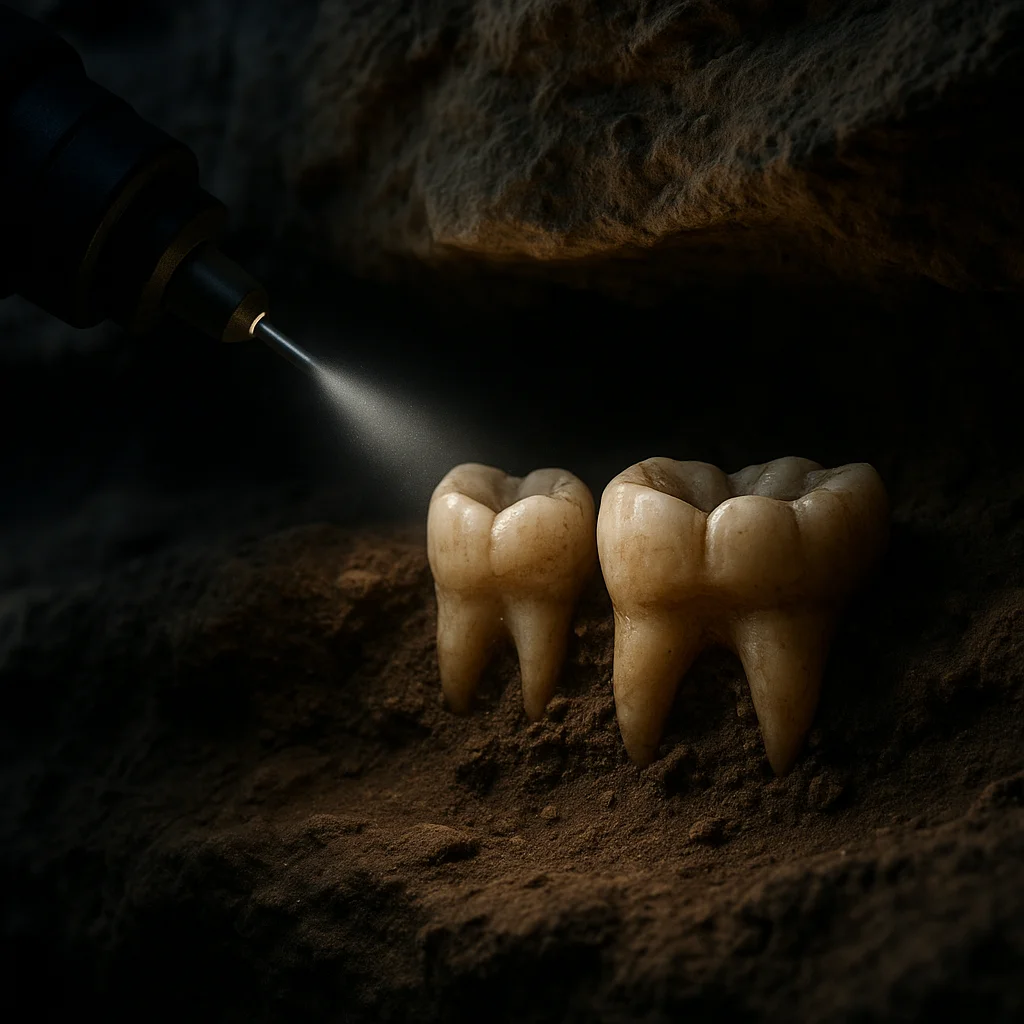
Visualization
In a striking advance for paleoanthropology, a multidisciplinary team led by Dr. Qiaomei Fu of the Chinese Academy of Sciences has unveiled molecular evidence extracted from fossilized tooth enamel, illuminating an evolutionary nexus among East Asian Homo erectus, Denisovans, and modern human populations. This study, reported in Nature, delivers the first protein-level insight into the genetic architecture of Homo erectus, a species whose migratory success once spanned continents and epochs, but whose molecular legacy has remained stubbornly obscure.
Homo erectus, acknowledged as Homo’s perennial globetrotter, first left Africa over 1.9 million years ago and persisted in Asia until as recently as 100,000 years before present (BP). Despite this longevity and dispersal, genomic data have been nearly nonexistent given the notorious instability of ancient DNA (aDNA) in subtropical and temperate environments typical of Asian fossil sites. To circumvent this, Dr. Fu’s team leveraged the remarkable durability of dental enamel proteins, focusing on fossil remains from three Chinese locales: Zhoukoudian in Beijing’s limestone caves, Hexian in temperate Anhui, and Sunjiadong nestled in the Henan loess plains. The fossils sampled represented six distinct Homo erectus individuals, all dated stratigraphically and via uranium-series methods to circa 400,000 years BP.
The methodological pivot to protein paleogenomics exploits enamel’s hypermineralized matrix, which acts as a molecular tomb for peptide fragments long after DNA has vanished. Through a series of demineralization and chromatographic steps, the researchers isolated peptides and mapped their sequences using high-resolution tandem mass spectrometry (LC-MS/MS). The focus fell on ameloblastin (AMBN), a protein critical to enamel biomineralization, due to its sequence variability and evolutionary informativeness.
Two amino acid substitutions in the AMBN gene sequence emerged as lynchpins. The first, a novel missense mutation denoted AMBN-A253G (adenine replaced by guanine at codon 253), was discovered exclusively across all sampled erectus enamel peptides and has not been identified in any other extant or extinct hominin, nor in great apes. The second, AMBN-M273V, a methionine-to-valine alteration at residue 273, had previously been recognised solely in Denisovan material from the Denisova Cave in Siberia. The AMBN-A253G variant, as the first molecular synapomorphy uniting geographically dispersed Chinese Homo erectus, provides compelling evidence for intraspecific homogeneity and continuity across the northern and southern Chinese fossil record during the mid-Pleistocene.
The detection of AMBN-M273V simultaneously in Homo erectus and Denisovan lineages suggests a more intimate evolutionary interplay. Population genetic models posit two plausible scenarios: either the AMBN-M273V variant originated in a common ancestor of both lineages and persisted in parallel, or, more parsimoniously given its restricted phylogeographic pattern, it introgressed from East Asian Homo erectus into Denisovan groups through admixture events in the mid-to-late Pleistocene. The latter pathway aligns with established findings that Denisovan ancestry persists in contemporary Southeast Asian and Oceanian populations (notably Papuans, with Denisovan ancestry quotients as high as 5%), and that Denisovans themselves possessed genetic mosaics reflecting complex admixture webs.
The phylogenetic implications are profound. If AMBN-M273V entered the Denisovan gene pool via Homo erectus, as suggested by its geographical and temporal distribution, Denisovan introgression into modern humans would have mechanically ferried this variant into the genomes of certain living populations—a molecular echo of Pleistocene gene flow. This scenario is consistent with patterns of archaic Denisovan DNA in present-day Australasia and underscores the tangled, reticulate nature of hominin evolution east of the Wallace Line.
Dr. Fu’s findings chart a novel course for paleoproteomics in resolving long-standing questions about archaic hominin kinships where aDNA yields no answers. The discovery of shared genetic markers between Homo erectus and Denisovans across thousands of years and miles reifies the hypothesis that hybridization and population structure in East Asia were substantially more complex than previously envisioned. It also situates Homo erectus not as a terminal branch on the human family tree, but as a pivotal player whose molecular legacy lingers in the genetic palimpsest of modern and archaic descendants.
As technological sophistication in ancient protein extraction and peptide sequencing continues to advance, the molecular secrets long sequestered in fossil enamel may yield further evidence—shifting kinship diagrams and expanding our understanding of the evolutionary events that shaped the morphology, distribution, and genetic architecture of hominins in deep time. The next frontier may not be buried in sediment, but locked in the biochemical lattices of teeth, awaiting the analytic clarity of mass spectrometry to illuminate how ancient lineages intertwined across the vast expanse of Pleistocene Asia.