Field: Technology
MIT scientists reprogram immune cells into formidable cancer adversaries in situ
Published | Technical Staff
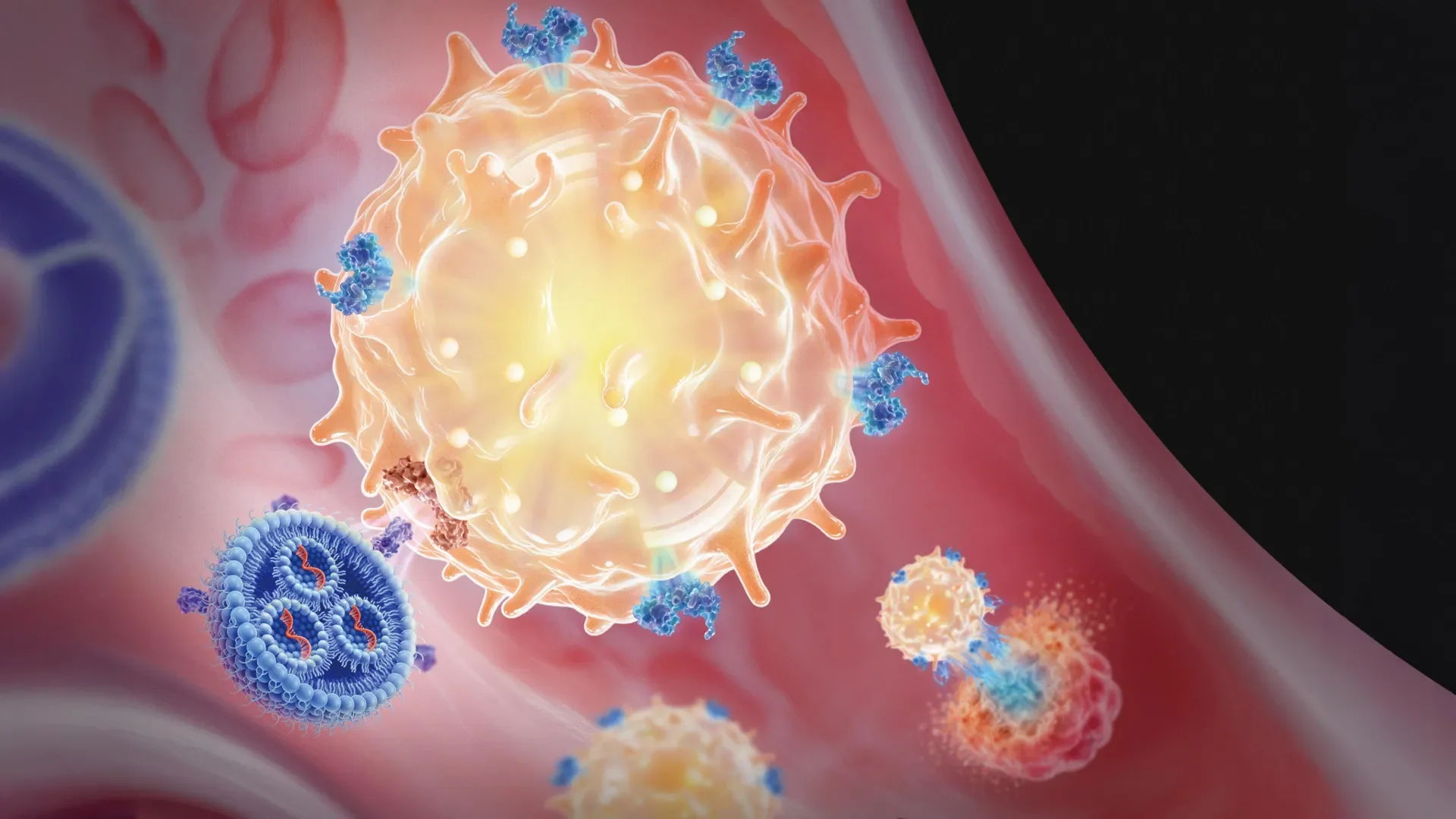
Visualization
A groundbreaking advancement by researchers at the Massachusetts Institute of Technology (MIT) heralds a potential revolution in cancer therapy, harnessing the body’s own immune system in a manner never before possible. This novel approach employs targeted lipid nanoparticles to deliver messenger RNA (mRNA) instructions directly to natural killer (NK) cells, empowering them to identify and obliterate malignant cells from within the body. This innovative in vivo modification has significant ramifications for both cancer treatment and the management of autoimmune diseases, heralding not just a shift in methodology but also a more cost-effective and streamlined pathway to therapy.
The crux of this innovation lies in exploiting NK cells, a subset of the immune system renowned for their ability to indiscriminately target and destroy compromised cells, including cancerous and harmful immune cells. In conventional therapeutic frameworks, such as chimeric antigen receptor (CAR) T cell therapy—which has already received FDA approval for various hematologic malignancies—the process is cumbersome and time-consuming. It involves extracting T cells from the patient, genetically modifying them in specialized laboratories, proliferating them to clinically relevant quantities, and finally re-infusing them back into the patient, a multi-step procedure fraught with logistical challenges and delays.
The MIT team, led by professor Daniel Anderson alongside postdoctoral researcher Yuang Chen and graduate students Julia Monkovic and Haseeb Mughal, proposes an elegant solution that circumvents these complexities. Instead of extracting NK cells for laboratory modification, the researchers designed lipid nanoparticles that encapsulate mRNA encoding a chimeric antigen receptor tailored to engage specific tumor antigens. Once introduced into the patient—via a benign infusion—the lipid nanoparticles home in on NK cells, guided by surface-bound antibody fragments that preferentially bind to the cells' unique receptors. This targeted delivery system ensures that the mRNA is taken up efficiently, allowing the NK cells to synthesize the necessary receptors directly within the patient's immune system.
Sigmametric advancements based on previous work in lipid nanoparticle technology have allowed the researchers to adapt the mRNA constructs to recognize various targets. For instance, they can manipulate the NK cells to generate receptors specific to CD19—an antigen expressed on B cells, or CD3, prevalent in T cells. The versatility of this technology means that with relative ease, the therapeutic can be tailored to combat an array of malignancies and pathogenic conditions.
Initial forays into this innovative therapy involved administering the nanoparticle-laden mRNA to murine models afflicted with aggressive melanoma. Here, the results were palpably promising; through this direct engineering, approximately 80 percent of the NK cells were successfully modified to express the chimeric receptor. In subsequent trials, three out of five treated mice exhibited complete tumor regression, an outcome that underscores the therapeutic potential of this method.
The research team also observed notable efficacy against T cell lymphoma utilizing humanized mouse models—organisms that had been transfused with human blood cells, thus allowing for a more creature-reflective simulation of human immune responses. After multiple nanoparticle administrations, the tumors in these models were eradicated, demonstrating the engineered NK cells' capability to coordinate an effective immune response akin to their CAR-modified counterparts produced through traditional ex vivo methods. The results indicated no significant differences in therapeutic outcomes, suggesting that in vivo reprogramming could provide equally efficacious cancer-fighting attributes while fundamentally reducing the inherent complexities associated with current cellular therapies.
This new technique not only offers an intriguing alternative in the armory against cancer but also opens the door to addressing autoimmune diseases wherein T cells misidentify healthy cells as threats, often leading to devastating conditions like lymphoma and autoimmune hepatitis. The inherent flexibility of the NK cellular response creates a synergistic advantage, allowing for the potential reprogramming of these immune agents that are less likely to engage in self-destructive behavior compared with modified T cells. As the researchers elaborate, “NK cells can treat these T cell malignancies—not only T cell cancer but also T cell autoimmune diseases.”
Ultimately, the research published in *Nature Biotechnology* showcases an audacious leap forward. If clinically validated, this technique could substantively alter how immunotherapies are developed and delivered, promising a future where patients could obtain effective, personalized treatment with minimal intervention. Instead of a lengthy hospital stay and the burden of waiting for genetically modified cells to return to them, individuals may soon be able to roll up their sleeves for what might become a routine infusion that reprograms their immune system—unleashing their natural defenses against malignancies and restoring homeostasis.