Field: Technology
MIT scientists pioneer a novel approach to soft robotics by constructing a microscopic swimming robot powered by living muscle cells.
Published | Technical Staff
Visualization
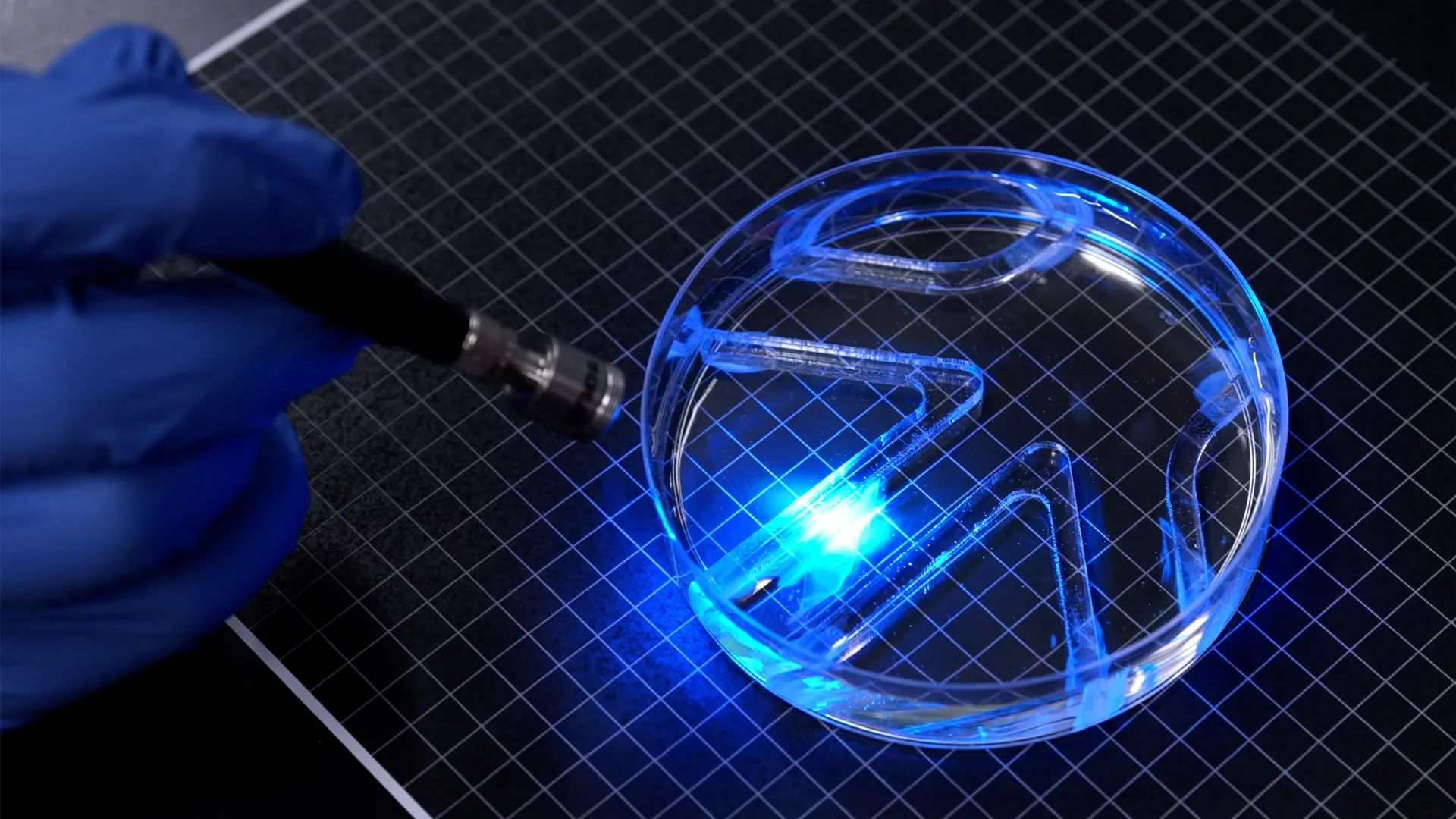
In a groundbreaking study published in Advanced Functional Materials, engineers from the Massachusetts Institute of Technology have unveiled a paper-thin robotic design that employs genetically engineered living muscle cells to generate propulsion in aquatic environments. The innovative device, akin in dimensions to a stick of gum, reveals both the potential and sophistication of biocompatible robotics designed for delicate and intricate tasks in ecosystems where traditional machines would falter.
Central to this development is a flexible gel framework outfitted with fins coated in muscle cells that are modified to contract in response to specific wavelengths of light. This cellular architecture is strikingly efficient; the muscle tissue employed here is remarkably thinner than the diameter of a human hair, yet exhibits the capacity to induce significant movement. By precisely directing light onto one or both fins, the team can invoke muscle contractions, initiating a flapping motion that propels the robot through water.
Under experimental conditions, the MIT swimming robot successfully navigated a basic underwater maze, achieving a remarkable locomotion rate of approximately four times its own length per minute. While this speed might seem modest compared to elite human swimmers, it aligns closely with the leisurely swimming pace of certain marine species, such as the cow shark. Ritu Raman, associate professor of mechanical engineering and lead author of the study, emphasizes the inherent challenge of aquatic propulsion, noting, "It takes a lot of force to move through water versus air. The robot's quite strong, given its size."
This research signifies an evolutionary step in the field of soft robotics, marking the first instance of a lightweight, two-dimensional biohybrid capable of autonomous movement powered solely by living tissue. Traditional biohybrid robots rely predominantly on three-dimensional muscle structures derived from millions of cultured cells, a method that presents both logistical and economic challenges. In contrast, MIT’s innovation could fundamentally alter the landscape of soft robotics. By utilizing a minimalist design comprised of an efficient muscle framework, this new generation of biohybrid technology promises to refine both cost-efficiency and operational effectiveness.
The underlying principles of this robotic creation build on earlier work by Raman’s lab, which showcased engineered muscle disks reminiscent of the iris of the human eye. In that experiment, muscle cells were arranged along a patterned gel disk to achieve controlled movements through contraction—a concept that laid the foundational understanding of manipulating living cells for robotic applications. However, the inherent limitations of this previous design led the researchers to seek greater force production capable of driving their newest aquatic invention.
In the pursuit of optimizing muscle performance, the team identified that the supporting gel substrate must possess specific features: composition, stiffness, and groove geometry were all critical parameters for maximizing muscle cell functionality and efficiency. Notably, they transitioned from using fibrin, a soft gel that constrained performance through shrinkage under muscle contraction forces, to gelatin methacrylate (GelMA). This more robust material not only facilitated superior cell alignment within square-bottomed grooves but also allowed for the fabrication of an optimal gel thickness—approximately half a millimeter—that ensured stability while minimizing weight.
Through rigorous experimentation with various gel formulations and physical designs, the researchers discovered that stiffer substrates enhanced the alignment of muscle fibers, thereby enhancing the robot’s overall force generation. This relationship is pivotal; aligned muscle cells are more likely to coalesce into fibers that work in concert, increasing contraction force. Furthermore, the team augmented muscle strength through preconditioning, stimulating muscle cells with periodic light pulses to promote growth and improve their contractile capabilities prior to incorporation into the final robotic assembly.
As the researchers assembled their robotic creation, they effectively crafted a dual-finned structure capable of independent movement. Each fin, patterned with precisely engineered grooves and populated with muscle fibers, operates under the control of light, offering unprecedented maneuverability. This delicate operation imbues the device with not only the practical functionality of locomotion but also the potential for complex tasks such as probing environmentally sensitive regions, where the soft, responsive nature of living tissue offers substantial advantages over rigid robotic counterparts.
The implications of this work extend far beyond the immediate applications of a miniature swimming robot. It heralds the dawn of a new class of self-healing, biologically-integrated robots capable of operating in environments that would be challenging for conventional robotic technologies. As the potential for biohybrid robotics continues to unfold, researchers remain optimistic about their capacity to intertwine biological systems with engineered devices in a manner that preserves the finesse and adaptability of living organisms. Thus, through the innovative application of living muscle cells, MIT engineers invite us to envision a future where the line between biology and technology becomes increasingly blurred, empowering machines to navigate the fragility of the natural world with unprecedented agility and resilience.
Central to this development is a flexible gel framework outfitted with fins coated in muscle cells that are modified to contract in response to specific wavelengths of light. This cellular architecture is strikingly efficient; the muscle tissue employed here is remarkably thinner than the diameter of a human hair, yet exhibits the capacity to induce significant movement. By precisely directing light onto one or both fins, the team can invoke muscle contractions, initiating a flapping motion that propels the robot through water.
Under experimental conditions, the MIT swimming robot successfully navigated a basic underwater maze, achieving a remarkable locomotion rate of approximately four times its own length per minute. While this speed might seem modest compared to elite human swimmers, it aligns closely with the leisurely swimming pace of certain marine species, such as the cow shark. Ritu Raman, associate professor of mechanical engineering and lead author of the study, emphasizes the inherent challenge of aquatic propulsion, noting, "It takes a lot of force to move through water versus air. The robot's quite strong, given its size."
This research signifies an evolutionary step in the field of soft robotics, marking the first instance of a lightweight, two-dimensional biohybrid capable of autonomous movement powered solely by living tissue. Traditional biohybrid robots rely predominantly on three-dimensional muscle structures derived from millions of cultured cells, a method that presents both logistical and economic challenges. In contrast, MIT’s innovation could fundamentally alter the landscape of soft robotics. By utilizing a minimalist design comprised of an efficient muscle framework, this new generation of biohybrid technology promises to refine both cost-efficiency and operational effectiveness.
The underlying principles of this robotic creation build on earlier work by Raman’s lab, which showcased engineered muscle disks reminiscent of the iris of the human eye. In that experiment, muscle cells were arranged along a patterned gel disk to achieve controlled movements through contraction—a concept that laid the foundational understanding of manipulating living cells for robotic applications. However, the inherent limitations of this previous design led the researchers to seek greater force production capable of driving their newest aquatic invention.
In the pursuit of optimizing muscle performance, the team identified that the supporting gel substrate must possess specific features: composition, stiffness, and groove geometry were all critical parameters for maximizing muscle cell functionality and efficiency. Notably, they transitioned from using fibrin, a soft gel that constrained performance through shrinkage under muscle contraction forces, to gelatin methacrylate (GelMA). This more robust material not only facilitated superior cell alignment within square-bottomed grooves but also allowed for the fabrication of an optimal gel thickness—approximately half a millimeter—that ensured stability while minimizing weight.
Through rigorous experimentation with various gel formulations and physical designs, the researchers discovered that stiffer substrates enhanced the alignment of muscle fibers, thereby enhancing the robot’s overall force generation. This relationship is pivotal; aligned muscle cells are more likely to coalesce into fibers that work in concert, increasing contraction force. Furthermore, the team augmented muscle strength through preconditioning, stimulating muscle cells with periodic light pulses to promote growth and improve their contractile capabilities prior to incorporation into the final robotic assembly.
As the researchers assembled their robotic creation, they effectively crafted a dual-finned structure capable of independent movement. Each fin, patterned with precisely engineered grooves and populated with muscle fibers, operates under the control of light, offering unprecedented maneuverability. This delicate operation imbues the device with not only the practical functionality of locomotion but also the potential for complex tasks such as probing environmentally sensitive regions, where the soft, responsive nature of living tissue offers substantial advantages over rigid robotic counterparts.
The implications of this work extend far beyond the immediate applications of a miniature swimming robot. It heralds the dawn of a new class of self-healing, biologically-integrated robots capable of operating in environments that would be challenging for conventional robotic technologies. As the potential for biohybrid robotics continues to unfold, researchers remain optimistic about their capacity to intertwine biological systems with engineered devices in a manner that preserves the finesse and adaptability of living organisms. Thus, through the innovative application of living muscle cells, MIT engineers invite us to envision a future where the line between biology and technology becomes increasingly blurred, empowering machines to navigate the fragility of the natural world with unprecedented agility and resilience.