Field: Technology
MIT scientists break a 20-year rule and unlock never-before-seen crystal structures
Published | Technical Staff
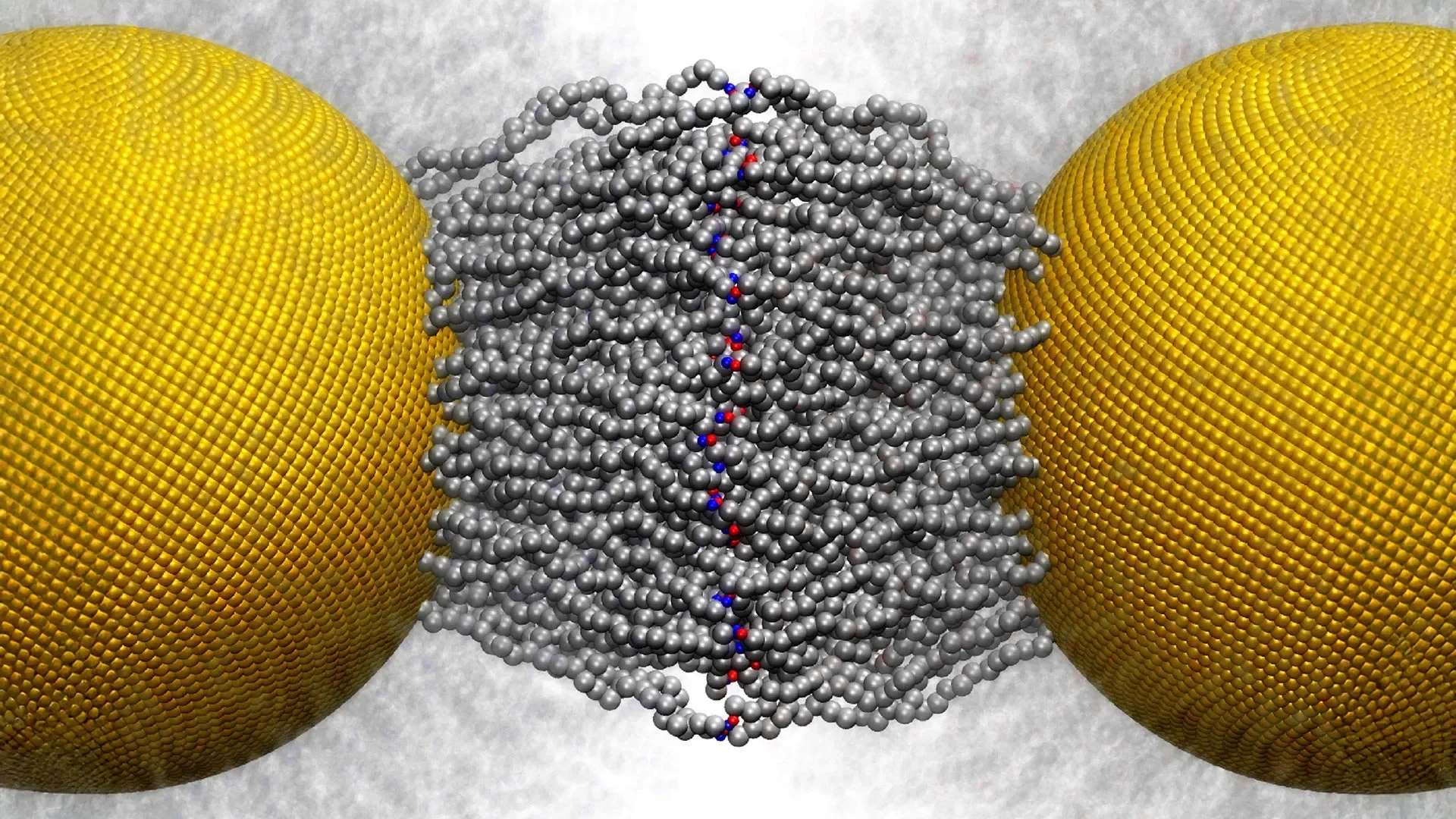
Visualization
In a groundbreaking leap that revises two decades of entrenched thought in materials science, researchers at the Massachusetts Institute of Technology (MIT) have redefined the rules for nanoparticle assembly, leading to the creation of innovative and unforeseen crystal structures. This radical shift stems from the use of highly flexible molecular links, challenging the long-standing doctrine that stringent rigidity was essential for optimal nanoparticle organization.
The potential implications of this discovery span a plethora of applications, ushering in new possibilities in fields like electronics, medicine, energy solutions, and agriculture. The research team explores how the previously unfathomable flexibility and inherent electrical properties of molecular connectors manipulate the configurations of nanoparticles, thereby determining the emergent characteristics of these newly formed materials.
At the core of nanoparticle behavior lies a fundamental tenet of materials science: the arrangement of constituent materials directly influences their collective properties. Rob Macfarlane, the Richard P. Simmons (1953) Professor in Metallurgy at MIT, elucidates this principle, asserting that understanding the spatial organization of building blocks grants researchers the ability to engineer materials with bespoke properties. This capability becomes particularly salient in the realm of nanoparticles—minute entities whose sizes and morphological properties can be tailor-made for specific functions in drug delivery, energy storage, and sensors.
Nevertheless, achieving an aggregated structure from discrete nanoparticles is fraught with complexity. One of the paramount challenges consists of controlling the adhesion dynamics between individual particles, which necessitates precision regarding both the numerosity and orientation of connecting bonds. Absent such control, assembled nanoparticles default to densely packed arrangements that severely limit the range of obtainable structures and their respective functionalities.
Historically, researchers have adhered to two predominant strategies to counteract these challenges: one involved geometric modification of nanoparticles to define fitting arrangements, while the other entailed engineering specific surface regions to attract neighbors in a carefully curated manner. While effective, such approaches often proved intricate, requiring tailored protocols that were challenging to synthesize and scale. These interventions hinge on the employment of molecular connectors known as ligands, which join neighboring nanoparticles, traditionally designed to be rigid, maintaining precise angles to ensure structural stability.
MIT's novel approach discards this rigidity, instead harnessing flexibility as a means of control. By fashioning ligands that can bend and rearrange as the nanoparticles converge, the research team postulated a game-changing paradigm: allow the molecular bonds to self-organize rather than conform to a predefined static structure. This approach is counter to previous beliefs, where any deviation from a rigid construction would invariably lead to assembly failures.
The mechanism at play sees ligands endowed with electrical charges—some positively charged, others negatively charged—allowing the likelihood of attractive interactions to govern assembly. This attraction encourages the connectors to bend towards opposite charges, guiding the nanoparticles into cohesive formations. The flexibility of the connectors, therefore, plays an essential role in dictating connection multiplicity: the so-called valency of each nanoparticle.
“Instead of predetermining the connections with complex synthesis methods, we enabled the bonds to be as pliable as possible, allowing them to settle on configurations that maximize stability and cohesion,” remarks Macfarlane. This self-organization facilitates a myriad of possible structures, paving the way for the creation of materials previously deemed unattainable.
The synthesis methodology employed by the MIT team highlights the nuanced interplay between polymer chemistry and colloidal assembly. By leveraging polymer chains, which are inherently flexible and are composed of repeating subunits, the researchers have developed a system where highly versatile ligands can dynamically adjust during the assembly process. This flexibility not only facilitates a broader variation of forms but also enhances the potential for scalability, connecting the realms of theoretical exploration and practical application.
As this research transcends conventional boundaries, it signals a pivotal moment in materials science. The implications of such flexibility in nanoparticle assembly may yield designer materials with distinct and advantageous properties, revolutionizing applications in various domains. The new methodologies and findings outlined in their forthcoming publication in *Nature Materials* stand to ignite a transformative era, reshaping how scientists and engineers engage with nanomaterials moving forward. As these insights permeate the landscape of materials research, they herald a future where the assembly of nanoparticles might no longer be shackled by previously held dogmas, but instead be propelled by an innovative spirit of flexibility and adaptability.