Field: Technology
Miniature Masters of Mammoth Ivory: Exquisite 40,000-Year-Old Bird Figurines Unveiled from the Swabian Jura
Published | Technical Staff
Visualization
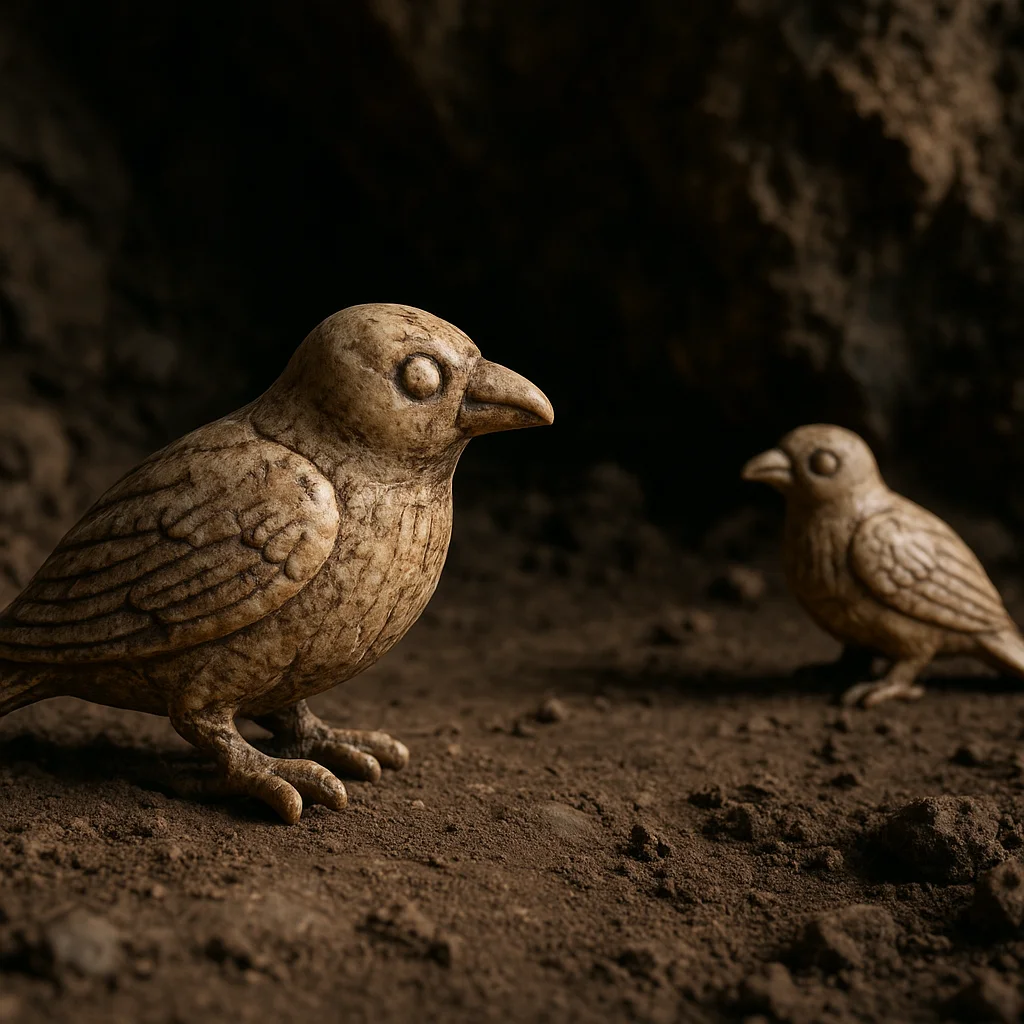
In an unprecedented revelation from the depths of human prehistory, archaeologists at Hohle Fels Cave in southwestern Germany have brought to light two miniature avian figurines, carved from the tusks of Ice Age mammoths some 40,000 years ago. These diminutive sculptures, each just 2 centimeters in length and weighing merely 1.3 and 0.7 grams, now rank among the most diminutive and intricate representatives of Upper Paleolithic portable art ever unearthed.
Recovered within the Aurignacian stratigraphic horizon—an era pivotal for the emergence of symbolic behavior among early Homo sapiens—these artifacts surfaced just 1.5 meters apart, offering a rare glimpse into the dexterity and observational acuity of their Paleolithic creator, possibly a single artisan. The spatial and chronological proximity of the finds suggests contemporaneity, reinforcing the hypothesis of localized artistic traditions flourishing in the Swabian Jura as part of a larger UNESCO World Heritage cluster celebrated for its corpus of early figurative art.
The iconography of the two ivory miniatures evinces a striking naturalism. The first carving depicts a compact bird, hunched low in a posture evocative of brooding—interpreted, on morphological grounds, as a ptarmigan (Lagopus muta), an avian resident still found in the region’s modern fauna. The delicacy of this representation is apparent in the modulated curvature of the back and the nuanced treatment of the feathering, qualities that differentiate it from the more reductive and abstracted anthropomorphic and zoomorphic carvings, such as the famed Löwenmensch (lion-man), also discovered locally. The second, albeit imperfectly preserved, displays wings outstretched in ambiguous motion—possibly landing, taking flight, or engaging in a courtship display. While less diagnostic, its proportions and surface detailing invite identification as either a ptarmigan, grouse, or perhaps a bird of prey.
Professor Nicholas Conard, director of the excavation and a leading authority at the University of Tübingen, underscores the significance of the artisanship: “These figurines demand advanced ivory-working skill, particularly given their scale. The specificity of anatomical features is remarkable for the epoch. Not only are the depictions naturalistic, but close analysis allows us to postulate on the species represented and infer behaviors captured—an achievement in both technical and observational terms.”
Analytical procedures deployed by the team included high-magnification microscopy to discern the sequence and character of carving tool marks—a crucial aspect given the notorious brittleness and tendency of mammoth ivory to splinter under jerky, poorly controlled pressure. The manufacturing process likely involved first isolating a slender flake along the growth plane of the tusk, followed by subtractive sculpting with finely retouched stone blades (possibly of burin or microblade form), and subsequent smoothing and polishing to refine the surface. The mass constraints of these artifacts—m = 1.3 g and m = 0.7 g, respectively—impose stringent demands on the carver’s torque control and hand steadiness, particularly in executing the fine morphological elements such as the tail feathers and wing tips, which, in several places, approach a thickness less than 1 millimeter.
The archaeological context of Hohle Fels Cave situates these figurines among a vertical sequence of Aurignacian deposits. Radiocarbon chronology, calibrated by Bayesian modeling of associated faunal and charcoal samples, places the occupation horizon at ca. 40,000 BP (Before Present), congruent with the onset of anatomically modern humans’ expansion into the Upper Danube corridor. This region, with its proximity to the paleo-environmentally rich Lake Schmiechen—a locus for migratory bird species even today—would have provided the seasonal stimulus and motif repertoire for such works.
The finds not only amplify our understanding of the nascent symbolic lexicon and cognitive sophistication of early Homo sapiens but also complement a broader suite of behavioral innovations documented in the region. As Stefanie Kölbl, managing director of the Museum of Prehistory and Ice Age Art in Blaubeuren, notes, “Birds have long been both an environmental constant and a cultural signifier here. Their presence is encoded not only in art, but also in music—recall that the world’s oldest bone and ivory flutes, capable of producing polyphonic melodies, originate from these same cave systems.”
Beyond the aesthetic triumph, the figurines provoke further research questions: Do they serve as totemic objects, ritual paraphernalia, or were they pedagogical aids in the nascent symbolic communication systems of Upper Paleolithic communities? Is their specificity tied to seasonal hunting practices, avian migrations, or metaphysical associations with flight and transformation?
As the analytical work continues, these avian icons—almost weightless yet heavy with implication—remind us that the first artists of Europe did not merely record the world around them, but rendered it in forms as minutely observed as they were finely executed, inaugurating a tradition of visual culture that endures to this day. The full account of these finds will be published in the forthcoming volume of **Archäologische Ausgrabungen in Baden-Württemberg**, marking a milestone in our appreciation of Ice Age artisanship and cognitive complexity.
Recovered within the Aurignacian stratigraphic horizon—an era pivotal for the emergence of symbolic behavior among early Homo sapiens—these artifacts surfaced just 1.5 meters apart, offering a rare glimpse into the dexterity and observational acuity of their Paleolithic creator, possibly a single artisan. The spatial and chronological proximity of the finds suggests contemporaneity, reinforcing the hypothesis of localized artistic traditions flourishing in the Swabian Jura as part of a larger UNESCO World Heritage cluster celebrated for its corpus of early figurative art.
The iconography of the two ivory miniatures evinces a striking naturalism. The first carving depicts a compact bird, hunched low in a posture evocative of brooding—interpreted, on morphological grounds, as a ptarmigan (Lagopus muta), an avian resident still found in the region’s modern fauna. The delicacy of this representation is apparent in the modulated curvature of the back and the nuanced treatment of the feathering, qualities that differentiate it from the more reductive and abstracted anthropomorphic and zoomorphic carvings, such as the famed Löwenmensch (lion-man), also discovered locally. The second, albeit imperfectly preserved, displays wings outstretched in ambiguous motion—possibly landing, taking flight, or engaging in a courtship display. While less diagnostic, its proportions and surface detailing invite identification as either a ptarmigan, grouse, or perhaps a bird of prey.
Professor Nicholas Conard, director of the excavation and a leading authority at the University of Tübingen, underscores the significance of the artisanship: “These figurines demand advanced ivory-working skill, particularly given their scale. The specificity of anatomical features is remarkable for the epoch. Not only are the depictions naturalistic, but close analysis allows us to postulate on the species represented and infer behaviors captured—an achievement in both technical and observational terms.”
Analytical procedures deployed by the team included high-magnification microscopy to discern the sequence and character of carving tool marks—a crucial aspect given the notorious brittleness and tendency of mammoth ivory to splinter under jerky, poorly controlled pressure. The manufacturing process likely involved first isolating a slender flake along the growth plane of the tusk, followed by subtractive sculpting with finely retouched stone blades (possibly of burin or microblade form), and subsequent smoothing and polishing to refine the surface. The mass constraints of these artifacts—m = 1.3 g and m = 0.7 g, respectively—impose stringent demands on the carver’s torque control and hand steadiness, particularly in executing the fine morphological elements such as the tail feathers and wing tips, which, in several places, approach a thickness less than 1 millimeter.
The archaeological context of Hohle Fels Cave situates these figurines among a vertical sequence of Aurignacian deposits. Radiocarbon chronology, calibrated by Bayesian modeling of associated faunal and charcoal samples, places the occupation horizon at ca. 40,000 BP (Before Present), congruent with the onset of anatomically modern humans’ expansion into the Upper Danube corridor. This region, with its proximity to the paleo-environmentally rich Lake Schmiechen—a locus for migratory bird species even today—would have provided the seasonal stimulus and motif repertoire for such works.
The finds not only amplify our understanding of the nascent symbolic lexicon and cognitive sophistication of early Homo sapiens but also complement a broader suite of behavioral innovations documented in the region. As Stefanie Kölbl, managing director of the Museum of Prehistory and Ice Age Art in Blaubeuren, notes, “Birds have long been both an environmental constant and a cultural signifier here. Their presence is encoded not only in art, but also in music—recall that the world’s oldest bone and ivory flutes, capable of producing polyphonic melodies, originate from these same cave systems.”
Beyond the aesthetic triumph, the figurines provoke further research questions: Do they serve as totemic objects, ritual paraphernalia, or were they pedagogical aids in the nascent symbolic communication systems of Upper Paleolithic communities? Is their specificity tied to seasonal hunting practices, avian migrations, or metaphysical associations with flight and transformation?
As the analytical work continues, these avian icons—almost weightless yet heavy with implication—remind us that the first artists of Europe did not merely record the world around them, but rendered it in forms as minutely observed as they were finely executed, inaugurating a tradition of visual culture that endures to this day. The full account of these finds will be published in the forthcoming volume of **Archäologische Ausgrabungen in Baden-Württemberg**, marking a milestone in our appreciation of Ice Age artisanship and cognitive complexity.