Field: Technology
Milky Way’s Dramatic Past: Supercomputer Simulations Reveal a Galactic Disk Flip after Ancient Collision
Published | Technical Staff
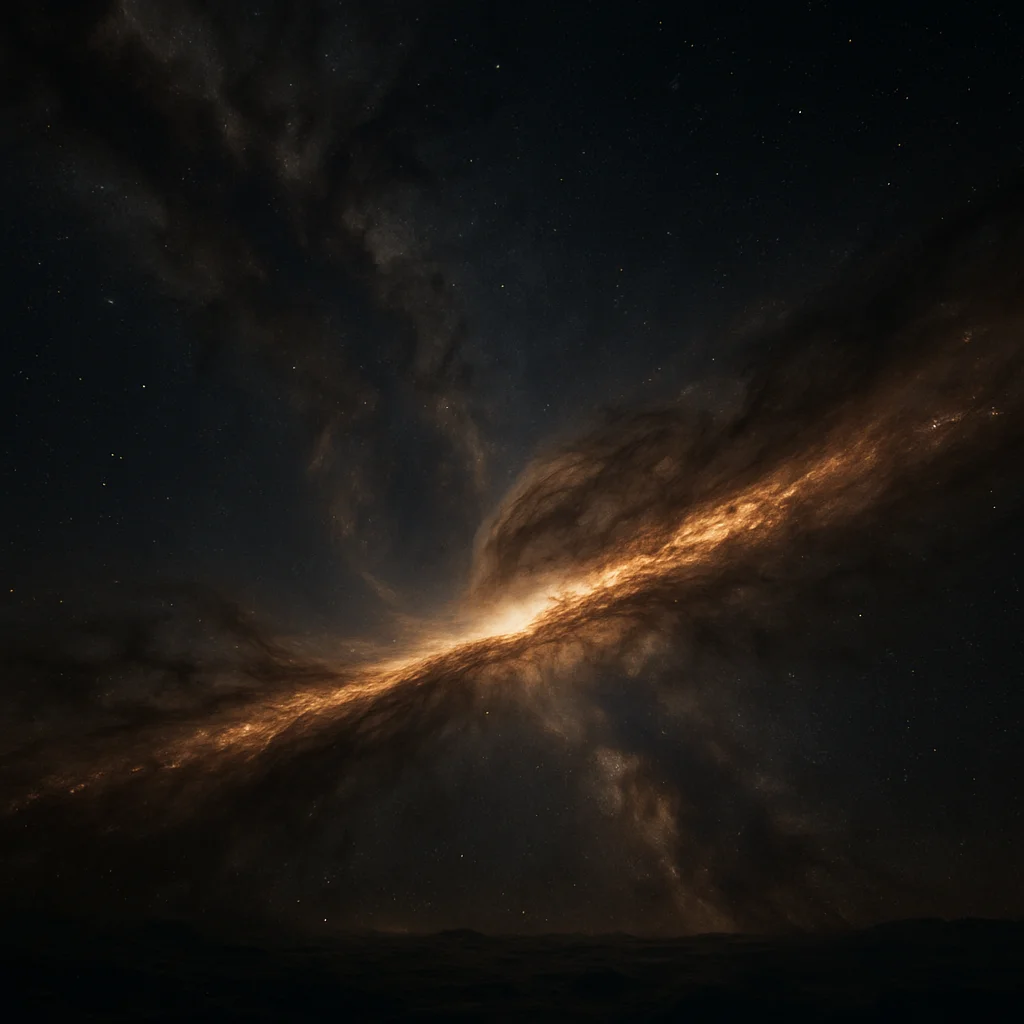
Visualization
The seemingly placid, flat disk of our Milky Way belies a tumultuous past—one that, according to cutting-edge supercomputer simulations, may have included a titanic event known as a ‘disk flip.’ This radical reorientation, in which the entire galactic disk pivots by more than 90 degrees, is now emerging as a natural aftermath of violent head-on galactic collisions, offering a compelling explanation for one of the Milky Way’s enduring mysteries: the unusually sluggish rotation of its stellar halo.
The lion’s share of stars inhabiting the Milky Way reside within its iconic spiral disk. Enclosing this disk is the sprawling stellar halo, a diffuse spheroid dominated by stars whose origins often trace back to smaller satellite galaxies cannibalized over cosmic time. Decades of data—most notably from ESA’s Gaia mission—have established that this halo rotates at a remarkably slow angular velocity, ω_halo. The physical origins of this kinematic inertia, however, have eluded astronomers for years.
To dissect this puzzle, Dr. Kirill Batrakov and colleagues at Durham University turned to the Auriga suite, a suite of cosmological hydrodynamical simulations designed expressly to track the evolution of Milky Way analogs over ~13 billion-year epochs. Among 25 high-fidelity Milky Way-like galaxies, their analysis correlated halo rotation rates with each system’s merger history and disk dynamical behavior. Intriguingly, the simulations revealed that galaxies whose haloes exhibited the lowest mean rotation—⟨v_ϕ,halo⟩ ≈ 0 km/s—shared two characteristics: each had experienced a head-on collision with a major galactic interloper, and each had endured a large-scale disk flip.
To quantify a “disk flip,” the authors computed the change in orientation of the angular momentum vector, **L_disk**(t), over cosmic time. They identified flips as events where |cos θ| < 0.1736, or equivalently, θ_disk > 80°, with θ = arccos((**L_disk,final** · **L_disk,initial**)/(|**L_disk,final**||**L_disk,initial**|)). Within the simulation ensemble, only those galaxies with pronounced disk reorientations ultimately displayed haloes as non-rotating as the Milky Way’s own.
Observationally, the Gaia-Sausage-Enceladus event stands out as the likeliest culprit in our Galaxy’s history. Some 10–11 Gyr ago, a massive dwarf galaxy—bearing a stellar mass M* ≈ 10^9 M_⊙—plunged into the nascent Milky Way, its orbital pole misaligned with that of our primordial disk. The gravitational and dynamical torques excited during the merger not only shredded the interloper, scattering its stars into characteristic elongated "sausage"-shaped orbits, but also imparted sufficient torque to flip the Milky Way's disk orientation by nearly a right angle.
This radical reorientation carries profound dynamical implications. Stars throughout the disk—possibly even the proto-Sun—would have been forced onto new orbits with different inclinations and eccentricities, potentially scrambling the local stellar environment throughout the Solar System’s infancy. The disk, once stably oriented, was recast on a new axis, with only the passage of cosmic time and subsequent quiescent evolution erasing the most conspicuous evidence of this tumult.
Equally compelling is the finding that the rotational inertia of the old stellar halo is closely mirrored in the rotation state of the Galaxy's co-evolving dark matter halo. In the simulations, galaxies whose stellar haloes showed minimal net angular velocity also possessed dark matter haloes with aligned, but similarly slow, rotation axes. This synchronous evolution points to a strong coupling between baryonic and non-baryonic components during the epoch of major mergers, providing indirect constraints on the elusive angular momentum transfer mechanisms within ΛCDM cosmology.
The disk flip phenomenon is far from ubiquitous. Only those galactic systems that sustained both a major merger and an appropriately misaligned impact geometry developed sharply reoriented disks and unspun haloes. Ascertaining that the Milky Way experienced just such a regime-defining event reframes both our understanding of the Galaxy’s secular evolution and the stable environment assumed throughout Solar System history.
Crucially, the authors note that these profound vestiges of galactic violence are inferred not from ancient light, but from the painstaking reconstruction of stellar kinematics available in the present day—the epitome of “near-field cosmology,” exploiting the Milky Way as an archetype for broader galactic evolution. These findings, unveiled at the 2026 National Astronomy Meeting in Birmingham, underscore that even galaxies appearing “normal” today may harbor deep dynamical scars from ancient, transformative encounters. As methodologies and computational power continue to advance, the narrative of our Galaxy promises to become ever more intricate, anchoring the Milky Way firmly as the Rosetta Stone for understanding the volatile birth and growth of spiral galaxies throughout the universe.