Field: Technology
Milky Way’s Central Black Hole is Surrounded by Metal-Rich Gas, Webb Reveals
Published | Technical Staff
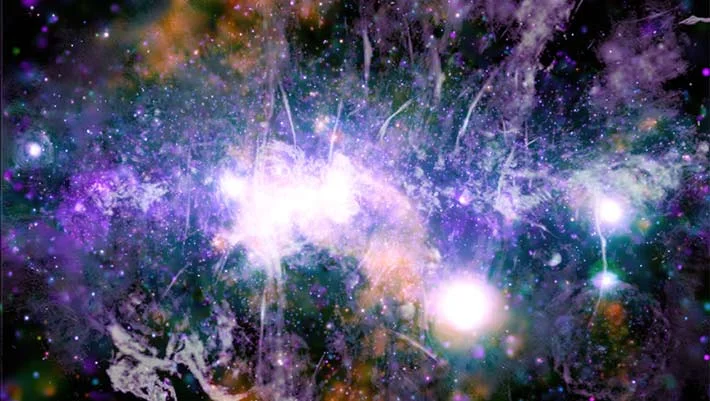
Visualization
Recent observations from the James Webb Space Telescope have unveiled new insights into the enigmatic heart of our Milky Way, where the supermassive black hole Sagittarius A* resides. This celestial body, thought to exhibit a voracious appetite for cosmic material, is found to be consuming significantly less matter than its counterparts in other galaxies. A multifaceted analysis of the environment surrounding this black hole points toward a compelling question: how does the composition and density of available material influence the consumption behavior of Sagittarius A*?
The research team, guided by McGill University Ph.D. student Nicole Ford, exploits Webb's advanced capabilities to probe the gas clouds orbiting the black hole. As Webb captures infrared light with unprecedented spectral and spatial resolution, it reveals intricate details regarding the thermal emissions of various gas clouds. By measuring these emissions, the team was able to discern the metallicity of these clouds, identifying elements more complex than hydrogen and helium—an indication that they have been enriched by nucleosynthesis processes following supernova explosions. Such enrichment processes produce heavier elements like carbon, oxygen, and iron, suggesting a rich history of stellar evolution and demise in the vicinity of Sagittarius A*.
This venture builds upon the foundational work established by NASA’s Chandra X-ray Observatory, which has previously illustrated the high-energy landscape of the Galactic center. The complementary data sets provided by Chandra and recent findings from Webb detail the dynamic interplay of high-energy X-rays and radio emissions, showcasing a panorama marked by both chaos and complexity. Color-coded imaging from Chandra presents an array of X-ray energies, enriching our understanding of the energetic environment surrounding the black hole, while radio data from the MeerKAT telescope provide further context to this cosmic realm.
In a parallel examination, astronomer Mayura Balakrishnan and colleagues employed X-ray observations to investigate potential energy bursts from Sagittarius A*. Their analysis reveals a challenging aspect of the study: disentangling the black hole's influence from local gas emissions proves to be a daunting task, compounded by the vigorous interactions that occur among the dust, gas, and stellar structures in the Galactic center. This complicates efforts to utilize gas emissions as a historical record of the black hole’s activity, emphasizing the significance of interpreting these findings in conjunction with sophisticated simulations that model gas evolution throughout cosmic timescales.
At the heart of this research lies a scientific conundrum—in what manner do the physical properties of nearby gas, which has been heavily influenced by prior stellar explosions, serve as a limiting factor for Sagittarius A*'s consumption of matter? As the black hole pulls at the very fabric of its surroundings, understanding the “minispiral” that forms from this interaction requires a broad lens, merging observational data with theoretical frameworks.
Continued investigations are expected to provide deeper clarity on the mechanisms governing interactions between Sagittarius A* and the metallic gas clouds, potentially reshaping our comprehension of accretion processes in supermassive black holes. This confluence of recent data, particularly from Webb, not only expands the horizon of our astronomical knowledge but also sheds light on the profound cosmic narratives played out in the almost ethereal yet profoundly material realm of the Galactic core.