Field: Technology
Meteors don't just burn up. What really happens is far more violent.
Published | Technical Staff
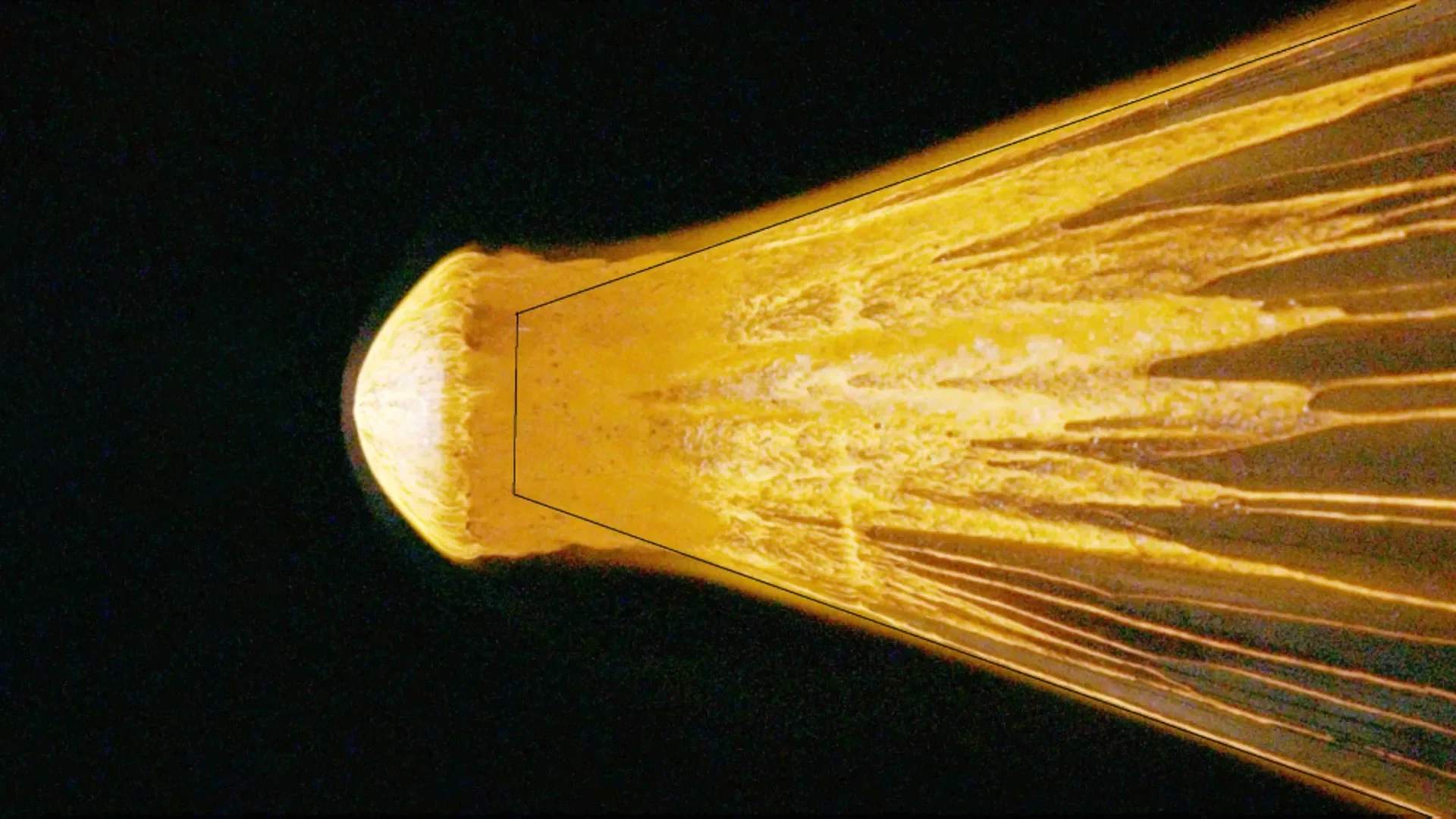
Visualization
As celestial objects plunge toward Earth, the fate of these frigid space rocks transforms dramatically upon entry into the planet’s atmosphere. A comprehensive examination by researchers has unraveled a sequence of seven distinct stages that these meteoroids undergo, highlighting the predominance of melting and fragmentation over the previously accepted notion of mere evaporation. This newfound understanding reveals essential dynamics that explain why meteorites scatter upon impact and how hazardous asteroids explode in the atmosphere.
Conducted by a team led by Dr. Peter Jenniskens from the SETI Institute and NASA Ames Research Center, this research involved thorough analysis of video recordings and photographs from 75 meteorite falls, culminating in findings disseminated in the journal Meteoritics & Planetary Science. The study challenges the historical view of meteoric combustion, previously thought to be the result of solid body evaporation at extreme temperatures.
The initial phase of a meteoroid's interstellar journey begins high in the atmosphere, wherein it generates a shock wave as it collides with air molecules. At this stage, the object experiences rapid deceleration, with the surrounding gas heating up and glowing. Here, it produces the spectral streak of light familiar to us: the meteor or "shooting star."
As the meteor continues its descent and enters an increasingly dense atmospheric layer, it enters the second phase marked by intensified brightness. Researchers observed that changes in luminosity can reveal the speed at which the meteoroid is rotating, a phenomenon documented in amongst higher velocities, where complete rotations can occur within a span ranging from 0.5 to 5 seconds. By the third phase, the object evolves into a fireball, a key development characterized by the predominance of melting. This rapid outlet of energy and high-speed aerodynamics strips molten material from the surface, leading to the formation of droplets that subsequently evaporate upon detachment from the parent body.
Research further identified that during the fourth phase at altitudes approximating 60 kilometers (around 40 miles), the melting achieves a steady equilibrium, resulting in uniform brightness levels that indicate a stability in mass loss. The findings suggest that melting alone can account for as much as 40 percent of the meteoroid’s mass reduction.
The sequence progresses into the fifth phase as the increasing air pressure fracturing the meteoroid sets in. Surprisingly, fragmentation initiates when the rock experiences air pressure equivalent to only one-fifth of that typically observed on recovered meteorites on Earth. This observation indicates that preexisting structural weaknesses, due in part to prior collisions, make meteoroids susceptible to disruption early in their atmospheric journey. The consequent fragmentation enhances the meteor's deceleration; mathematical models relating to ablation provide a fundamental backdrop explaining this gradual slowing down during fragmentation.
During this pivotal phase, the configuration of the surviving rock also plays a crucial role in determining the trajectory of ejected fragments. Researchers, including co-author Darrel Robertson of NASA Ames Research Center, posited that if the retentive rear section maintains its integrity, it creates a low-pressure vacuum that guides smaller segments of the meteoroid, controlling their landing zones.
As the rock descends further, Phase 6 commences with a dramatic culmination of events: the rear portion disintegrates, generating a stunning flare while ejecting debris that now possesses significantly higher relative speeds. This late-stage fragmentation typically yields red-shaded flashes, starkly contrasted with the vivid greens seen earlier.
Ultimately, during Phase 7, the remaining pieces undergo further transformations, continuing their descent toward Earth while experiencing additional melting and fragmentation. It is at this juncture that fragments cultivate a thin fusion crust, marking their final phase as they land on Earth’s surface. The atmospheric winds can further influence their landing zones, sometimes diverting them from their trajectories.
Interesting revelations from this study do not merely pertain to small meteorites; they extend their implications toward our comprehension of much larger asteroids, whose dimensions can measure from the size of vehicles to that of city blocks. The findings elucidate the complex mechanics at play during atmospheric engagement, fostering an understanding of the underlying processes that govern formidable asteroid airbursts.
By cataloging the diverse behaviors observed across the 75 meteorite falls, the research offers critical insights into the atmospheric entry dynamics that govern both small meteoroids and the much larger, potentially dangerous asteroids that, if unmitigated, could ignite catastrophic explosions in the atmosphere. Understanding these processes is vital as humanity continues to explore the cosmos, emphasizing the ever-looming potential dangers posed by these interstellar wanderers.