Field: Technology
Meteorite Found in Sahara is Piece of Mars at Least 4.1 Billion Years Old
Published | Technical Staff
Visualization
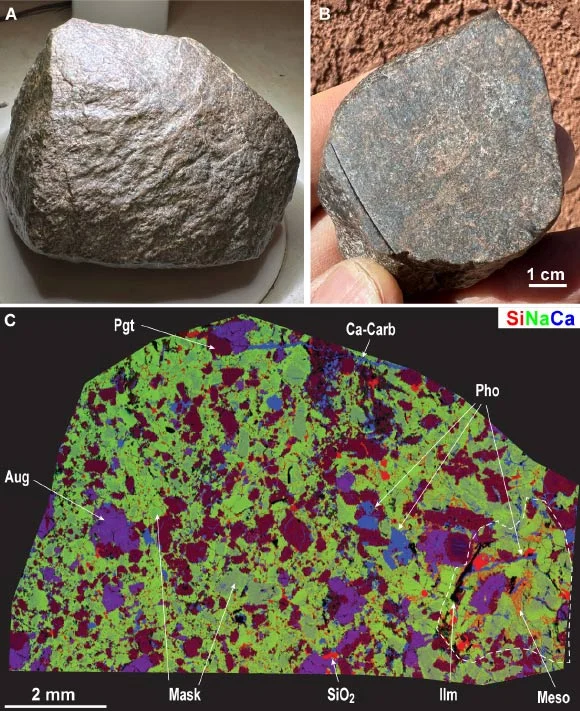
The Sahara Desert in Mali has unveiled a celestial treasure, Teghaza 001, a Martian meteorite that provides an extraordinary glimpse into the planet's primordial crust formed over 4.1 billion years ago. This meteorite, identified four years prior, has recently been scrutinized in detail, revealing its significance as a geological relic capable of shedding light on early Martian history. A revelation made by a cohort of researchers, including Dr. Yang Liu from NASA’s Jet Propulsion Laboratory, asserts that this specimen could serve as a Rosetta Stone for Mars, paving the way for a deeper understanding of the planet’s ancient environments.
Teghaza 001 comprises eight distinct fragments totaling 798.5 grams, with the largest piece weighing in at 442 grams and measuring approximately 10 centimeters in diameter. This is noteworthy, as it stands apart from the majority of nearly 300 known Martian meteorites, which tend to originate from a much younger geological framework—primarily rocks shaped over the last 2.4 billion years. What sets Teghaza 001 apart is its classification as a coarse-grained igneous rock, specifically a plagioclase-rich gabbro, a typology that indicates a history of slow cooling likely occurring beneath the Martian surface.
Employing uranium-lead dating methodologies, researchers determined the age of zircon crystals embedded within Teghaza 001 to be approximately 4.11 billion years. This method, a staple in geochronology, hinges on the predictable decay of uranium isotopes into lead, allowing for an assessment of the rock's formation time. Complementary rubidium-strontium analysis corroborated these findings with a less precise but similarly ancient estimate of around 4.24 billion years. The implications of these isotopic ages suggest that the mineral-laden water might have circulated through the rock shortly after its crystallization, a process that distinctly predates any known impacts that might have ejected the material from Martian soil into space.
Dr. Carl Agee, director and curator at the University of New Mexico's Institute of Meteoritics, stresses the uniqueness inherent in Teghaza 001 as an unadulterated rock type, in contrast to other Martian finds—such as Northwestern Africa 7034, commonly referred to as "Black Beauty," which is a conglomeration of varied rock types. Where Black Beauty boasts ancient fragments, Teghaza 001 embodies a singularity that speaks to a period of Mars's early geological identity. Furthermore, the meteorite hints at a watery past: its oxygen isotopes possess heavier signatures compared to those of other Martian meteorites, indicative of interactions with fluids active in an oxygen-rich environment.
The study delves deeper into the mineralogical composition of the rock, revealing that various minerals had undergone chemical alterations on Mars prior to an impact that ultimately ejected Teghaza 001. Through careful comparison of its chemical constituents with high-resolution orbital data, researchers pinpointed the southern Martian highlands—particularly the expansive region northwest of the Hellas impact basin—as the likely provenance for this ancient rock, suggesting that the geological conditions therein were conducive to the formation and alteration observed.
Dr. Agee quantifies the significance of this discovery, emphasizing its rarity not only in age but in the distinctive environmental conditions it encapsulates from an era of Mars that remains largely undocumented by existing samples. With the estimated chances of stumbling upon another specimen like Teghaza 001 being extremely slim, researchers are invigorated with the knowledge that they possess a rare, windowed view into a time period that could illuminate the initial conditions and evolution of our neighboring planet.
As planetary scientists continue to unravel the mysteries held within Martian meteorites, Teghaza 001 stands as a monumental achievement, enabling a deeper exploration of Mars’ early crust and mantle. This extraordinary artifact serves not merely as a celestial trophy, but as a historical document connecting Earth-based scientists to the planetary narratives swirling in the cosmos, challenging our understanding of life-sustaining environments from billions of years ago.