Field: Technology
Mesozoic Mammal *Dongoconodon platycauda* Brings Semiaquatic Surprises and Unexpected Tooth Replacements
Published | Technical Staff
Visualization
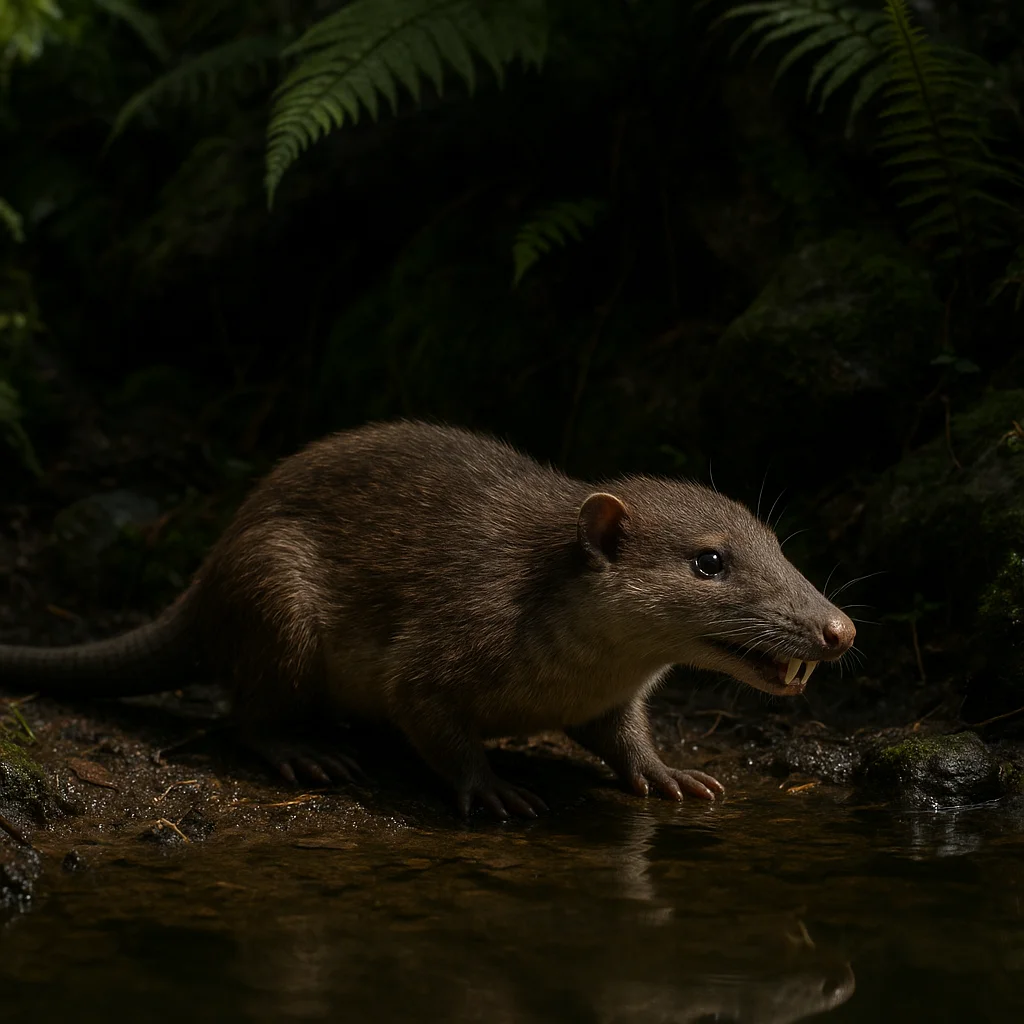
A remarkable fossil unearthed from the Early Cretaceous Jiufotang Formation in Liaoning, China, is prompting paleontologists to rethink the ecological and developmental boundaries of Mesozoic mammals. *Dongoconodon platycauda*, an otherwise diminutive eutriconodontan—estimated at just 115–190 grams, similar in mass to a modern water vole—has now emerged as a strikingly specialized, semi-aquatic carnivore with platypus-like appendages and a dental replacement regime excluded by the conventional diphyodont paradigm that typifies living mammals.
The exquisite fossil, collected in 2016, preserves a nearly complete, articulated skeleton with an intact cranial assembly and mandible. High-resolution computed tomography (CT) scans of the jaws revealed a surprise: in key positions, at least three generations of teeth are present, most notably among all four tooth types—incisors, canines, premolariforms, and molariforms. In living mammals, tooth replacement adheres strictly to diphyodonty—two functional generations, represented by deciduous and permanent sets. However, *Dongoconodon* offers unequivocal evidence for a derived form of polyphyodonty, with replacement teeth still in development beneath other replacements. In the right lower mandible, anterior to the erupted canine, three unerupted teeth are enclosed in alveolar bone: a primordial incisor, its successor, and a second incisor, with posteriorly fully erupted molariforms (second and third). The spatial and temporal replacement relationship—specifically, multiple replacement cycles for the same tooth position—defies all known sequences in extant or extinct Mammaliaformes.
The functional and ecological implications of this deviation from diphyodonty are compelling. The repeated generation of new teeth (polyphyodonty) and the replacement of even molariform teeth suggests a dietary regime that imposed high mechanical demands—presumably processing hard or abrasive animal tissues in a carnivorous niche. This is congruent with observations from closely related eutriconodontans such as *Gobiconodon borissiaki*, also reported to replace back teeth more than once, a trait otherwise unknown among crown mammals. The implication is that selective pressures related to prey acquisition and consumption in aquatic or semi-aquatic environments may have driven reversionary dental developmental pathways, facilitating ongoing oral renewal.
Morphologically, *Dongoconodon*'s adaptations for aquatic life are equally revealing. Its manus and pes exhibit a pronounced resemblance to those of modern platypuses (*Ornithorhynchus anatinus*), with elongated, dorsoventrally flattened phalanges and bony flanges that precisely correspond to known webbing attachment sites in extant monotremes. Its caudal vertebrae are robust, box-like, and display clear dorsoventral flattening, drawing a striking parallel to the aquatic rodent nutria (*Myocastor coypus*), whose tail structure is optimized for aquatic maneuverability. Researchers quantified these affinities by analyzing a matrix of 13 limb-bone measurements and comparing *Dongoconodon* to an ecomorphological dataset of 124 extant mammals classified by lifestyle. In every case, the fossil fell within the morphospace occupied by recognized semi-aquatic taxa.
Biomechanical inference supports the hypothesis of a swimming mammal propelled by forelimb-generated thrust—an analog to monotreme locomotion—with the laterally compressed, paddle-like tail functioning as a stabilizing rudder during aquatic navigation. The simultaneous presence of webbed extremities and robust caudal modifications marks *Dongoconodon* as the earliest known mammal to independently evolve this suite of adaptations, prior to the monotreme lineage’s aquatic radiation by tens of millions of years.
Paleontologists, led by Shundong Bi (Yunnan University) and colleagues, situate *Dongoconodon* as an unexpected outlier—one which subverts canonical models of Mesozoic mammalian morphological conservatism. “The new fossil shows adaptations for semiaquatic life, with hands and feet like the platypus that were similarly webbed,” the authors note, while simultaneously documenting a dental regime that represents an unprecedented return to polyphyodonty among derived mammals. The convergence of these features in a small Cretaceous taxon broadens the ecological and developmental repertoire attributed to early mammals, challenging the view that diphyodont dentition and terrestriality were inextricable hallmarks of Mesozoic Mammalia.
Published this week in *Nature Communications* (Bi et al., 2026, doi: 10.1038/s41467-026-77339-w), the *Dongoconodon* discovery does more than fill a temporal and anatomical gap—it compels a reexamination of the selective pressures and developmental plasticity that underpinned the radiation of early mammals into Mesozoic waters. The evolutionary experiment that produced *Dongoconodon* appears, at least for a time, to have converged on solutions familiar to us from the Cenozoic, yet achieved them via an archaic and heretofore unanticipated developmental toolkit.