Field: Technology
Longest Feather Ever Found in Amber Offers Clues to Flight’s Origins
Published | Technical Staff
Visualization
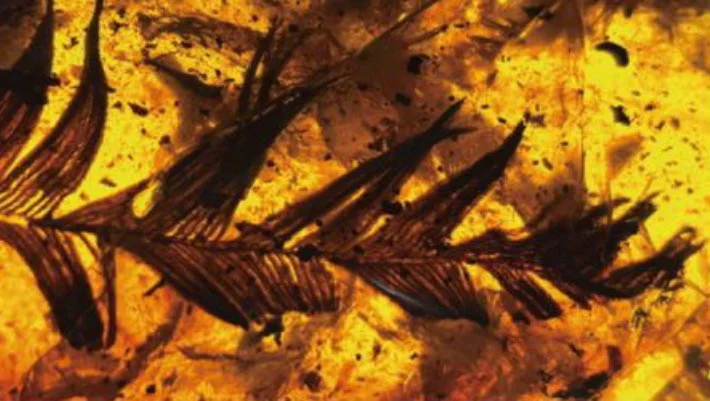
In a remarkable depiction of evolutionary history, a Cretaceous feather, dating back approximately 99 million years, has surfaced encased in Burmese amber, providing unprecedented insights into the morphology of ancient avian structures and the origins of flight. This feather, catalogued as ECNU A0033 by researchers based at East China Normal University, stands as the longest three-dimensionally preserved pennaceous feather to date and offers clues about the evolutionary landscape of non-avialan theropods.
ECNU A0033's impressive dimensions reflect its adaptation for potential aerodynamic functionality, with a preserved length of approximately 105 mm and an estimated original length exceeding 140 mm, taking into account an absent proximal section that likely constituted a quarter of its entirety. Its structure reveals two symmetrical vanes composed of densely arranged barbs, providing an initial glimpse into the complex architecture of modern flight feathers. Despite its superficial resemblance to contemporary feathers, a closer examination reveals notable primitive characteristics that challenge established assumptions regarding the evolutionary timeline of avian flight mechanisms.
The intricate interplay of feather morphology and functionality has long intrigued scientists, particularly the implications of pennaceous feathers—recognized as a critical evolutionary innovation associated with the transition from theropods to birds. The absence of structures such as barbule hooklets in ECNU A0033 highlights a crucial evolutionary gap. These hooklets, which serve to interlock neighboring barbs in modern feathers, are essential for maintaining the aerodynamic surface necessary for flight. Consequently, the vanes of this feather lack the continuous structure that characterizes advanced feather designs.
The findings further underscore a pivotal aspect of feather evolution: the gradualistic development of feather specialization. Computational fluid dynamics simulations suggest that the feather's open construction renders it significantly more flexible than if it had a solid, cylindrical rachis. This structural flexibility implies that, while the feather had achieved notable length and symmetry, its performance under aerodynamic conditions would have been considerably limited without the advanced internal architecture seen in contemporary feathers.
This feather thus serves as evidence for a "modular" evolution process in feather morphology, wherein different anatomical components arose independently over time. The simultaneous presence of substantial elongation and a well-crafted vane structure, juxtaposed against the incomplete internal features necessary for high aerodynamic performance, points toward a nuanced evolutionary trajectory. The conclusions drawn from ECNU A0033 maintain that extensive adaptations could manifest without the concurrent refinement of the internal composition required for high-function capabilities.
In addition to its structural significance, the specimen also piques interest through its pigmentation. Analysis of the feather's preserved melanosomes indicates a dark coloration, a trait consistent with other known feathered dinosaurs and early avian species. The coloration patterns observed suggest that darker hues may have been common among non-avialan theropods, further enriching the understanding of feather ecology in the time of the dinosaurs.
Despite the absence of skeletal remains directly associated with ECNU A0033, its morphology aligns closely with traits characteristic of non-avialan pennaraptoran theropods, reinforcing the link between these ancient creatures and the evolutionary origins of flight. The study, published in Gondwana Research, not only broadens the narrative concerning feather evolution but also stirs intriguing inquiries about the developmental pathways leading to the triumph of avian flight.
As science delves deeper into the fossil record, discoveries like ECNU A0033 illuminate the steps on the evolutionary ladder, showcasing how intricate relationships among structural forms, pigmentations, and adaptive functionalities offer a fuller picture of our planet's prehistoric biosphere. The significance of ECNU A0033 transcends its mere dimensions; it encapsulates the complexity and gradual nature of evolutionary advances, reminding us that the road to flight was as much an iterative process as it was a revolutionary one.