Field: Technology
Lava World TOI-561b May Have Reflective, Cloudy Atmosphere
Published | Technical Staff
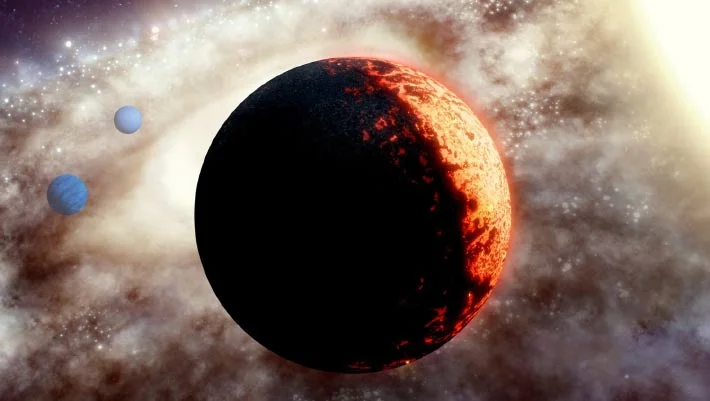
Visualization
Deep within the celestial tapestry of the Milky Way, approximately 280.5 light-years away in the constellation Sextans, lies the ancient star system TOI-561, notable not only for its impressive longevity but also for its intriguing planetary inhabitants. At the heart of this system is TOI-561b, a rocky exoplanet that defies prevailing theories of atmospheric loss through an extraordinary discovery gleaned from advanced observations by the NASA/ESA/CSA James Webb Space Telescope.
TOI-561, also cataloged as TYC 243-1528-1, possesses a mass and size roughly 80% of our Sun and is dated at about 10 billion years, placing it among the elder statesmen of the cosmos. This planetary system harbors at least three transiting planets, with TOI-561b positioned as the innermost. Known as a super-Earth, TOI-561b orbits its parent star with astonishing speed, completing a revolution every 0.44 days. Its dimensions are equally striking, measuring approximately 1.4 times the radius of Earth and with a mass weighing in at 2.2 times that of our home planet. Remarkably, this gives TOI-561b a surprising mean density of about 4.3 grams per cubic centimeter, indicative of its rocky composition.
Traditionally, astrophysical models suggest that such heavily irradiated worlds would have long since shed their atmospheres. Dr. Anjali Piette, an astronomer at the University of Birmingham, emphasizes the anomaly presented by TOI-561b, stating, “Our discovery challenges current theories. We would expect a heavily irradiated rocky planet like TOI-561b to have lost its atmosphere billions of years ago.” Yet, compelling evidence suggests otherwise; TOI-561b may harbor a significant atmosphere that has persisted for eons, prompting questions about its origin. One potential hypothesis is that the planet began with an unusual abundance of gaseous materials, while another posits that the extensive ocean of molten rock enveloping its surface could act similarly to a planetary volcano, continually replenishing its atmospheric constituents.
Utilizing the NIRSpec instrument aboard the James Webb Space Telescope, Dr. Piette and her team meticulously tracked the planet’s thermal emissions through a series of secondary eclipses and transits. By constructing a ‘phase curve’—a detailed representation of how TOI-561b’s brightness fluctuates throughout its orbit—they measured the contributions of the planet's dayside emission spectrum to derive a brightness temperature around 2,050 K. This temperature starkly contrasts with the ~3,200 K anticipated for a bare, non-reflective rocky surface, raising further intrigue about the planet's atmospheric characteristics.
These observations were further elucidated by contrasting them against computer simulations of the planet's climate. The indicators suggest that a cloudy cover composed of silicate minerals—likely silicon dioxide and magnesium silicate—could exist in the exoplanet's upper atmosphere, functioning akin to sunscreen and significantly affecting its temperature profile. Professor Lisa Dang from the University of Waterloo elaborates on the implications of these findings: “We measured how the planet’s brightness and heat changed throughout its orbit… This technique, known as a phase curve, revealed that the planet reflects a significant amount of light from its star, and that heat is being redistributed around the planet instead of only on the sunlit side. Together, these point to the presence of an atmosphere.”
The future trajectory of research into TOI-561b raises significant questions regarding its atmospheric composition and behavior, including whether it bears resemblance to Venus or represents an extreme variation of Io, the volcanically active moon of Jupiter. Observations at longer wavelengths with the Webb telescope are poised to deepen our understanding of this intriguing world, striving to elucidate how a planet of such extreme thermal conditions has retained a gaseous envelope for billions of years. The comprehensive findings from this research, documented in the Astronomical Journal, not only expand our knowledge of TOI-561b but unlock new avenues of inquiry into the atmospheric dynamics of rocky exoplanets orbiting nearby stars. As our observational capabilities evolve, the secrets of TOI-561b may yet redefine our understanding of exoplanet atmospheres and the life cycles of planetary bodies across the universe.