Field: Technology
Large Orca Relative Hunted in North Sea Over Two Million Years Ago
Published | Technical Staff
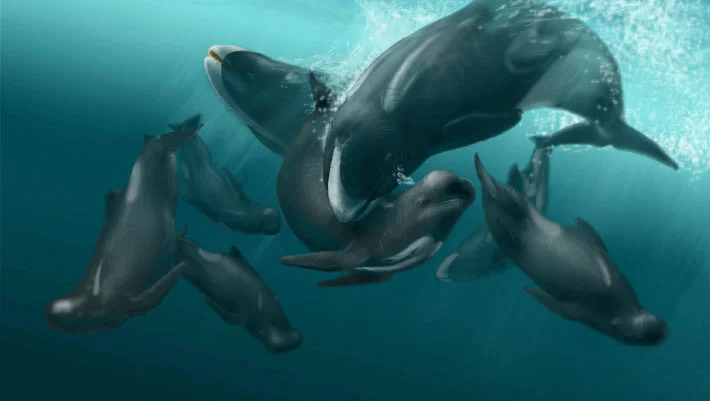
Visualization
In a remarkable intersection of paleontology and modern commercial activity, fossils retrieved from fishing trawlers operating in the southern North Sea have unveiled the presence of an ancient relative of the killer whale, an Orcinus species that thrived over two million years ago, during the early Pleistocene epoch. This pioneering research, undertaken by a multidisciplinary team from the Natural History Museum Rotterdam, the Geological Survey of the Netherlands, and the University of Pisa, sheds light on the evolutionary history and dietary strategies of these apex predators, whose evolutionary roots have remained shrouded in mystery until now.
The killer whale, known scientifically as Orcinus orca, is distinguished as the largest member of the oceanic dolphin family. Dr. Hidde Bakker, affiliated with the Natural History Museum Rotterdam, elucidates that these formidable marine mammals inhabit the upper echelons of marine food webs, facing minimal threats as adults. Their diverse diet encompasses a vast array of marine fauna—ranging from mollusks and fish to seabirds, turtles, and even other marine mammals, including both pinnipeds and larger baleen whales.
Social structures play a critical role in the hunting strategies employed by killer whales, which operate predominantly in pods and exhibit a repertoire of complex feeding methodologies. Among these, populations with a macropredatory diet display a distinctive grip-and-tear technique, reminiscent of feeding behaviors seen in certain shark species. This remarkable adaptation, attributed to species like the Antarctic Type A killer whale, enables effective predation on substantial prey, with male specimens attaining lengths that can average around 7.8 meters (25.6 feet) and occasionally reaching nearly 9 meters (29.5 feet).
Despite a renaissance of interest in the phylogenetic trajectory of killer whales, the origins of this genus remain nebulous, primarily due to a sparse fossil record related to both extant and extinct members of the Orcinus lineage. To date, the only identified extinct species has been Orcinus citoniensis, with its lineage often eclipsed by modern representatives of the genus.
The empirical findings arise from meticulous analysis of five fossil specimens classified as Orcinus sp., which consist of two partial skulls, a lower jaw fragment, and two sets of cervical vertebrae. These relics suggest a size estimation for the ancient orca of between 7.2 and 7.7 meters (23.6 to 25.3 feet), putting this creature on par with today’s most colossal male killer whales.
The fossils, unearthed as bycatch during commercial fishing operations, originate from two specific sites offshore, designated as the "Noordhinder" and "Outer Gabbard," located approximately 100 kilometers west of Rotterdam. To ascertain the temporal context of these specimens, researchers performed a detailed examination of microscopic algae cysts preserved within the marine sediments still adhering to one of the skulls. The findings indicated a dating range of 2.6 to 2.1 million years, placing the fossils squarely within the Gelasian stage of the Pleistocene.
Among the unique morphological traits observed, the jaw fragment displays a series of large, deep tooth sockets, while the vertebrae suggest a capacity for considerable head mobility. Dr. Bakker and his collaborators infer that these anatomical features, combined with the overall size of the Orcinus sp., are indicative of macroraptorial feeding behaviors, which implicitly involve the pursuit and capture of sizeable marine prey.
The implications of discovering Orcinus sp. as the largest delphinid recorded from the Pleistocene cannot be overstated; it provides the earliest evidence for the emergence of macroraptorial predation within the family Delphinidae, notably predating the Middle Pleistocene divergence of contemporary killer whale ecotypes inferred from genomic analyses. By establishing that such sophisticated feeding strategies were in place over two million years ago, the research emphasizes the long-term sustainability of apex predation dynamics in marine environments, while simultaneously flagging potential vulnerabilities to rapid human-induced changes in these ecosystems.
Documented in an article published online in the journal PeerJ, this groundbreaking study heralds not only a significant advancement in our understanding of killer whale evolution but also underscores the intricate links between geological history and the adaptive changes of apex predators within marine realms. The longevity of these powerful creatures and their placed role at the top of the food chain serves as a poignant reminder of both nature's complexity and its fragility in the face of anthropogenic pressures.