Field: Technology
Large Hadron Collider Reveals Evidence of Big Bang Matter in Surprisingly Small Collisions
Published | Technical Staff
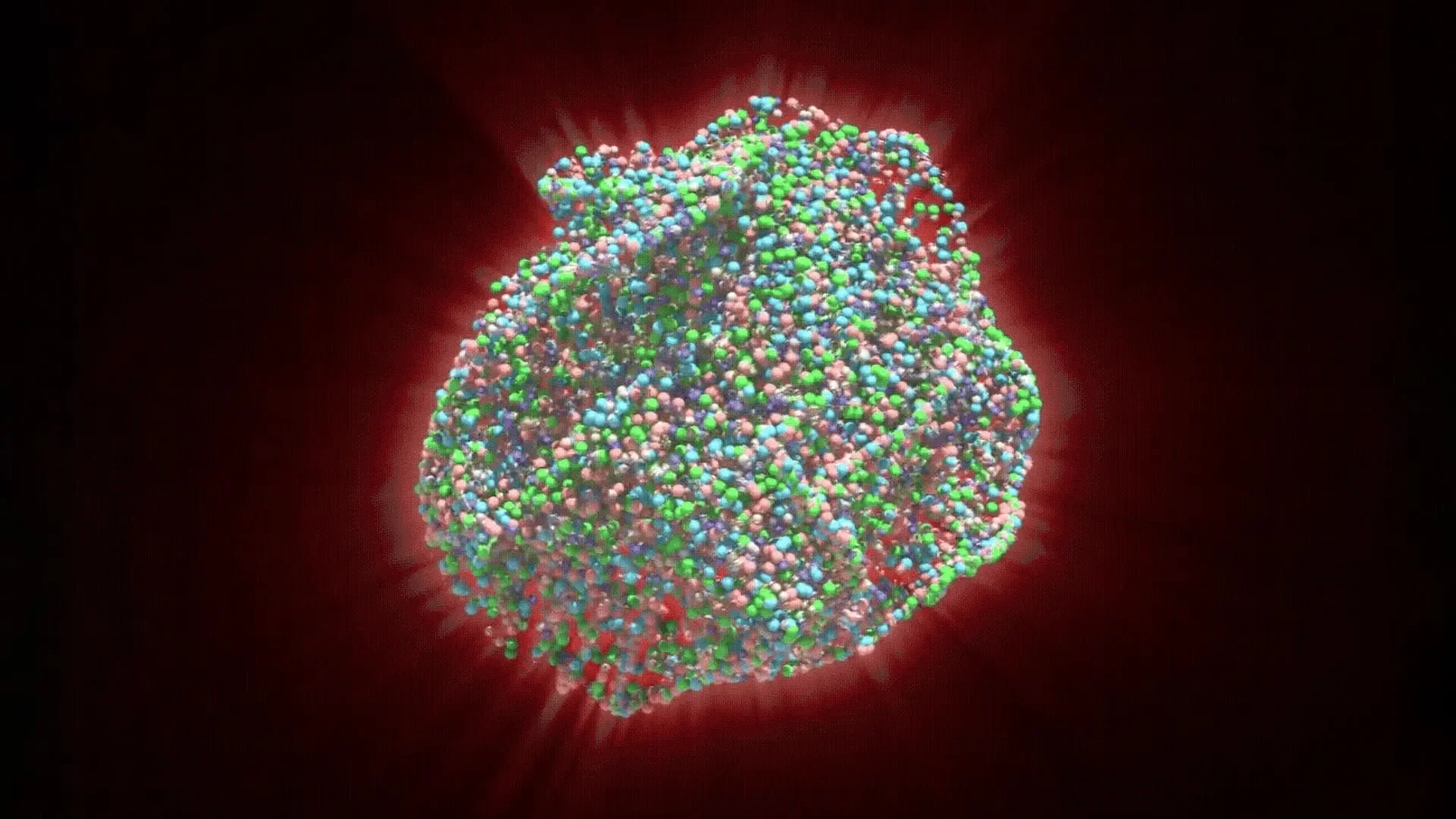
Visualization
In an intriguing development that challenges long-held assumptions in high-energy physics, scientists at CERN's Large Hadron Collider (LHC) have documented compelling evidence suggesting that the extreme state of matter known as quark-gluon plasma (QGP) can be produced in relatively small atomic collisions. This groundbreaking discovery emerges from a series of collisions involving oxygen and neon nuclei, raising new questions about the conditions that may have prevailed in the fledgling universe moments after the Big Bang.
Quark-gluon plasma is understood to exist at staggering temperatures—over 100,000 times those found at the core of the Sun—where protons and neutrons dissolve into their constituent quarks and the gluons that mediate their binding. For decades, researchers believed that the requisite conditions for generating such a plasma could only be achieved through the collision of very heavy atomic nuclei, such as lead, which weighs more than 200 times greater than individual protons that are commonly employed in particle physics investigations. The LHC was constructed precisely for these high-energy collisions, aiming to recreate the conditions of the universe during its first microsecond.
Surprisingly, findings from the four principal LHC collaborations—ALICE, ATLAS, CMS, and LHCb—indicate that QGP may also be formed in collisions involving significantly lighter elements. Earlier research conducted by the ALICE collaboration hinted at QGP in proton-lead and proton-proton collisions. However, the revelation that even oxygen-oxygen and neon-neon collisions can produce signatures of this exotic state marks a significant paradigm shift in high-energy collider experiments.
A fundamental technique for identifying quark-gluon plasma involves observing how energetic quarks and gluons lose energy as they traverse this hot, dense medium—an effect referred to as parton energy loss. The ATLAS collaboration's investigations into particle jet pairs produced during these lighter nuclear collisions revealed notable discrepancies in energy levels. Such jets are defined as collimated streams of particles born from the collision aftermath. The discrepancies in energy distributions were particularly pronounced in central collisions, where atomic nuclei collide head-on, thereby increasing the volume and density of QGP produced during the event.
Further reinforcing these observations, the ATLAS team found a relationship between the degree of energy loss and the centrality of the collision. Specifically, more central impacts produced greater energy loss, consistent with theoretical expectations. Preliminary analyses suggested that charged particles recoiling in the opposite direction to emitted photons exhibited similar energy loss behavior, implicating QGP's presence.
The other LHC collaborations employed varied methodologies, but the consistency of the results has established a compelling case for the formation of quark-gluon plasma in lighter atomic collisions. CMS provided evidence showing a suppression of charged-particle production in both oxygen-oxygen and neon-neon interactions compared to proton-proton collisions, which aligns with expectations of parton energy loss within a QGP medium. LHCb further corroborated these findings by investigating charm quark production suppression, reinforcing the hypothesis that larger nuclei collisions lead to increased plasma formation and more significant energy loss.
Complicating these interpretations, however, is the realization that reduced particle production doesn't solely imply energy loss—it could arise from other processes as well. The ALICE collaboration attempted to elucidate the question by comparing the production rates of neutral pions in oxygen-oxygen versus proton-oxygen collisions. This nuanced analysis provided more definitive evidence of parton energy loss occurring in the former collision type.
Beyond these energy interactions, physicists explored the exotic dynamics of particles generated in these high-energy setups. For instance, CMS's examination of upsilon mesons—particles formed from a bottom quark and its antiquark—revealed variable suppression based on binding strength to the surrounding plasma. The LHCb experiments presented similar findings, reinforcing the idea that different quark binding states are affected differently by plasma interactions, potentially providing insights into the characteristics and extent of the QGP produced.
Intriguingly, ALICE researchers noted an unexpected pattern in post-collision particle directions, revealing that baryons—particles composed of three quarks—exhibited distinct directional preferences that differed from mesons, composed of only two quarks. This directional behavior could hint at complex interactions within the quark-gluon plasma, further informing ongoing research into its properties and dynamics.
In summary, the recent findings from CERN's LHC reshape our understanding of quark-gluon plasma formation, suggesting that even lightweight atomic collisions can recreate conditions akin to those present in the early universe. Through the meticulous study of energy loss mechanisms, particle production suppression, and directional dependencies, scientists are poised to unravel the intricacies of the primordial matter manifesting in these sophisticated experiments, inching closer to the elusive moments following the Big Bang.