Field: Technology
Jurassic Fossil Discovery Unveils Critical Clues in the Stepwise Evolution of Avian Tails
Published | Technical Staff
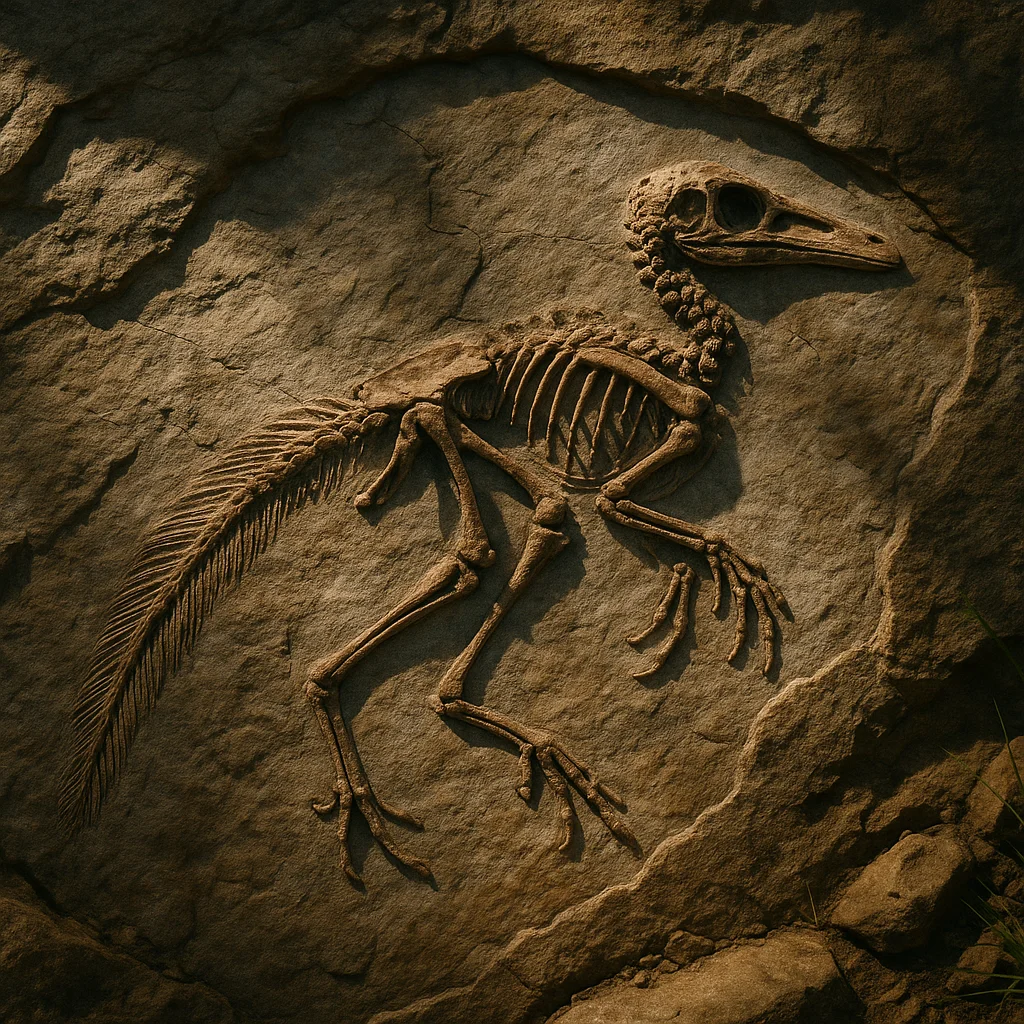
Visualization
The evolutionary trajectory from long-tailed, terrestrial theropods to the compact-tailed, volant birds of today has remained one of the most enigmatic episodes in vertebrate history. Now, the discovery of *Zhengheornis buyu*, a diminutive and previously undocumented Jurassic avialan from China’s Nanyuan Formation, delivers a pivotal piece of paleontological evidence, revealing a distinct morphological intermediate in the evolutionary reduction of the avian tail.
Modern birds, or Neornithes, are characterized by a remarkably abbreviated tail, culminating in the pygostyle—an autapomorphic structure comprising a fused terminal cluster of caudal vertebrae. This ossified structure acts as the anchorage for the tail fan, integral to aerodynamic maneuvering and powered flight. By contrast, their Mesozoic forebears, typified by *Archaeopteryx* and non-avialan maniraptoran dinosaurs, bore elongate tails comprising upwards of 23–30 separate vertebrae, lacking the functional specialization seen in extant avifauna.
The central evolutionary conundrum—whether caudal shortening and the formation of the pygostyle occurred as a coupled event or in independent phases—has been exacerbated by a dearth of relevant fossil intermediates. The fossil record has, until now, largely failed to capture taxa representing the hypothesized sequence of vertebral diminution preceding vertebral fusion. The prevailing theoretical framework, predicated on the contemporaneous emergence of both long-tailed and pygostylian birds in the fossil record, has cast doubt on the biological plausibility of a transitional, short-tailed yet unfused condition.
This impasse is now alleviated by the articulated holotype of *Zhengheornis buyu*, stratigraphically dated to approximately 148–150 million years before present, at the close of the Jurassic (Tithonian) period. Unearthed in 2024 near Yangyuan village, Zhenghe County, Fujian Province, the specimen occupies a basal avialan position within the so-called Zhenghe Fauna—a taxonomic assemblage that also includes *Fujianvenator*, *Baminornis*, and a fragmentary specimen identified by a lone furcula.
Distinct from other Jurassic avialans, *Zhengheornis buyu* demonstrates a remarkable reduction in caudal complexity. Quantitative analysis reveals a mere 15 caudal vertebrae, in stark contrast to *Archaeopteryx* (23–24 vertebrae) and more basal theropods, which may exhibit over 30. Notably, these vertebrae in *Z. buyu* remain discrete, lacking any evidence of fusion into a pygostyle. Morphologically, the two terminal caudal elements adopt a box-like geometry reminiscent of the oviraptorosaurian dinosaur *Caudipteryx*, yet absent in other contemporaneous avialans, suggesting parallel or convergent functional constraints on distal tail evolution.
Ontogenetic assessment—using femoral circumference and length to estimate body mass according to the allometric scaling equation \( M = 0.00016 \times (C^2 \times L)^{2.73} \) (where C = femoral circumference, L = femoral length)—yields a remarkably diminutive adult mass range of 74–163 grams. This positions *Z. buyu* as the smallest non-pygostylian theropod currently documented, surpassing the previously smallest known adult *Archaeopteryx* in the record.
The paleobiological implications extend beyond caudal anatomy. Functional analysis of limb proportions and inferred ecological niches positions *Z. buyu* as a potential generalist, not exhibiting clear adaptations to either arboreal or cursorial lifestyles, unlike its Zhenge Fauna contemporaries—*Fujianvenator*, which conspicuously exhibits cursorial adaptations, and others that may have occupied divergent morpho-ecological guilds. Such disparity in body size, skeletal form, and inferred life history strategies signals a rapid, mosaic adaptive radiation among Avialae at the Jurassic-Cretaceous boundary.
These exceptional attributes drive a transformative revision of our models for avian origins. The fossil of *Zhengheornis buyu* decisively supports a stepwise evolutionary paradigm, wherein caudal vertebral reduction preceded the eventual emergence of the pygostyle. As articulated by primary investigators Drs. Zhonghe Zhou and Min Wang (Institute of Vertebrate Paleontology and Paleoanthropology, Chinese Academy of Sciences), the specimen embodies a long-hypothesized but never-before-seen anatomical mosaic: a shortened tail composed of unfused vertebrae, thereby refuting claims of improbability for such an intermediary condition.
In conclusion, *Zhengheornis buyu* reconstructs an essential missing phase in aviary evolution, offering empirical resolution to the timing and sequence of tail modification leading to flight-worthy modern birds. The implications extend to broader evolutionary theory, illuminating the tempo and heterogeneity of anatomical innovation that marked the earliest avialan radiations. The findings, published in *Science Advances* (Wang et al., 2026), redefine our understanding of avian tail evolution, resolving a decades-long debate with fossil evidence as elegant as it is conclusive.