Field: Technology
Jupiter’s Bow Shock Revealed as a Natural Particle Accelerator: Insights into Relativistic Electron Production and Cosmic Ray Origins
Published | Technical Staff
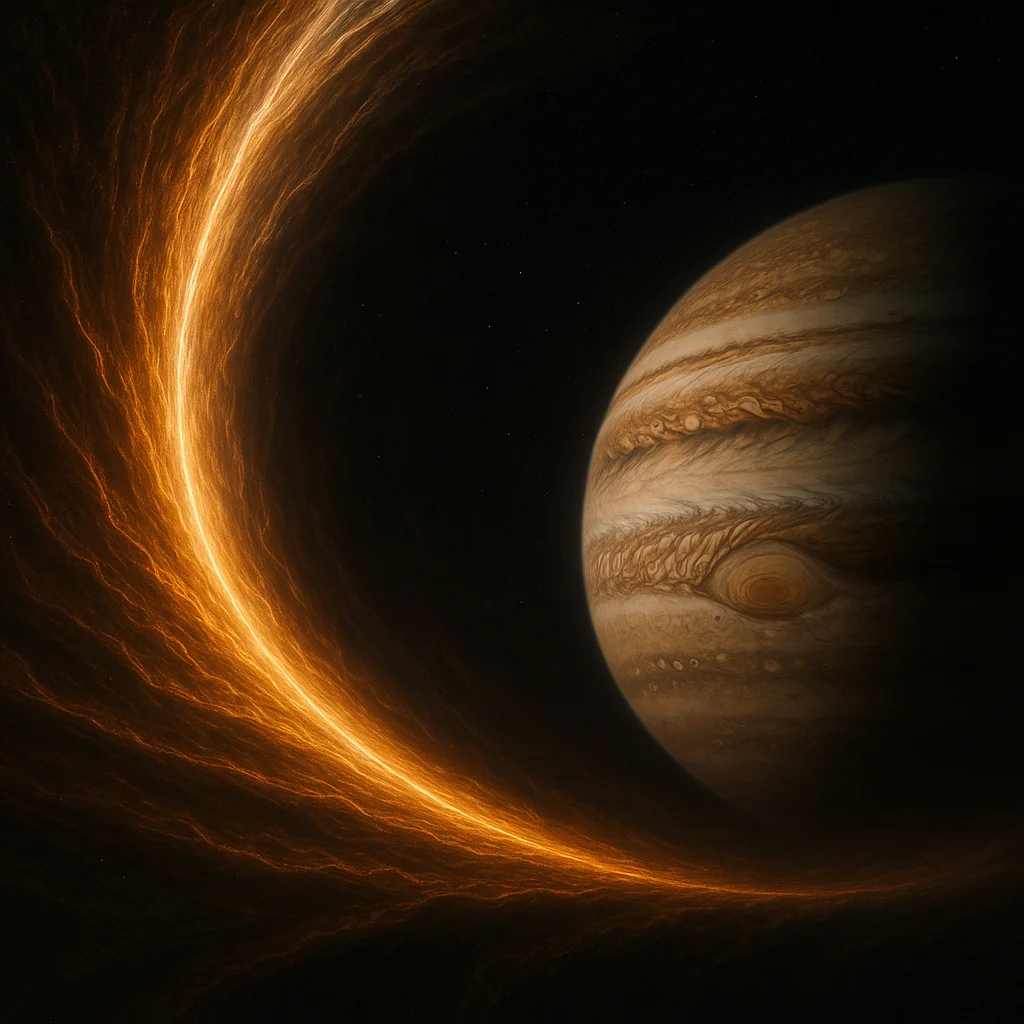
Visualization
For over a century, the quest to trace the origin of high-energy cosmic rays has remained a cornerstone in the study of astrophysical plasmas. Recent data from NASA’s Juno spacecraft, however, have delivered unprecedented observational insight, providing compelling evidence that Jupiter’s bow shock serves as a powerful natural accelerator, capable of propelling electrons to relativistic energies exceeding 1 MeV. This finding not only expands our understanding of the dynamics of planetary bow shocks but also forges an empirical link between solar system physics and the mechanisms that energize cosmic rays throughout the universe.
As Juno traversed Jupiter’s magnetospheric frontier on October 1, 2023, the spacecraft encountered the planet’s extensive bow shock—a collisionless shockwave formed as fast-moving solar wind impinges upon Jupiter’s formidable magnetic field. The interaction zone just upstream of this boundary, known as the foreshock, was long theorized to serve as a crucible for electron acceleration via electromagnetic interactions, rather than direct particle collisions, which are exceedingly rare in the dilute plasma of the outer solar system. While the concept of collisionless shocks as cosmic particle accelerators is entrenched in astrophysical theory, direct observation of the process had proved elusive—until now.
The nature of a collisionless shock can be framed by the Rankine–Hugoniot conditions, which describe the conservation of mass, momentum, and energy across the shock front when dissipation arises predominantly from collective electromagnetic effects rather than particle collisions. Here, the Jupiter foreshock revealed itself as an especially dynamic environment, with Juno’s multi-instrument suite delivering a 20-minute snapshot of remarkable turbulence and particle energization within a pronounced foreshock transient, a vast, bubble-like magnetoplasma anomaly.
Within this structure, onboard detectors registered electrons rapidly accelerated to kinetic energies on the order of 1 MeV (where kinetic energy, \( E_k = (\gamma - 1)m_e c^2 \), and Lorentz factor \( \gamma \gg 1 \)), evidence of particle velocities approaching the speed of light. These findings offer a compelling in situ confirmation of the “relativistic electron acceleration” process, a phenomenon previously observed only in the context of Earth’s foreshock but long surmised to operate at planetary scales throughout the cosmos.
Further significance is found in the research team’s proposal for a universal scaling law connecting the macroscopic properties of the foreshock transient—specifically, its spatial extent—to the maximal attainable particle energy, a principle reminiscent of the well-known Hillas criterion. The Hillas limit (\( E_{\text{max}} = \beta B R \)), where \( E_{\text{max}} \) is the maximum particle energy, \( \beta \) is the particle velocity as a fraction of the speed of light, \( B \) is the ambient magnetic field strength, and \( R \) is the characteristic size of the accelerator, provides an analytic framework for understanding constraints on energetic particle production in plasmas from planetary bow shocks to supernova remnants.
By applying this empirical scaling—anchored in Juno’s direct measurements—the research articulates a continuum in cosmic particle acceleration: MeV-scale electrons at planetary bow shocks, GeV energies in protostellar and supernova environments, and even upward to tens of TeV under the extreme conditions present in the remnants of massive stellar explosions. These results present a unifying view of non-thermal particle energization across astrophysical scales, furnishing a powerful method to constrain the maximum achievable energies of cosmic rays in disparate plasma environments.
The broader implications resonate beyond planetary science. Understanding the microphysics of shock-driven acceleration informs models of space weather—solar energetic particle events that impact satellites and power grids on Earth—while also elucidating fundamental pathways by which cosmic rays modulate planetary atmospheres and even catalyze prebiotic chemistry.
With the publication of these findings in Nature (Raptis et al., 2026), the newly established connection between Jupiter’s bow shock and the energetic frontiers of cosmic rays offers a vital empirical anchor for the next generation of astrophysical models. As planetary missions continue to push the boundaries of in situ plasma diagnostics, the solar system’s own giant-world laboratory may yet yield further answers about the universal processes energizing the cosmos.