Field: Technology
James Webb discovers a scorching lava planet with a “giant sunscreen”
Published | Technical Staff
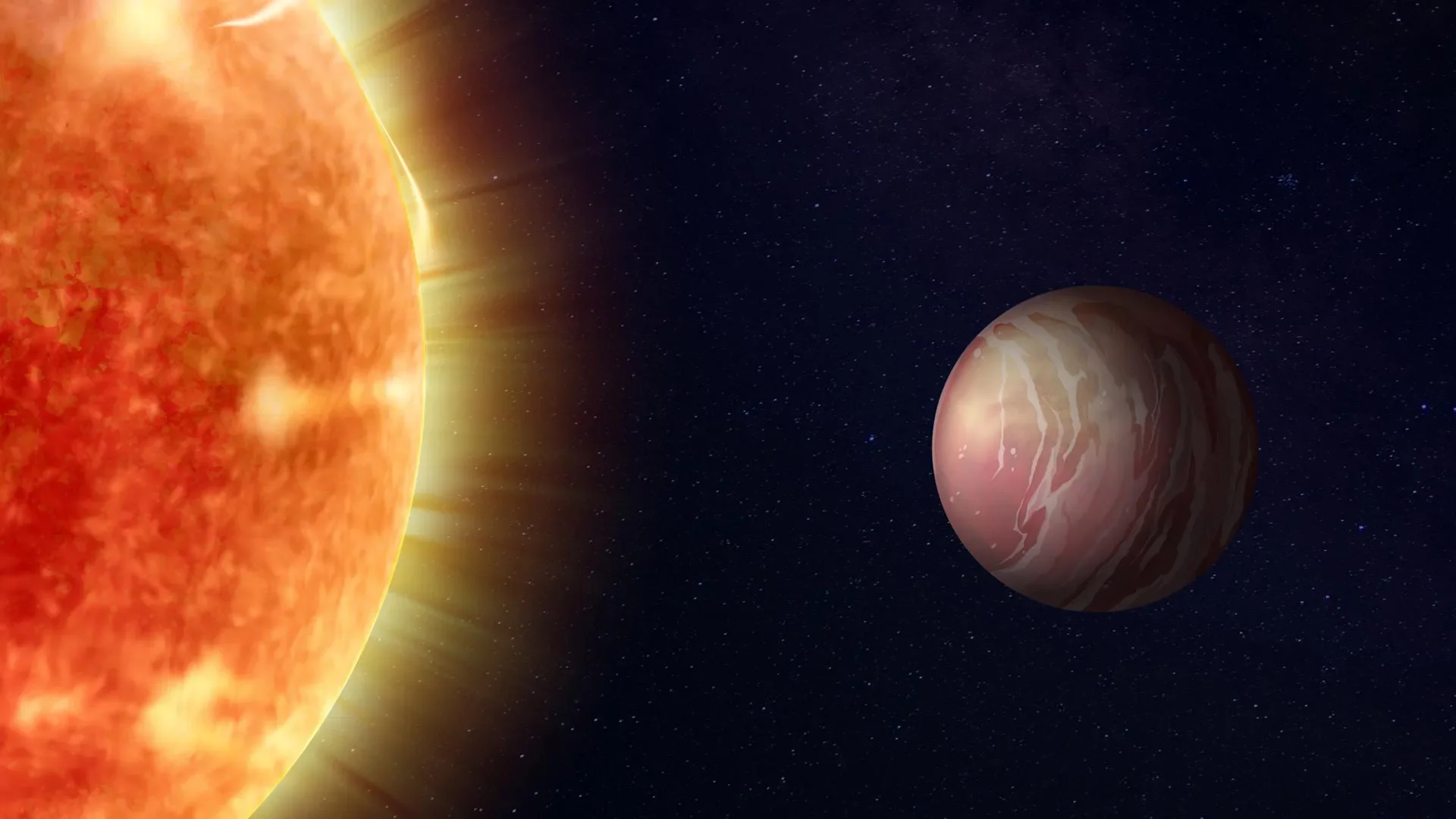
Visualization
Astronomers have recently unearthed astonishing revelations about a lava-enshrouded exoplanet, TOI-561 b, located a staggering 280 light-years from Earth. This planet, which thrives in an environment where one would expect atmospheric disintegration under relentless stellar bombardment, unveils a thick atmosphere that astounds researchers. From an expansive molten surface, TOI-561 b reflects an impressive 75% of the incoming starlight—hinting at the presence of reflective mineral clouds, acting as a cosmic sunscreen.
Utilizing the advanced capabilities of the James Webb Space Telescope (JWST), an international cohort of scientists led by Dr. Anjali Piette from the University of Birmingham executed detailed observations over a span of 37 hours, capturing nearly four complete orbits of TOI-561 b around its host star. The JWST's methodologies for analyzing exoplanets involve monitoring their brightness and thermal emissions through a technique called phase curves. This is crucial for understanding the energy dynamics in such extreme environments.
The data derived from these observations paints an unusual portrait of TOI-561 b, where a substantial atmosphere appears to exist despite its inhospitable environment. Currently hypothesized to be rich in carbon dioxide or sulfur dioxide, this atmosphere defies earlier models that posited the inevitable stripping of gases due to unrelenting stellar radiation. Instead, the implications suggest that TOI-561 b is not merely an atmospheric relic, but a dynamic system continually replenished by volcanic activity originating from a global ocean of molten rock beneath its surface. This geologic vigor might be akin to Jupiter’s moon Io, which is marked by persistent volcanic phenomena.
Deep within the thermal confines of TOI-561 b, researchers speculate about silicate clouds composed of silicon dioxide (SiO2) and magnesium silicate (MgSiO3). These clouds form above the churning magma ocean and are likely responsible for the planet's high reflectivity, which is remarkably comparable to that of Venus. This reflectivity contesting the notion that such rocky worlds should be scorched, raises pivotal questions about the mechanisms sustaining an atmosphere in such extreme conditions.
Overall temperature readings of TOI-561 b have been found to obviate the expected thermal outcomes for a rocky planet in close orbit to a relatively young star. The observable cooler temperatures, especially on its dayside when bathed in constant stellar radiation, indicate that a significant fraction of incoming energy does not warm the surface as predicted. Instead, it appears to be rerouted to the nightside or, through reflective clouds, vacated back into space entirely.
The implications of this research are manifold. As Dr. Piette articulates, the survival of a thick atmosphere on TOI-561 b opens a treasure trove of scientific inquiries regarding the atmospheric genesis and maintenance of planets so notoriously hostile. The dynamic interplay between atmospheric composition and geothermal activity presents an evolutionary puzzle: did TOI-561 b evolve from an abundant primordial gas reserve, or has it been a constant geological sphere emitting gases into the upper atmosphere?
In pursuit of clarifying these enigmas, future observations with the JWST are poised to explore longer wavelengths, yielding critical insights into the chemical makeup of TOI-561 b's atmosphere. This could elucidate whether the planet's atmospheric properties more closely mimic that of Venus—a thick, corrosive layer rich in carbon dioxide—or represent a more volcanic and dynamic analogue to Io.
As astronomers endeavor to deconstruct the complex atmospheric phenomena at play in TOI-561 b, the discovery not only challenges extant theories but also signals a deeper understanding of the various pathways that planetary atmospheres may take, even under conditions previously ruled out by conventional models. TOI-561 b, then, becomes not simply an object of observation but a beacon illuminating the diverse narratives spun by worlds residing beyond our solar neighborhood, paving the way for a richer narrative in the ever-expanding realm of exoplanet science.