Field: Technology
Interstellar Comet 3I/ATLAS Carries Methane with Record-Breaking Heavy Hydrogen
Published | Technical Staff
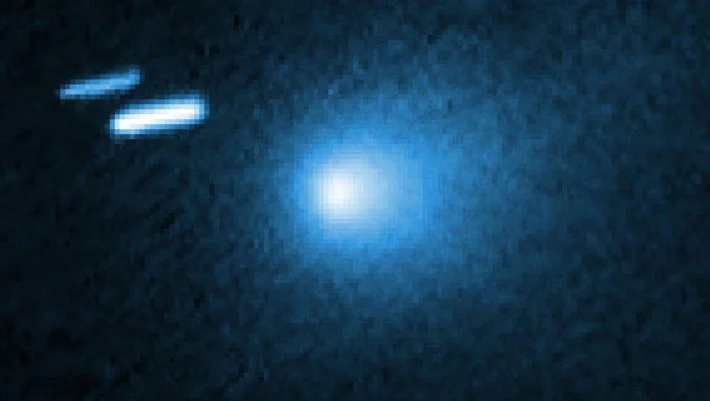
Visualization
The passage of interstellar comet 3I/ATLAS through our Solar System has yielded unprecedented insights into the primordial conditions of distant stellar environments. Utilizing the capabilities of the NASA/ESA/CSA James Webb Space Telescope, astronomers have unveiled the most deuterium-rich methane ever recorded within our solar enclave, raising intriguing questions about the evolution of ices and organic compounds in extraterrestrial contexts.
3I/ATLAS, discovered recently traversing a hyperbolic trajectory, has become a focal point for planetary scientists eager to glean the biochemical signatures left behind by objects originating from beyond our solar system. With a heliocentric velocity indicative of its interstellar roots, it is thought that 3I/ATLAS formed in a low-metallicity environment over three billion years ago. Dr. Nathan Roth of NASA’s Goddard Space Flight Center, alongside a team of researchers, indicates that the comet's origins may align more closely with those of stars residing in the Galactic halo than within the Solar System’s dense stellar disk. However, distinguishing between a thick and thin disk origin remains a challenge.
Through high-precision observations of 3I/ATLAS' coma, Roth and colleagues utilized Webb’s Near Infrared Spectrograph (NIRSpec) on December 22 and 23, 2025, while the comet was situated approximately 2.4 astronomical units (AU) from the Sun. In addition to the detection of methane, the team identified several other organic compounds, including methanol, ethane, and formaldehyde, as well as essential volatiles like water (H2O) and carbon monoxide (CO). Notably, carbon monoxide emerged as the most abundant species, with a production rate approximately 3.6 times greater than that of water, delineating the complex compositional landscape of the cometary coma.
The focal point of this research lies in the deuterium-to-hydrogen (D/H) ratio calculated for the methane present. This ratio was found to be approximately 3.33%, an extraordinary figure that surpasses methane measurements recorded in the only other comet where deuterated methane has been confirmed, 67P/Churyumov-Gerasimenko, by a factor of fourteen. Furthermore, this measurement is 1.4 times greater than any previously documented D/H ratios for organic molecules detected within our solar vicinity, standing as a significant marker of the distinctive chemical processes at play in the formation of 3I/ATLAS.
This D/H ratio resembles values derived from theoretical conjectures regarding deuteration processes in interstellar regions. The natural abundance of deuterium, a heavier isotope of hydrogen, serves as a potent indicator of chemical conditions during molecular formation. To contextualize these findings, researchers drew upon deuteration trends in cyclopropenylidene — a hydrocarbon that acts as a proxy for understanding deuterated compounds in star-forming regions.
While direct measurements of methane D/H outside of the Solar System are sparse, existing models suggest that in specific cold cores and star-forming regions, methane D/H ratios could ascend to between 4% and 7%, rendering the observed 3I/ATLAS value plausible. However, the scientific endeavor continues, as elucidating whether current theoretical models regarding star formation or disk chemistry can account for the observed ratios remains an ongoing necessity, with the hope that future chemical models will provide deeper clarity.
Amid these findings, tantalizing evidence hints that the ratios observed in protostellar and interstellar environments may indeed be consistent with the exceptional D/H value of 3I/ATLAS. The implications of this research, published on October 23 in Nature Astronomy, extend far beyond mere cometary studies, proposing a reflection on the cosmic heritage of material that ultimately coalesces into the planets we inhabit.
In the grand exploration of our cosmos, 3I/ATLAS stands not merely as a fleeting visitor but as a messenger from distant realms, carrying within its icy envelope secrets that may unravel across the tapestry of time and space the fundamental processes governing the birth and evolution of organic materials throughout the universe.