Field: Technology
Inside this quantum computer, memory vibrates like a guitar string
Published | Technical Staff
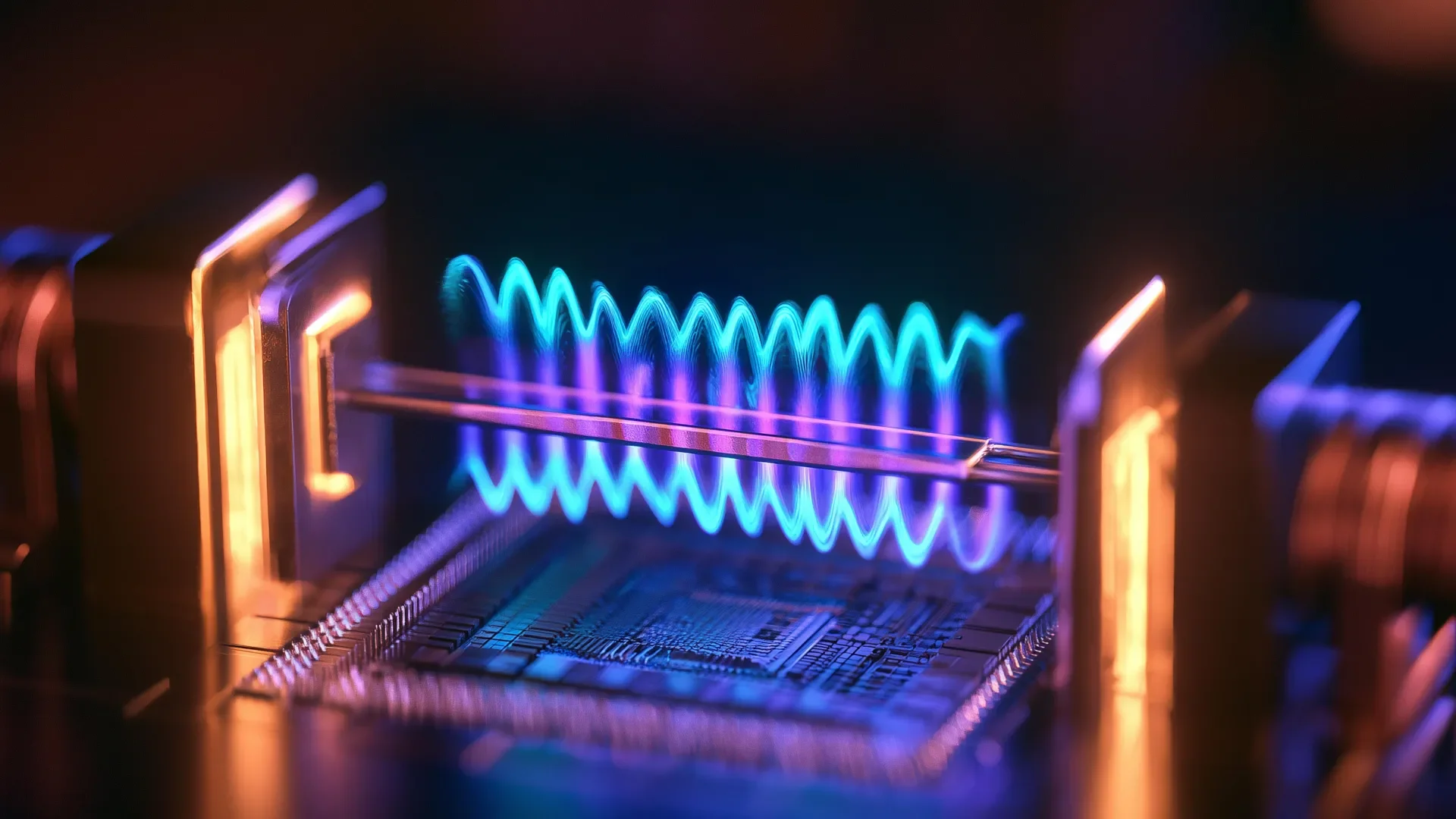
Visualization
At the intersection of quantum mechanics and practical computing, a pioneering breakthrough at ETH Zurich illuminates the potential of a novel quantum computer architecture that encapsulates information in microscopic mechanical vibrations akin to those elicited by guitar strings. Spearheaded by physicist Yiwen Chu, this innovative approach heralds a new paradigm—a machine equipped to perform complex calculations at unprecedented scales may soon emerge from the shadows of theoretical exploration into functional applicability.
Central to this development is a departure from traditional quantum computing paradigms, wherein quantum information is typically stored electromagnetically. This nascent system leverages mechanical resonators—microscopic structures that vibrate at frequencies beyond human hearing—to maintain quantum states, thereby providing a novel means of quantifying and manipulating information. The introduction of this vibrational memory aligns closely with the fundamental principles of quantum mechanics, such as superposition and entanglement, optimizing the operation of quantum processors while overcoming the vexing challenge of information retention.
In conventional design, the roles of processing and memory are closely intertwined; however, Chu's architecture delineates these functions, allowing for enhanced efficiency. The superconducting qubit serves as the nucleus of computation, functioning like the central processing unit (CPU) in classical architectures, while the distinct quantum memory operates as a flexible reservoir of information. This arrangement not only stabilizes computational tasks but also significantly diminishes the spatial demands of quantum machines by channeling data through compact mechanical resonators.
The principles of harmonic oscillation govern the interaction between the superconducting qubit and its associated vibrational states. Each mechanical resonator can inhabit various vibratory modes, effectively enabling the system to store multiple bits of quantum information simultaneously. This multifaceted approach to data storage is especially compelling, as it flouts the spatial limitations inherent in electromagnetic memory systems that may stymie the evolution of quantum computing infrastructure.
One of the paramount challenges in the realm of quantum computing is the preservation of delicate quantum states. Quantum coherence can easily be disrupted, leading to information loss and computational inaccuracies. Therefore, the efficacy of this vibrating memory architecture lies in its ability to enhance temporal stability. By prolonging the duration over which quantum states remain coherent, the newfound methodology alleviates the pressing concerns surrounding multiphase calculations that require sustained access to stored data.
Recent experiments documented in the journal Science illuminate the operational capabilities of this extraordinary system. The researchers conducted tests deploying two quintessential computational techniques: quantum Fourier transform and period finding. These algorithms serve as bedrocks for a multitude of tasks within quantum computing environments, necessitating a meticulous orchestration of quantum states. Chu's system exhibited not only the potential to perform these operations efficiently, but also the capacity to maintain coherence among multiple states, an essential attribute for meaningful quantum computation.
The implications of this advancement transcend the mere establishment of a storage medium; rather, it positions the architecture as a viable conduit for executing all fundamental operations requisite for arbitrary quantum computations. This versatility is pivotal, as the quest for a programmable, general-purpose quantum computer remains ongoing. While the present form of this experimentation represents a heralded milestone, the transition towards scalable systems capable of harnessing and expanding upon this innovative quantum memory remains on the horizon.
As Chu and her team continue their inquiries, they confront the formidable task of integrating additional components and refining computational complexity while preserving the precision verified in experimental settings. The prospect of practical quantum computers—those with sufficient power for extensive scientific and industrial applications—remains tantalizingly close yet still necessitates considerable technical advancements.
In summary, the resonance of vibrations within this quantum computing framework echoes a future where quantum machines become increasingly compact, powerful, and adept at preserving information. The investigation at ETH Zurich stands as a testament to the boundless possibilities revealed when fundamental principles of physics are harnessed in novel, interdisciplinary applications. Whether this transformative architecture paves the way for widespread quantum computing remains to be seen, yet its potential to reshape computational capacities is undeniably profound.