Field: Technology
IceCube detects ghost particles with 10 billion times the energy of solar neutrinos
Published | Technical Staff
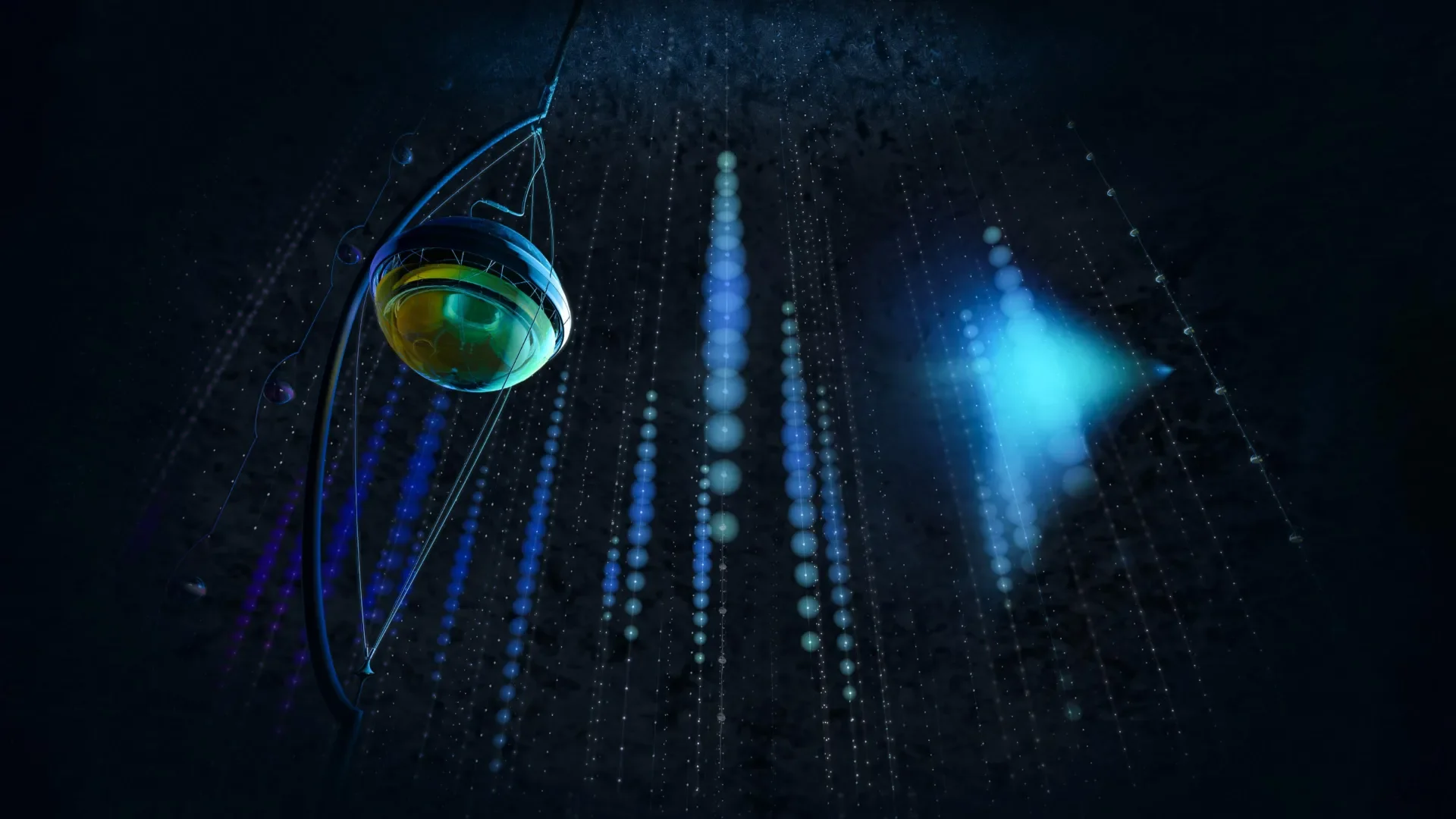
Visualization
In the frigid expanse of Antarctica, an intricate array of sensors embedded within an ice sheet approximately one cubic kilometer in volume stands as a sentinel, probing the cosmos for elusive particles known as neutrinos. These nearly massless entities are generated in the most extreme and energetic events in the universe, embodying mysteries that could illuminate fundamental processes from the Big Bang to the formation of black holes. The IceCube Neutrino Observatory, which operates beneath the polar ice, has recently garnered attention by detecting neutrinos with energy magnitudes ten billion times greater than those emitted by the Sun, casting a spotlight on their cosmic origins.
Neutrinos, often dubbed “ghost particles,” interact so weakly with matter that they can traverse entire planetary bodies, including Earth, without disruption. This ability gives rise to their unique status in particle physics; they are one of the least understood entities in the Standard Model. A typical neutrino has a mass projected to be roughly 10 million times lighter than an electron, yet their mass remains one of the biggest unresolved questions in physics today. Their interactions, governed by the weak nuclear force, challenge even the most sophisticated experimental designs, leading physicists like Francis Halzen—who recently received a Nobel Prize for his work in this domain—to push technological boundaries for their detection.
The hunt for neutrinos commenced with Wolfgang Pauli's theoretical postulations in the 1930s, theorizing the existence of a mysterious particle to account for missing energy in beta decay. It would take over two decades before neutrinos could be empirically observed, with Clyde Cowan and Frederick Reines achieving this feat through their Project Poltergeist in 1956. This milestone confirmed the existence of neutrinos, yet the challenge of monitoring them remained formidable.
Halzen’s vision drove the establishment of the IceCube observatory in the late 1990s, capitalizing on the unique properties of Antarctic ice. Clear and relatively free from bubble contamination, the ice provides an unparalleled medium for monitoring the faint bursts of Cherenkov radiation—faint blue light emitted when neutrinos collide with matter, generating secondary charged particles such as electrons or muons. Researchers drilled into the ice to deploy strings of photomultiplier tubes, adept at capturing these fleeting flashes of light that serve as indicators of neutrino interactions.
The most remarkable achievements of IceCube lie in its ability to detect high-energy neutrinos whose origins defy conventional cosmic phenomena. Estimates suggest that for every square centimeter of the Earth's surface, approximately 100 billion neutrinos pass through each second, primarily originating from the Sun or other stellar processes. However, IceCube’s heavy hitters arrive from deep space phenomena capable of producing neutrinos of astonishing energy—events that occur far beyond the reach of optical telescopes.
The detection of ultra-high-energy neutrinos, with energies up to 10 billion times that of solar neutrinos, has prompted significant theoretical discourse. These exceptional particles might originate from processes involving cosmic rays or from the environments surrounding supernovae or active galactic nuclei—phenomena whose very mechanisms remain poorly understood. For instance, one of the most extreme neutrinos recorded by IceCube has an energy magnitude 200 times higher than typical solar neutrinos, framing questions that push the boundaries of our current understanding of physics.
George Fuller, a Distinguished Professor at the University of California, San Diego, encapsulates the intrigue surrounding these high-energy neutrinos. “The fact that it got here at all,” he mused, “may be saying something profound about the universe.” This assertion raises pivotal inquiries not only about the sources of these particles but also about the fundamental laws governing their propagation.
As IceCube continues to refine its methodologies and unravel the stories told by these ghostly particles, the scientific community anticipates that the insights gleaned may eventually lead to a deeper understanding of the cosmos and reveal new physics. In a universe replete with enigmas, the perseverance to understand and capture the slightest flicker of neutrino interactions stands as a testament to humanity's quest for knowledge about the intricate and often perplexing tapestry of existence.