Field: Technology
Hubble reveals a stunning twist in how the universe emerged from darkness
Published | Technical Staff
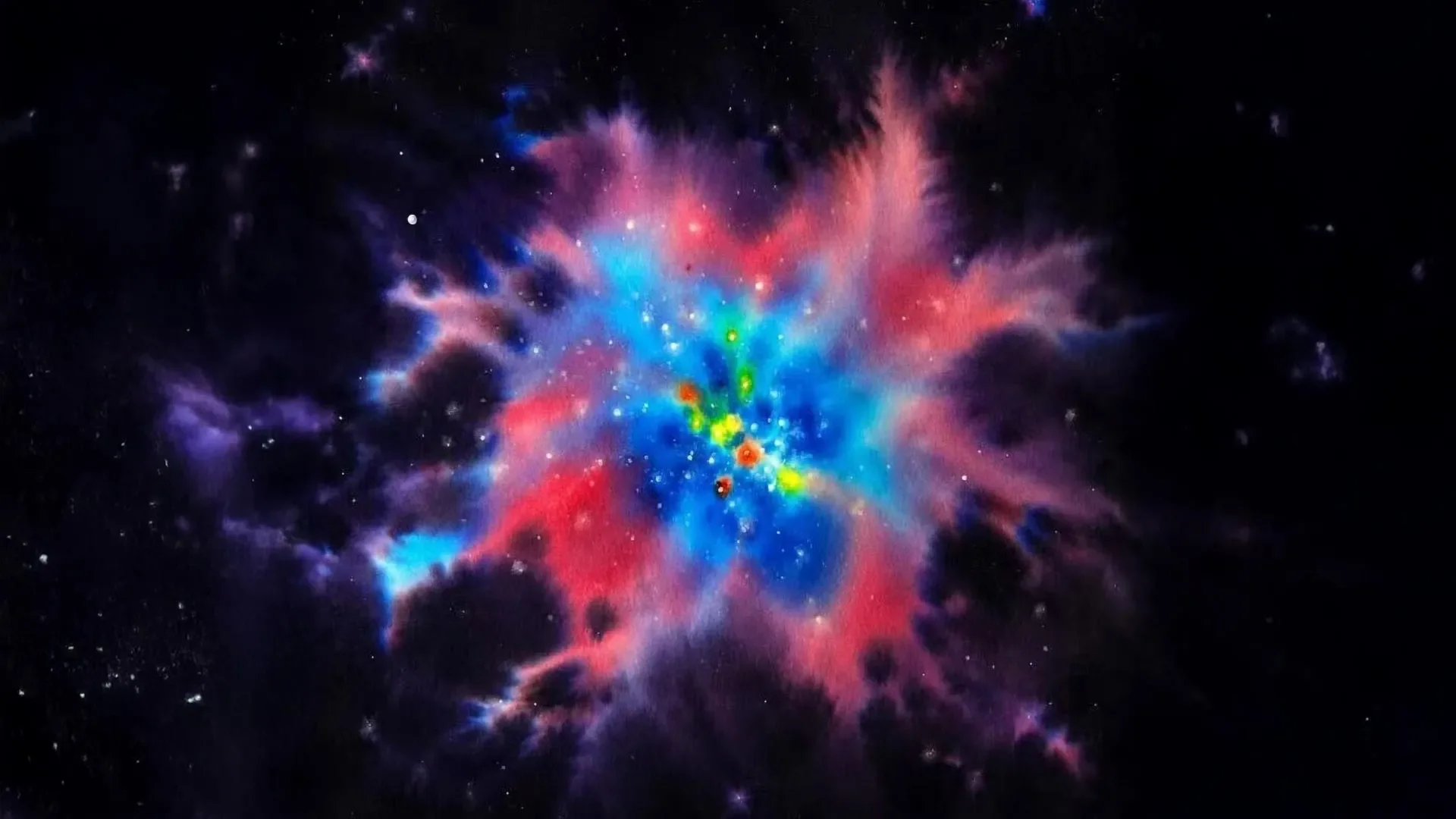
Visualization
A recent breakthrough by astronomers utilizing NASA's Hubble Space Telescope has overturned long-held beliefs regarding the interplay of radiation and the early universe, which was once engulfed in a dense veil of hydrogen approximately 13 billion years ago. Traditionally, scientists maintained that the explosive winds from dying stars—specifically supernovae—were pivotal in fostering radiation's escape from early galaxies, thereby lifting the cosmic fog. However, compelling new evidence emerges to suggest that these very winds may act as impediments against such radiation, challenging our fundamental understanding of cosmic evolution.
This research, conducted by an international team of astronomers from esteemed institutions including the University of Michigan and published in *Nature Astronomy*, delves deep into the epoch known as reionization. This pivotal period marks the transformation of neutral hydrogen—an omnipresent gas trapping ultraviolet radiation—into ionized hydrogen, thereby creating a universe increasingly transparent to ultraviolet light. The exact mechanisms behind the reionization phenomenon and the sources of radiation responsible for this shift have long eluded clarity, leaving significant gaps in our comprehension of cosmic history.
The prevailing interpretation surrounding reionization posited supernova explosions as agents of change, propelling winds that ostensibly served to clear the gas obscuring nascent star formations. These galactic winds were thought to facilitate passageways for ultraviolet photons to traverse the cloudy intergalactic medium, thus contributing to the ionization process. The research team, led by Cody Carr, unearthed findings that put this hypothesis in a stark new light.
Utilizing Hubble's capabilities, the researchers assessed the spectra obtained from nearby starburst galaxies, which are currently undergoing intense star formation akin to conditions thought to be present during reionization. Through spectral analysis, scientists could pinpoint how the gas dynamics—a delicate dance of warmth and pressure—functioned around massive stars. In their evaluation, they discovered a counterintuitive correlation: galaxies that demonstrated robust galactic winds exhibited a marked decrease in the escape of ionizing radiation.
The mechanics behind this phenomenon are rather intricate. The study elucidates that supernova-driven winds, rather than imparting freedom for ultraviolet radiation, generated turbulence that increased the density and coverage of neutral hydrogen and dust—factors known to absorb and scatter ionizing photons. Carr articulated, "Essentially, the processes by which galaxies were expected to leak ionizing radiation is not what we had assumed." The results indicated that instead of clearing the gas effectively, supernova energies complicated the surrounding environment, increasing rather than alleviating the impediments to ionizing radiation.
Intriguingly, while explosive winds hinder radiation escape, the research implies that radiation could escape through alternative pathways during the early lifecycle of these massive stars—prior to their transition into explosive supernovae. The escape mechanisms might be linked to smaller winds or fluctuations in stellar activity that set the stage for conditions favorable for ultraviolet photon release.
This study calls for a considerable shift in how astrophysicists approach the process of cosmic reionization. With co-author Stephan McCandliss elucidating the atmospheric impact of supernovae, he noted, "The energy input has fundamentally modified the distribution of neutral gas and dust,” indicating a need for a paradigm shift. "The focus may need to shift from the consequences of supernovae to the earlier stages of star formation, as young stars may be providing necessary pathways for radiation."
The ramifications of this discovery extend into the realm of computational modeling and simulations, which aim to recreate the evolution of galaxies, the dynamics of gas within them, and the resultant effects on the ionization of hydrogen. Modifications in our understanding of how radiation escapes from the galactic confines could necessitate a thorough reevaluation of existing models, ultimately enhancing their predictive accuracy regarding cosmic history.
Astronomers are already advocating for additional observation time with Hubble to explore a broader array of galaxies, aiming to ascertain whether the observed patterns hold beyond the studied samples. As our investigative forays probe deeper into the elusive processes of the early universe, one can only anticipate further revelations that may sculpt our comprehension of how one of the most critical phases in cosmic history unfolded from the shrouded depths of darkness into the brilliant luminosity we perceive today.