Field: Technology
Hubble Peers into Messier 30 to Uncover Milky Way’s Past
Published | Technical Staff
Visualization
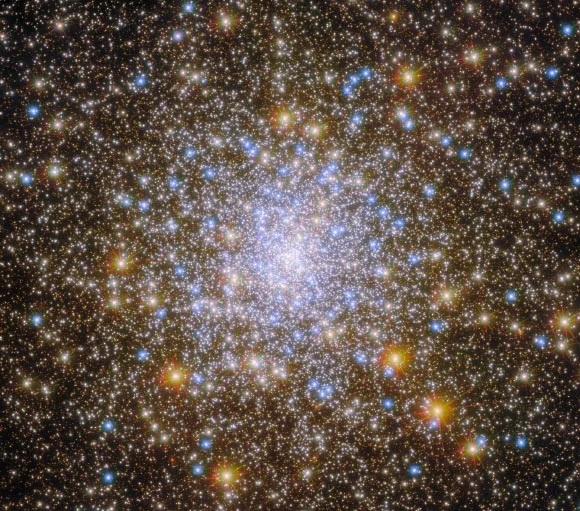
The globular cluster known as Messier 30, or M30, situated approximately 27,500 light-years from Earth in the southern constellation of Capricornus, serves as a pivotal subject for astronomers deciphering the enigmatic history of the Milky Way Galaxy. Observations made by the NASA/ESA Hubble Space Telescope have provided unprecedented insights into the formation and evolution of some of the oldest stellar populations within our galaxy, and intriguingly, raise the possibility that certain stars within this cluster may have origins extending beyond the confines of the Milky Way.
Discovered by the French astronomer Charles Messier on August 3, 1764, M30—also cataloged as NGC 7099 and colloquially known as the Jellyfish Cluster—represents a compelling aspect of our cosmic heritage. The dense congregation of stars, approximately 100,000 in total, is a relic from the early universe, composed primarily of Population II stars characterized by low metallicity. This low metallicity is integral, as it indicates that these stars formed during an era when the universe was still replete with primordial hydrogen and helium, providing a snapshot of the Milky Way's formative years.
Globular clusters like M30 are akin to cosmic time capsules. They preserve the original chemical makeup of the Milky Way, allowing researchers to glean insights into its development. By utilizing Hubble's multi-wavelength capabilities—spanning ultraviolet, visible, and near-infrared light—astronomers are equipped to unpack the complexities of stellar evolution within these ancient clusters. Each wavelength of light probes different aspects of stellar populations, unveiling details that would remain hidden in a more limited observational spectrum.
The implications of Hubble's findings extend far beyond mere celestial archeology. A statement from Hubble astronomers emphasized that while the precise origins of globular clusters like M30 are not fully understood, the peculiar orbits of some of these clusters present a tantalizing hypothesis. Many of them orbit in a direction contrary to the Milky Way's own rotation, suggesting an external genesis. This peculiar dynamical behavior implies that these ancient clusters may have been captured by the Milky Way's gravitational influence during its tumultuous early history.
Historically significant contributions, such as those from astronomer Harlow Shapley in the early 20th century, have illuminated the locations and distances of numerous globular clusters, revealing the structure of our galaxy and confirming that the Sun is not located at its center. Instead, Shapley’s work positioned the Galactic center toward the constellation Sagittarius, altering our understanding of the spatial dynamics of our cosmic neighborhood.
As research into clusters like M30 advances, it becomes increasingly essential for astrophysics to reconcile the observational data with theoretical models of galaxy formation and evolution. The multifaceted astrophysical processes that led to the formation of globular clusters—including stellar nucleosynthesis, supernova mechanics, and dynamical interactions within the early galaxy—must be integrated into a coherent framework that accounts for the ongoing discoveries made by telescopes like Hubble.
Ultimately, the exploration of Messier 30 and its stellar inhabitants reveals not just the potential for understanding our own galaxy’s past but also poses broader questions regarding the nature of galaxy interactions. If these globular clusters were indeed external to the Milky Way prior to their capture, what does this mean for the dynamics of galaxy formation as a whole? The journey into the depths of the universe’s history is far from over, but with each observation, instruments like the Hubble Space Telescope draw us closer to unveiling the rich tapestry of cosmic evolution that binds the foundations of our Milky Way to the vast intergalactic expanse.