Field: Technology
Hubble Illuminates the Primordial Secrets of Ancient Globular Cluster NGC 6426
Published | Technical Staff
Visualization
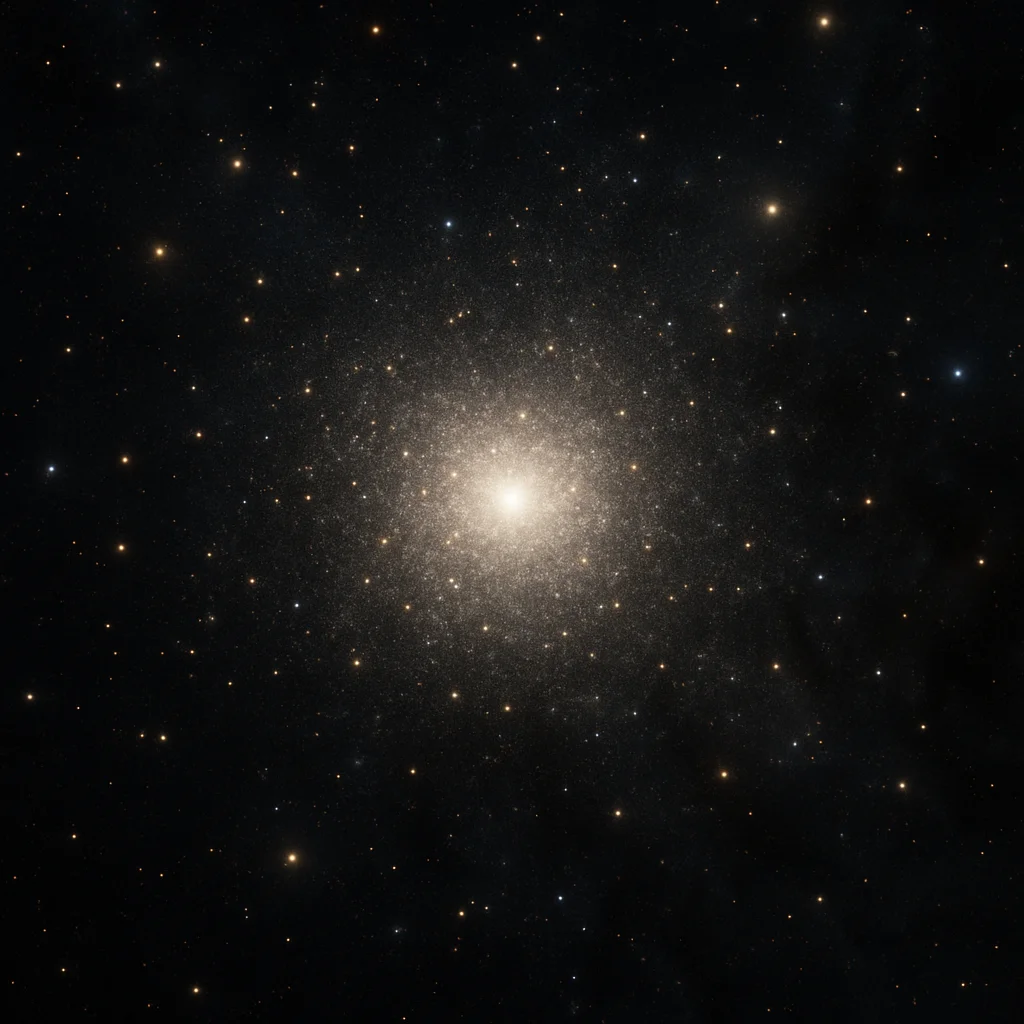
When NASA's Hubble Space Telescope peered deep into the constellation of Ophiuchus, it unveiled a relic from the cosmos’ dawn—a densely packed globular cluster known as NGC 6426, suspended in the galactic halo, roughly 67,000 light-years from Earth. This stellar congregation, catalogued originally in 1786 by William Herschel and also referred to as C 1742+031 or GCl 76, possesses extraordinary significance: its estimated age of approximately 13 billion years renders it nearly coeval with the Milky Way itself, and only a few hundred million years younger than the Universe’s own nascent spark, currently dated at 13.8 billion years by Planck satellite data.
Globular clusters like NGC 6426 have long been considered archetypes of simple stellar populations—collections born from a single, rapid collapse of a primordial gas cloud, with member stars typically exhibiting homogeneous chemistry and ages. However, the tapestry woven by precision Hubble imaging and high-resolution spectroscopy has begun to unravel this narrative. Specifically, NGC 6426 manifests evidence for at least two distinct stellar generations, as discerned through subtle variations in chemical abundances detected spectroscopically: a revelation that places new constraints on cluster formation models and points to more complex, multi-epoch assembly histories.
The Hubble image of NGC 6426, constructed from observations across multiple optical and near-infrared filters, elegantly visualizes temperature and compositional diversity among its stars. Stellar color, tied directly to blackbody radiation laws where peak wavelength λ_max ≈ 2.898 × 10^6 nm·K / T (Wien's displacement law), provides an instant census: blue-hued stars in the image represent higher surface temperatures, whereas redder members correspond to cooler profiles. These chromatic gradations also reflect underlying mass distributions and evolutionary stages, as higher-mass, hotter stars exhaust their fuel more rapidly.
Integral to unraveling the cluster’s cosmic history is its notably low metallicity—a property encapsulated by the [Fe/H] ratio, where metallicity log (Fe/H)_star – log (Fe/H)_Sun < –1 for most globulars, signifying that heavy elements (atomic number Z > 2) are present in trace amounts relative to hydrogen and helium. NGC 6426’s stars, occupying this metallicity regime, are thus direct witnesses to an epoch shortly after Population III stars began fusing hydrogen and seeding the interstellar medium with traces of carbon, oxygen, and other elements. In essence, NGC 6426 serves as a fossilized laboratory for the chemistry and nucleosynthetic processes extant shortly after the Big Bang—a time when baryonic matter still bore the imprint of primordial nucleosynthesis.
NGC 6426’s orbital trajectory carries it well beyond the Milky Way’s thin stellar disk and deep into the galactic halo, an extended spheroidal component characterized by its sparse population, high velocity dispersions, and prevalence of ancient objects. Its presence there, far from the dynamic perturbations of the inner galaxy, may have allowed it to retain its signature chemistry and structure across cosmic epochs.
Ultimately, the Hubble observations of NGC 6426 do more than simply offer a breathtaking snapshot of a distant cluster. They probe the conditions of a Universe still in chemical adolescence, when the periodic table beyond helium was only beginning to fill. As the boundary between observational astronomy and cosmochemical archaeology, clusters like NGC 6426 remain vital clues in the quest to reconstruct the formation, evolution, and enrichment pathways that forged the complexity seen in today’s cosmos. The continued study of such objects by Hubble and its successors promises to further illuminate the earliest chapters of our galaxy’s—and the Universe’s—story.