Field: Technology
Hubble and Webb Telescopes Zoom in on Cat’s Head Nebula
Published | Technical Staff
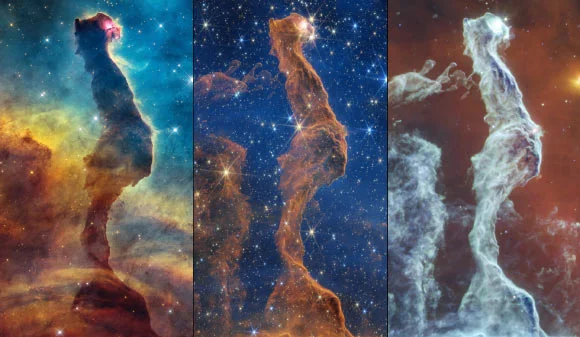
Visualization
In a remarkable endeavor, the NASA/ESA Hubble Space Telescope and the James Webb Space Telescope have combined their observational prowess to scrutinize an intricate structure within the cosmos known colloquially as the Cat’s Head Nebula. This nebula, an ethereal mass of gas and dust, is characterized by its enigmatic glowing red 'eye,' thought to house a young star still enshrouded in the remnants of its natal cocoon. Nestled approximately 7,500 light-years away in the Carina constellation, the Cat’s Head Nebula exemplifies the ephemeral yet rich nature of stellar formation regions.
The Hubble Space Telescope’s capabilities shine through in its rendering of the nebula's striking visible-light image, revealing a dense, dark brown pillar of dust. This visual representation provides a traditional view that complements the deeper insights afforded by Webb's advanced infrared imaging. The glowing red core, which stands in stark relief against the dark surroundings, most likely signals the presence of a nascent star—its luminosity dimmed partially by the thick veil of material still encasing it. Meanwhile, Webb's near-infrared camera (NIRCam) and mid-infrared instrument (MIRI) offer a more nuanced perspective on the nebula, uncovering distinct features not visible in Hubble's output.
The illuminating observations extracted from these two iconic telescopes showcase a striking evolution within the Cat’s Head Nebula. As interpreted by researchers, the unique feline silhouette is a testament to the sculpting forces at play; intense ultraviolet radiation and stellar winds from the surrounding massive stars in the Carina Nebula have shaped this celestial formation over millennia. The feedback from these energetic stars not only etches the nebula's outline but also initiates a process of photoevaporation, wherein the intense ultraviolet radiation ionizes and disperses surrounding gases.
A vivid interplay of colors in the images reveals an intricate dance between illumination and shadow; above the pillar, diffuse materials emit ethereal blue and cyan hues, transitioning through a spectrum of warm yellows, oranges, and reds below. These colors are indicative of ionized gases, a direct result of interaction with the intense radiation enveloping the star formation zone. The bright rim observed along the right flank of the filament underscores the differential response of various densities of gas and dust—denser regions withstand the erosive forces more robustly than their less substantial counterparts.
Importantly, Webb's infrared observations enhance our comprehension of the nebula's structure. As the filament becomes increasingly transparent in the infrared spectrum, Webb reveals its complex surface features that Hubble's visible-light contributions could not delineate. To the left of the nebulous ‘cat,’ subtle wisps of dust and gas linger, intricate structures shaped and exposed by the radiation from nearby stars—a ghostly attestation to the dynamic environment fostering star formation.
As astronomical investigators deliberated on these findings, a profound acknowledgment emerged: the Cat’s Head Nebula, while transient, encapsulates a wealth of information imperative to decoding the ongoing processes in stellar nurseries. The detailed interplay of ultraviolet radiation, gas dynamics, and stellar evolution converges in this singular observation, inviting both curiosity and further investigation. As these stellar landscapes continually evolve and disperse, they retain their role as cosmic laboratories—not just for processes of stellar origin, but as reflective windows into the very workings of the universe itself. Each pixel captured by Hubble and Webb unveils yet another layer of the intricate tapestry that defines cosmic evolution, offering insights best appreciated through the lens of both time and advanced technological prowess.