Field: Technology
How Octopuses Squeeze Through Holes Smaller Than Their Body
Published | Technical Staff
Visualization
Within the undiscovered depths of marine biology, the octopus stands as an extraordinary exemplar of evolutionary ingenuity, particularly regarding its ability to traverse environments through surprisingly constricted apertures. Recent research by a collaborative team from the National University of Singapore, the University of Naples Federico II, and Austria’s Haus des Meeres aquarium has elucidated this remarkable capability, unveiling a distinctive series of maneuvers that not only reflect the agility of these cephalopods but also harbor potential applications for the design of advanced soft robotics.
Octopuses, particularly the common octopus (Octopus vulgaris), have demonstrated an uncanny ability to contort their shape, rendering them capable of fluid traversal much like liquid passing through narrowed spaces. Dr. Wenci Xin, an influential figure in this study, articulates that “Their size does not always determine where they can go.” This assertion captures a fundamental principle of octopod locomotion—the ability to manipulate their gelatinous bodies through openings that seem unfathomably restrictive in relation to their bulbous mantles.
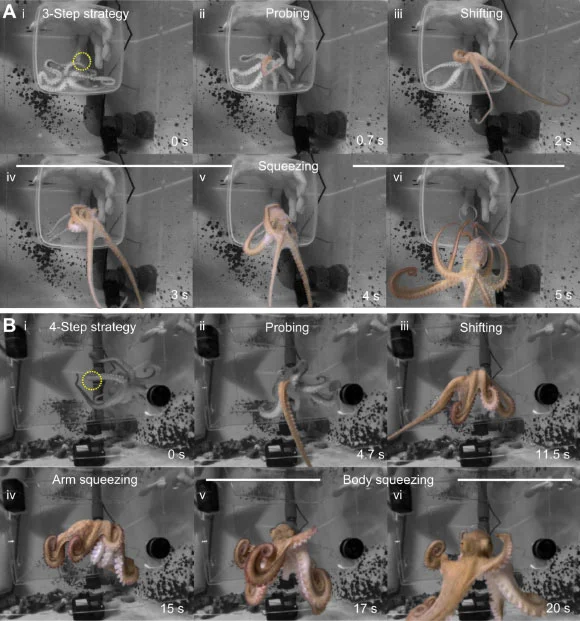
The investigative approach employed involved a series of meticulously arranged trials in which these remarkable creatures were filmed navigating a clear acrylic partition punctuated with holes of various sizes. Such structural transparency allowed researchers to observe the octopus’ methodical escape tactics. Through careful analysis of thirty individual trials, a clear pattern emerged in the octopuses’ behavior, revealing that they predominantly employed either a three-step or four-step strategy depending on the size of the opening encountered.
In scenarios where the hole exceeded the distance between an octopus’s ocular appendages, the three-step maneuver emerged as the preferred methodology. This sequence initiated with the first arm probing through the aperture, subsequently followed by three to five auxiliary limbs. The climax of this action occurred as the octopus efficiently pulled its entire body through in a single motion. Contrarily, when faced with a smaller opening, octopuses resorted to the four-step approach. This involved a methodical transition whereby they moved their legs first, subsequently navigating their head and mantle through the restrictive gap.
The statistically significant link between hole size and the chosen maneuver underscores the adaptability of octopuses in optimizing their methods of locomotion. Of the analyzed trials, the three-step strategy was successful in 14 instances associated with larger holes, while the four-step strategy was employed 15 times, exclusively in situations involving smaller openings. Notably, the trials indicated a preference for utilizing specific arms; predominance was seen in the use of the first two arms on the left, likely influenced by the tank setup where that side afforded a clearer vista of the immediate environment.
Interestingly, the study also incorporated tests involving juvenile Maya octopuses (Octopus maya), who initially demonstrated hesitation in approaching the smallest opening. In subsequent trials, though, two successfully traversed a larger hole using the established three-step approach. This development signifies a potential lack of accurate judgment regarding the feasibility of passage through apertures, indicating a scope for behavioral learning in these cephalopods.
The significance of these findings extends far beyond the whimsical display of octopus agility. The researchers propose that insights gleaned from octopus locomotion can inform the engineering of soft robots meant for navigating convoluted and constricted environments—ranging from urban search and rescue operations to intricate rescue missions within collapsed and hazardous structures. Dr. Xin underscores a fundamental limitation in current robotics, “All existing search-and-rescue and exploration robots possess slender, snake-like forms, optimized for narrow gaps, which constrains the number of sensors and manipulators that can be integrated.” By emulating the octopus’s methodical approach—organizing simple movements under a coordination that allows for adaptive limb control—engineers may be able to craft more efficient and versatile autonomous systems.
The implications of this research, as published in the Journal of Experimental Biology, suggest a frontier where biological principles structure future innovations in robotics. As humans look to mimic the fluidity and adaptability of nature, understanding the intricate behaviors underlying cephalopod movement not only enriches our biological knowledge but also propels the quest for advanced robotics that can thrive in today’s complex environments.
Octopuses, particularly the common octopus (Octopus vulgaris), have demonstrated an uncanny ability to contort their shape, rendering them capable of fluid traversal much like liquid passing through narrowed spaces. Dr. Wenci Xin, an influential figure in this study, articulates that “Their size does not always determine where they can go.” This assertion captures a fundamental principle of octopod locomotion—the ability to manipulate their gelatinous bodies through openings that seem unfathomably restrictive in relation to their bulbous mantles.
The investigative approach employed involved a series of meticulously arranged trials in which these remarkable creatures were filmed navigating a clear acrylic partition punctuated with holes of various sizes. Such structural transparency allowed researchers to observe the octopus’ methodical escape tactics. Through careful analysis of thirty individual trials, a clear pattern emerged in the octopuses’ behavior, revealing that they predominantly employed either a three-step or four-step strategy depending on the size of the opening encountered.
In scenarios where the hole exceeded the distance between an octopus’s ocular appendages, the three-step maneuver emerged as the preferred methodology. This sequence initiated with the first arm probing through the aperture, subsequently followed by three to five auxiliary limbs. The climax of this action occurred as the octopus efficiently pulled its entire body through in a single motion. Contrarily, when faced with a smaller opening, octopuses resorted to the four-step approach. This involved a methodical transition whereby they moved their legs first, subsequently navigating their head and mantle through the restrictive gap.
The statistically significant link between hole size and the chosen maneuver underscores the adaptability of octopuses in optimizing their methods of locomotion. Of the analyzed trials, the three-step strategy was successful in 14 instances associated with larger holes, while the four-step strategy was employed 15 times, exclusively in situations involving smaller openings. Notably, the trials indicated a preference for utilizing specific arms; predominance was seen in the use of the first two arms on the left, likely influenced by the tank setup where that side afforded a clearer vista of the immediate environment.
Interestingly, the study also incorporated tests involving juvenile Maya octopuses (Octopus maya), who initially demonstrated hesitation in approaching the smallest opening. In subsequent trials, though, two successfully traversed a larger hole using the established three-step approach. This development signifies a potential lack of accurate judgment regarding the feasibility of passage through apertures, indicating a scope for behavioral learning in these cephalopods.
The significance of these findings extends far beyond the whimsical display of octopus agility. The researchers propose that insights gleaned from octopus locomotion can inform the engineering of soft robots meant for navigating convoluted and constricted environments—ranging from urban search and rescue operations to intricate rescue missions within collapsed and hazardous structures. Dr. Xin underscores a fundamental limitation in current robotics, “All existing search-and-rescue and exploration robots possess slender, snake-like forms, optimized for narrow gaps, which constrains the number of sensors and manipulators that can be integrated.” By emulating the octopus’s methodical approach—organizing simple movements under a coordination that allows for adaptive limb control—engineers may be able to craft more efficient and versatile autonomous systems.
The implications of this research, as published in the Journal of Experimental Biology, suggest a frontier where biological principles structure future innovations in robotics. As humans look to mimic the fluidity and adaptability of nature, understanding the intricate behaviors underlying cephalopod movement not only enriches our biological knowledge but also propels the quest for advanced robotics that can thrive in today’s complex environments.