Field: Technology
Helium Escapes Lay Bare a Dynamic Atmosphere on Habitable-Zone Exoplanet LHS 1140b
Published | Technical Staff
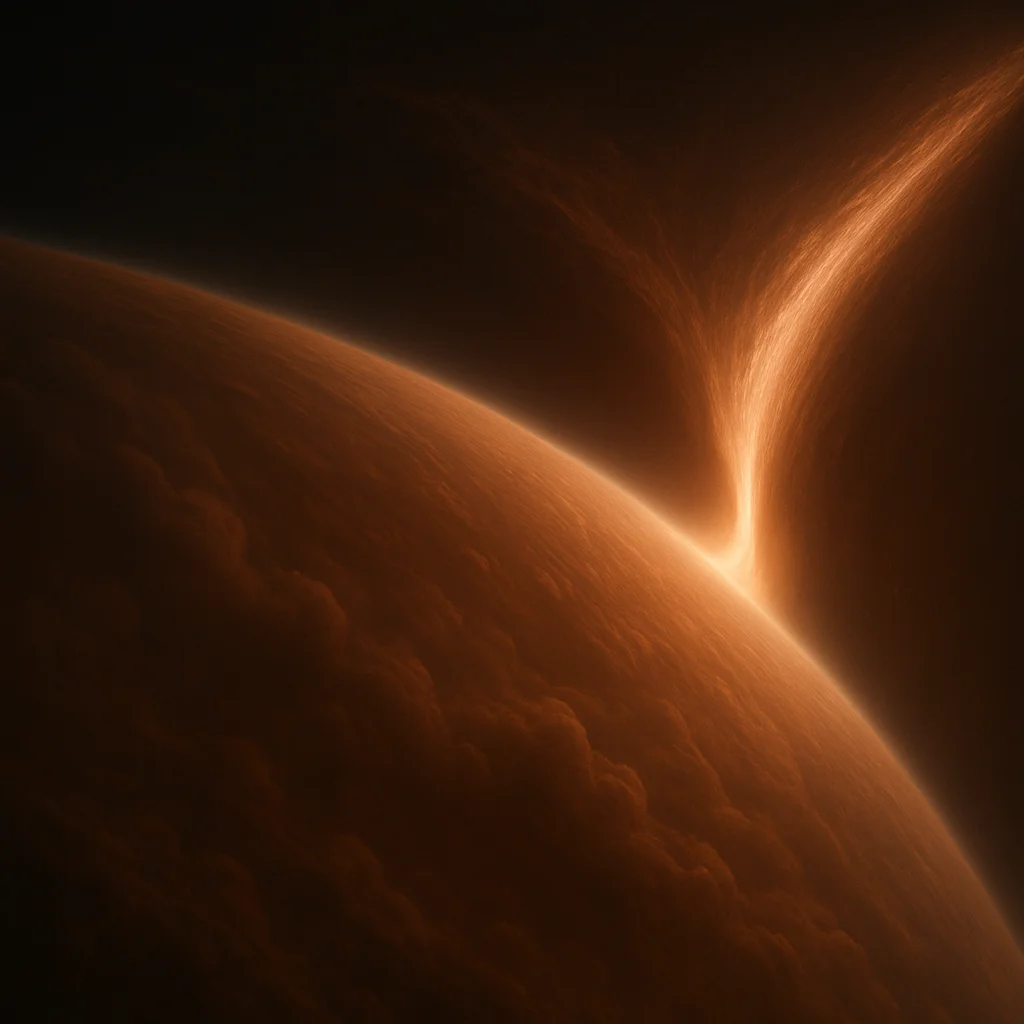
Visualization
A plume of helium, detected in spectral data streaming from the rocky exoplanet LHS 1140b, is rewriting our expectations for atmospheric persistence on super-Earths orbiting low-mass stars. The discovery, enabled by state-of-the-art infrared spectroscopy from the Magellan Clay telescope’s WINERED instrument at Las Campanas Observatory, marks the first unambiguous evidence of a substantial atmosphere on a terrestrial planet in another star’s habitable zone.
LHS 1140, variously cataloged as Gliese 3053 or GJ 3053, is a quiescent M-dwarf star approximately 3 billion years old and situated a mere 39 light-years away in Cetus. Unlike its more tempestuous red dwarf cousins, this relatively inactive stellar body has permitted the possible long-term retention of atmospheres on its planetary companions. Among the family of three—LHS 1140b, c, and d—LHS 1140b has captivated the attention of astronomers since its discovery in 2017. Its measured mass of 5.6 M⊕ and a radius of 1.73 R⊕ establish its designation as a super-Earth. LHS 1140b completes one orbital revolution every 24.7 days, placing it squarely within the empirical habitable zone according to the classic Kopparapu insolation models. Yet its incident stellar flux, approximately 0.42 S⊕ (where S⊕ is the solar constant at Earth), yields an equilibrium temperature, T_eq, of just 226 K—an ostensibly frigid world, but potentially compatible with subsurface or protected liquid water if greenhouse gases are present.
The crucial leap has come in the detection of a sustained, albeit variable, atmospheric constituent. In 2024, researchers deployed the Warm Infrared Echelle Spectrograph to Realize Extreme Dispersion (WINERED), targeting the signature 1.08 μm helium triplet line (He I 10830 Å), a sensitive tracer of exoplanetary atmospheric escape. The resulting high-resolution spectra revealed a veiled exodus of helium—clear evidence that the planet retains, and intermittently loses, a significant upper atmospheric layer.
The physical mechanism behind this escape is a function of the interaction between stellar high-energy irradiation—primarily soft X-rays and extreme ultraviolet (XUV) flux—and the uppermost atmospheric strata. When photons of energy E > 13.6 eV are absorbed at high altitudes, the ensuing photoionization and heating drive hydrodynamic outflows—often parameterized by the energy-limited escape rate:
\[
\dot{M}_\mathrm{esc} = \epsilon \frac{\pi R_p^3 F_\mathrm{XUV}}{G M_p K}
\]
where \( \dot{M}_\mathrm{esc} \) is the mass loss rate, \( \epsilon \) is the heating efficiency, \( R_p \) and \( M_p \) are the planet's radius and mass, \( F_\mathrm{XUV} \) is the incident XUV flux, \( G \) is the gravitational constant, and \( K \) is a correction factor for Roche lobe effects. The observations in 2024, compared to an absence of helium signal in 2025, suggest that this process is modulated by either intrinsic atmospheric variability, episodic stellar activity, or both—an unprecedented glimpse into atmospheric evolution on human-ascertainable timescales.
Astrochemical modeling of the detected escape profiles, in concert with non-detections of volatiles on sibling planet LHS 1140c, indicates that LHS 1140b harbors a helium-dominated and hydrogen-poor exosphere. Heavier species—particularly water vapor and molecular nitrogen—may be sequestered in denser atmospheric layers nearer the surface, shielded from both the erosive effects of XUV photons and the spectrograph’s detection limits. The stark dichotomy between LHS 1140b and 1140c underscores the theoretical concept of the “cosmic shoreline”: the notional boundary separating those planets whose gravitational binding energy (quantified via the escape velocity, \( v_\mathrm{esc} \)) exceeds the energy input from their host star, from those whose atmospheres succumb to hydrodynamic blow-off over geologic epochs.
The persistence of any volatile envelope on LHS 1140b is tantalizing. As Harvard astronomer Robin Wordsworth observes, the experiment has transitioned from a search for Earth analogues to a search for planets that have—against formidable odds—preserved the very air that could foster biosignatures. The detection of escaping helium is a double-edged sword: it suggests both the presence of a substantial atmosphere and its susceptibility to ongoing attrition. Whether this escape characterizes a quasi-steady-state outflow, akin to Earth's slow but persistent loss of hydrogen and helium to space, or the transient exhalations of a largely denuded rock, remains unresolved.
Forthcoming campaigns, especially those utilizing the James Webb Space Telescope, will target mid-infrared spectral windows in search of water vapor signatures and other molecular species. Detection of water in emission or transmission would imply a stratified, persistent, and potentially habitable atmosphere. Conversely, an absence could affirm a scenario in which LHS 1140b’s present atmospheric activity is but the dying breath of a once-thick envelope.
The implications reverberate through the wider context of exoplanetary astrophysics. While the “cosmic shoreline” continues to be refined, LHS 1140b has, at minimum, demonstrated that compact, rocky worlds in the habitable zones of old M-dwarfs can preserve atmospheres against centuries of irradiation. Whether such worlds are relics of failed habitability or crucibles of biospheric promise remains an open—and now empirically interrogable—question.
The published study in Science by Collin Cherubim et al. provides the most robust evidence yet for a tenuous but persistent atmosphere on a terrestrial exoplanet bathing in the gentle light of an M-dwarf star. As new instrumentation and time-series observations extend the reach of spectroscopic exoplanetology, worlds like LHS 1140b will define the boundaries of planetary endurance—and perhaps, the prospects for extraterrestrial life.