Field: Technology
Genetic Dissection of Madagascar’s Baobabs Decrypts a Hidden Tree Lineage: Adansonia bozy Resurrected
Published | Technical Staff
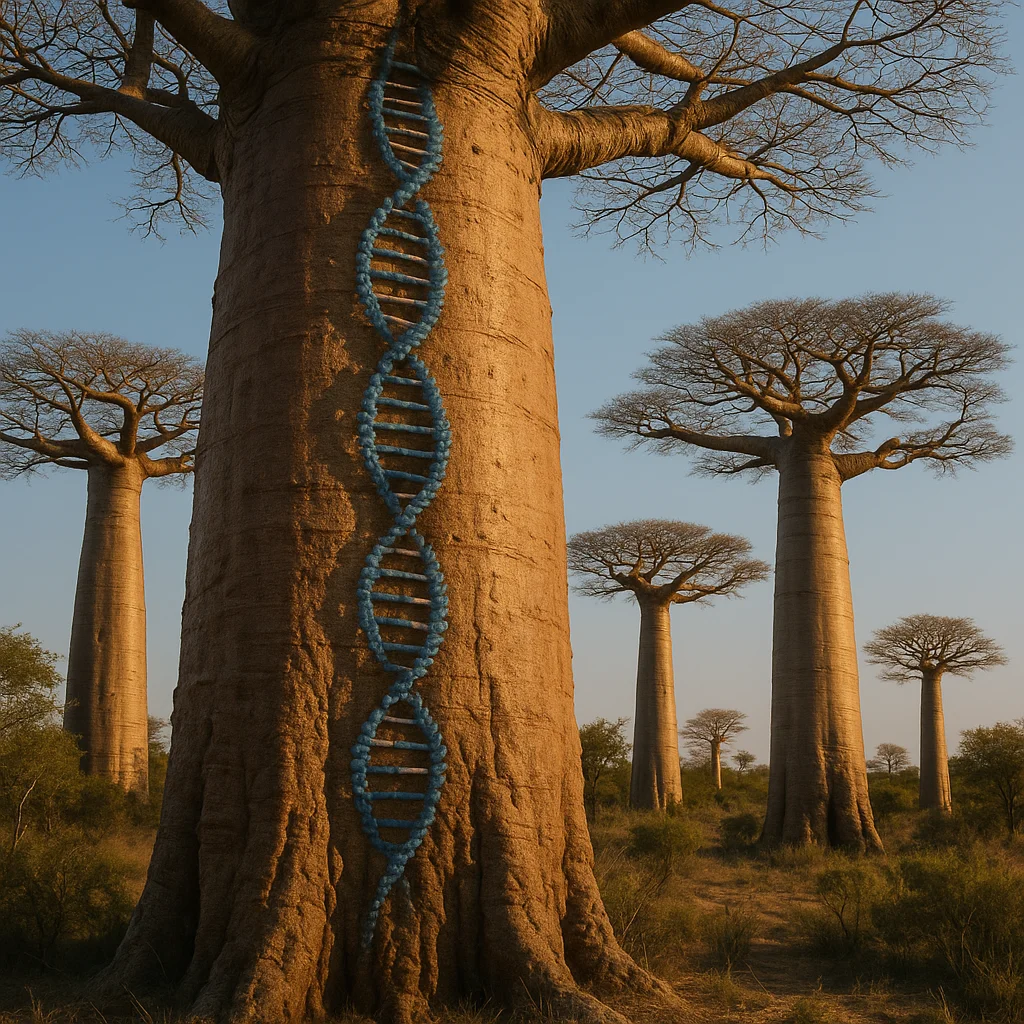
Visualization
For centuries, the iconic silhouette of Madagascar's baobab trees—massive, water-storing trunks crowned with delicate umbels of leaves—has been emblematic of the island’s biodiversity, yet the true nature of their diversity has long remained cryptic. Despite occupying a prominent place in both the island’s biosphere and the collective imagination, basic systematic uncertainties have nagged at botanists: How many Adansonia species truly reside in Madagascar, and what are their evolutionary relationships to each other?
A recent phylogenomic investigation, led by Dr. Nisa Karimi of the Missouri Botanical Garden, provides a definitive recalibration. Combining targeted sequencing of hundreds of nuclear genes with comparative analysis of complete chloroplast genomes, Karimi’s team dissected the genomic fabric of Adansonia populations sampled across the entire extent of the Malagasy landscape. Their data, published in Taxon (Karimi et al., 2026), reveal an unexpected split hidden within the most widespread of Madagascar’s baobabs, long known as Adansonia za.
Previous taxonomic treatments had condensed variation among baobab trees into a montage of just six endemic species distributed across the island, with only two relatives outside Madagascar: Adansonia digitata mirrors the genus on the African mainland, and Adansonia gregorii uniquely inhabits northwestern Australia. Within Madagascar, Adansonia za was considered the dominant, ubiquitous species, often encountered on vast tracts of the island. However, conflicting signals from earlier phylogenies, underpinned by sparse genomic sampling, foreshadowed the inadequacy of this consensus.
Karimi and colleagues deployed high-throughput, genome-wide sequencing to clarify these ambiguities. Through targeted capture of hundreds of orthologous genes and assembly of complete plastid genomes, the researchers constructed a robust species tree. Population genetic analyses, including principal component analysis (PCA) and model-based clustering (e.g., STRUCTURE), unmasked extremely sharp genetic discontinuities segregating northern and southern populations traditionally lumped as A. za.
Strikingly, northern populations—theoretically conspecific with southern A. za—were instead more closely allied, at a genome-wide level, to Adansonia perrieri and Adansonia madagascariensis. This relationship was underlined by metrics such as F_ST and D-statistics, which quantified gene flow and introgression events across the sampled populations. Morphological analyses, integrated with genetic evidence, underscored a congruent suite of differences: leaf architecture, fruit peduncle characteristics, and petal pigmentation all varied consistently between north and south, co-segregating with the unique northern genotypes.
Such crystalline genetic distinction and the morphological signature compelled the authors to resurrect the binomial Adansonia bozy, placed in taxonomic limbo since its initial designation by Jumelle and Perrier de la Bâthie in 1910. The holotype, sourced from the Sambirano River valley in 1909 and maintained at Paris’s Muséum national d’Histoire naturelle, anchors the resurrected species within the relatively humid, northwestern microhabitats centered on Madagascar’s Antsiranana province. Some outlying populations may marginally extend southward, but molecular diagnostics reliably delimit A. bozy from its neighbors.
Moreover, analyses of potential hybrid individuals—identified morphologically as admixtures between extant species—reflected a complex pattern of gene exchange (visible as “stars” on the researchers’ range maps). Notably, introgressed individuals with intermediary morphologies between A. za × A. perrieri and A. rubrostipa × A. madagascariensis highlight the dynamic evolutionary processes ongoing within the genus, yet the genomic boundaries of A. bozy remain robust.
Ecologically, the distribution of A. bozy within the Sambirano—one of Madagascar’s most rapidly deforested basins, driven by expanded cacao plantations and slash-and-burn rice cultivation—implicates serious conservation concerns. According to IUCN Red List criteria, parameters such as population size (N < 2,500 mature individuals), areal extent (AOO < 500 km²), and ongoing habitat fragmentation fulfill the thresholds for an Endangered classification (EN). The potential for increased extinction risk, if current trends continue, intensifies the urgency for biocultural conservation initiatives.
This phylogenomic reversal not only brings the recognized species count of Madagascar’s endemic baobabs to seven, but also illustrates the transformative impact of genomics on alpha taxonomy—a discipline still capable of revealing new actors even among the planet’s most celebrated plants. As Dr. Karimi observes, “It’s surprising that we’re still answering basic biological questions about baobabs, in terms of how many species actually exist on the landscape.” The resurrection of Adansonia bozy is a prime exemplar of such ongoing botanical revelations, a reminder that even the great giants of Madagascar harbor hidden stories—written, as ever, in their DNA.
A recent phylogenomic investigation, led by Dr. Nisa Karimi of the Missouri Botanical Garden, provides a definitive recalibration. Combining targeted sequencing of hundreds of nuclear genes with comparative analysis of complete chloroplast genomes, Karimi’s team dissected the genomic fabric of Adansonia populations sampled across the entire extent of the Malagasy landscape. Their data, published in Taxon (Karimi et al., 2026), reveal an unexpected split hidden within the most widespread of Madagascar’s baobabs, long known as Adansonia za.
Previous taxonomic treatments had condensed variation among baobab trees into a montage of just six endemic species distributed across the island, with only two relatives outside Madagascar: Adansonia digitata mirrors the genus on the African mainland, and Adansonia gregorii uniquely inhabits northwestern Australia. Within Madagascar, Adansonia za was considered the dominant, ubiquitous species, often encountered on vast tracts of the island. However, conflicting signals from earlier phylogenies, underpinned by sparse genomic sampling, foreshadowed the inadequacy of this consensus.
Karimi and colleagues deployed high-throughput, genome-wide sequencing to clarify these ambiguities. Through targeted capture of hundreds of orthologous genes and assembly of complete plastid genomes, the researchers constructed a robust species tree. Population genetic analyses, including principal component analysis (PCA) and model-based clustering (e.g., STRUCTURE), unmasked extremely sharp genetic discontinuities segregating northern and southern populations traditionally lumped as A. za.
Strikingly, northern populations—theoretically conspecific with southern A. za—were instead more closely allied, at a genome-wide level, to Adansonia perrieri and Adansonia madagascariensis. This relationship was underlined by metrics such as F_ST and D-statistics, which quantified gene flow and introgression events across the sampled populations. Morphological analyses, integrated with genetic evidence, underscored a congruent suite of differences: leaf architecture, fruit peduncle characteristics, and petal pigmentation all varied consistently between north and south, co-segregating with the unique northern genotypes.
Such crystalline genetic distinction and the morphological signature compelled the authors to resurrect the binomial Adansonia bozy, placed in taxonomic limbo since its initial designation by Jumelle and Perrier de la Bâthie in 1910. The holotype, sourced from the Sambirano River valley in 1909 and maintained at Paris’s Muséum national d’Histoire naturelle, anchors the resurrected species within the relatively humid, northwestern microhabitats centered on Madagascar’s Antsiranana province. Some outlying populations may marginally extend southward, but molecular diagnostics reliably delimit A. bozy from its neighbors.
Moreover, analyses of potential hybrid individuals—identified morphologically as admixtures between extant species—reflected a complex pattern of gene exchange (visible as “stars” on the researchers’ range maps). Notably, introgressed individuals with intermediary morphologies between A. za × A. perrieri and A. rubrostipa × A. madagascariensis highlight the dynamic evolutionary processes ongoing within the genus, yet the genomic boundaries of A. bozy remain robust.
Ecologically, the distribution of A. bozy within the Sambirano—one of Madagascar’s most rapidly deforested basins, driven by expanded cacao plantations and slash-and-burn rice cultivation—implicates serious conservation concerns. According to IUCN Red List criteria, parameters such as population size (N < 2,500 mature individuals), areal extent (AOO < 500 km²), and ongoing habitat fragmentation fulfill the thresholds for an Endangered classification (EN). The potential for increased extinction risk, if current trends continue, intensifies the urgency for biocultural conservation initiatives.
This phylogenomic reversal not only brings the recognized species count of Madagascar’s endemic baobabs to seven, but also illustrates the transformative impact of genomics on alpha taxonomy—a discipline still capable of revealing new actors even among the planet’s most celebrated plants. As Dr. Karimi observes, “It’s surprising that we’re still answering basic biological questions about baobabs, in terms of how many species actually exist on the landscape.” The resurrection of Adansonia bozy is a prime exemplar of such ongoing botanical revelations, a reminder that even the great giants of Madagascar harbor hidden stories—written, as ever, in their DNA.