Field: Technology
From Coffeehouse Ritual to Cardiovascular Ally: Parsing the Science on Moderate Caffeine Intake
Published | Technical Staff
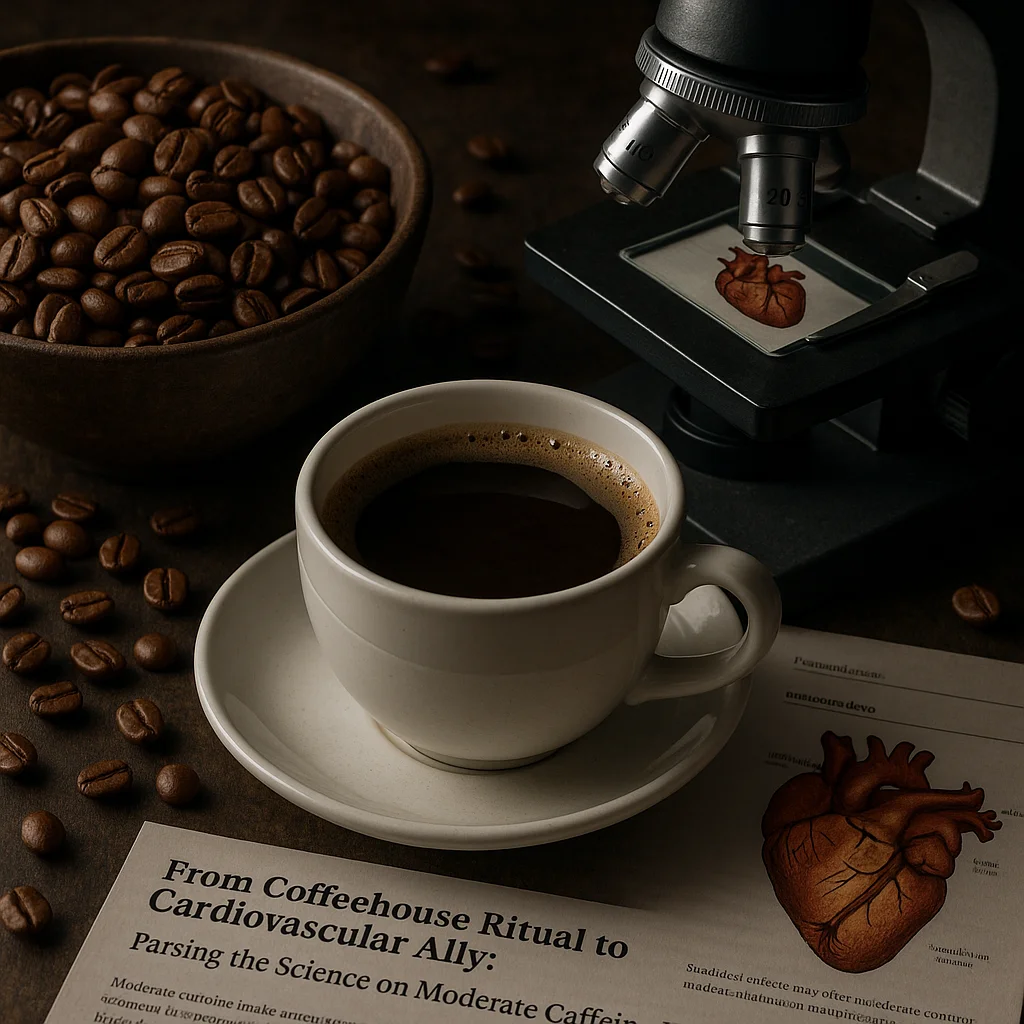
Visualization
Across centuries and continents, caffeine has maintained its role as the world’s most favored psychoactive compound. Despite its status as a daily staple for over two billion individuals, coffee remains mired in public controversy regarding its impact on cardiovascular health. A rigorous scientific statement led by Dr. Gregory Marcus and colleagues at UCSF, recently published in Circulation, coalesces decades of epidemiological and clinical investigations to clarify these health implications with nuanced granularity.
Caffeine’s pharmacokinetic signature is as unambiguous as its ubiquity. A methylxanthine alkaloid with complete oral bioavailability, its absorption is noted for its swiftness—plasma concentrations peak within an hour of ingestion, facilitated by high water solubility. While caffeine exhibits negligible tissue accumulation, as much as 80% of an ingested dose transiently enriches cerebral tissues, asserting both its neuroactive and systemic stimulatory effects.
Within the contemporary research landscape, Marcus et al. designate “moderate” caffeine consumption as a threshold of up to 400 milligrams per day. This corresponds pragmatically to three to five 8-ounce cups of black, standard brewed coffee, with caffeine content per fluid ounce ranging from 9.4 to 20.6 mg (where 1 fl oz ≈ 30 ml). The review underscores not only the safety at such levels for the vast majority of adults, but also a statistically significant association with reductions in incidence of coronary heart disease, stroke, heart failure, atrial fibrillation, hypertension, and type 2 diabetes. These assertions are not mere correlative speculations but are grounded in meta-analyses, prospective cohort studies, and randomized controlled trials—the latter offering the highest evidentiary tier.
A salient distinction emerges concerning forms and sources of caffeine. While habitual consumption of unadulterated coffee is correlated with salutary cardiovascular outcomes, high-caffeine energy drinks (some exceeding 40–69 mg caffeine per fluid ounce—approximately quadruple the content of brewed coffee) display a contrary profile, frequently precipitating hypertensive episodes and arrhythmogenic events such as premature ventricular contractions. These findings delineate a nonlinear risk curve, highlighting a therapeutic window for caffeine intake with a potentially adverse inflection at excess.
The biochemistry underlying caffeine’s cardiovascular effects is intertwined with antagonism of adenosine receptors, modulation of intracellular calcium, and transient vasodilatory or vasoconstrictive influences depending on dose and individual sensitivities. The inter-individual variability is thus not ancillary but fundamental: genetic polymorphisms (notably CYP1A2 variants affecting hepatic metabolism), concurrent medications, comorbidities, and age significantly modulate both pharmacodynamic and adverse-response spectra. For some, even sub-moderate intakes may catalyze palpitations, anxiety, or insomnia, while others metabolize the compound rapidly and experience negligible side effects.
Assessment of beverage composition further complicates the calculus. Sugar, cream, and flavored syrups—ubiquitous in commercial coffee preparations—may mitigate the cardiometabolic benefits conferred by pure coffee, introducing exogenous calories and glycemic load. Marcus and colleagues explicitly caution that these additives likely attenuate the observed protective associations.
As a synthesis of available evidence, this analysis validates moderate coffee/caffeine consumption as not merely innocuous but possibly protective vis-à-vis multiple cardiovascular endpoints—provided consumption stays within the recommended quantitative boundaries and eschews excess caloric additions. Nonetheless, variability in individual tolerance mandates a tailored approach: for the consumer, physiological self-monitoring and clinician consultation remain imperative. The study closes with a reminder that within caffeine’s global diffusion, a one-size-fits-all dictum is neither scientifically justified nor clinically prudent.
Caffeine’s pharmacokinetic signature is as unambiguous as its ubiquity. A methylxanthine alkaloid with complete oral bioavailability, its absorption is noted for its swiftness—plasma concentrations peak within an hour of ingestion, facilitated by high water solubility. While caffeine exhibits negligible tissue accumulation, as much as 80% of an ingested dose transiently enriches cerebral tissues, asserting both its neuroactive and systemic stimulatory effects.
Within the contemporary research landscape, Marcus et al. designate “moderate” caffeine consumption as a threshold of up to 400 milligrams per day. This corresponds pragmatically to three to five 8-ounce cups of black, standard brewed coffee, with caffeine content per fluid ounce ranging from 9.4 to 20.6 mg (where 1 fl oz ≈ 30 ml). The review underscores not only the safety at such levels for the vast majority of adults, but also a statistically significant association with reductions in incidence of coronary heart disease, stroke, heart failure, atrial fibrillation, hypertension, and type 2 diabetes. These assertions are not mere correlative speculations but are grounded in meta-analyses, prospective cohort studies, and randomized controlled trials—the latter offering the highest evidentiary tier.
A salient distinction emerges concerning forms and sources of caffeine. While habitual consumption of unadulterated coffee is correlated with salutary cardiovascular outcomes, high-caffeine energy drinks (some exceeding 40–69 mg caffeine per fluid ounce—approximately quadruple the content of brewed coffee) display a contrary profile, frequently precipitating hypertensive episodes and arrhythmogenic events such as premature ventricular contractions. These findings delineate a nonlinear risk curve, highlighting a therapeutic window for caffeine intake with a potentially adverse inflection at excess.
The biochemistry underlying caffeine’s cardiovascular effects is intertwined with antagonism of adenosine receptors, modulation of intracellular calcium, and transient vasodilatory or vasoconstrictive influences depending on dose and individual sensitivities. The inter-individual variability is thus not ancillary but fundamental: genetic polymorphisms (notably CYP1A2 variants affecting hepatic metabolism), concurrent medications, comorbidities, and age significantly modulate both pharmacodynamic and adverse-response spectra. For some, even sub-moderate intakes may catalyze palpitations, anxiety, or insomnia, while others metabolize the compound rapidly and experience negligible side effects.
Assessment of beverage composition further complicates the calculus. Sugar, cream, and flavored syrups—ubiquitous in commercial coffee preparations—may mitigate the cardiometabolic benefits conferred by pure coffee, introducing exogenous calories and glycemic load. Marcus and colleagues explicitly caution that these additives likely attenuate the observed protective associations.
As a synthesis of available evidence, this analysis validates moderate coffee/caffeine consumption as not merely innocuous but possibly protective vis-à-vis multiple cardiovascular endpoints—provided consumption stays within the recommended quantitative boundaries and eschews excess caloric additions. Nonetheless, variability in individual tolerance mandates a tailored approach: for the consumer, physiological self-monitoring and clinician consultation remain imperative. The study closes with a reminder that within caffeine’s global diffusion, a one-size-fits-all dictum is neither scientifically justified nor clinically prudent.