Field: Technology
Fossil Skull from Peru Reveals Pygmy Sperm Whale with Record-Breaking Facial Asymmetry
Published | Technical Staff
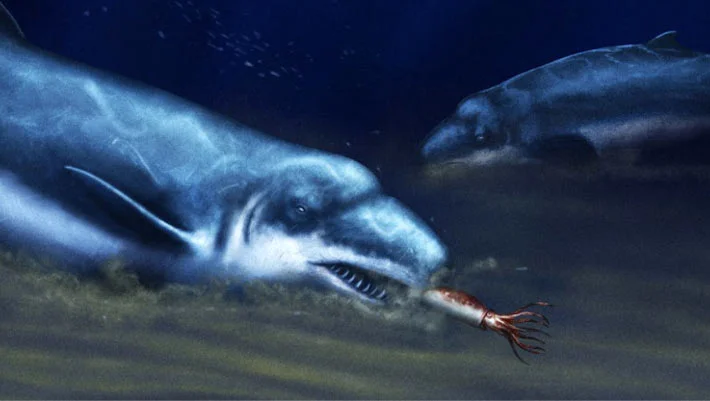
Visualization
In a remarkable discovery from the Late Miocene epoch, paleontologists have unveiled the fossilized skull of a previously unknown species of pygmy sperm whale, Scaphokogia huachafo, which lived approximately six million years ago in what is today southern Peru. This ancient marine mammal, measuring about 2.7 meters in length, showcases an extraordinary level of facial asymmetry that surpasses that of any known cetacean and potentially all mammals. The new findings illuminate the evolutionary adaptations that these creatures developed to thrive in their aquatic environments.
Unearthed from the Pisco Formation, layers of sediment laid down between 6.3 and 5.6 million years ago in the Sacaco basin, the nearly complete skull initially provoked skepticism regarding its condition. Dr. Aldo Benites-Palomino, a leading vertebrate paleontologist at GeoZentrum Nordbayern, expressed initial caution about the extreme distortion, suspecting possible taphonomic influences—the alterations that occur post-mortem due to environmental pressures. Upon meticulous examination, however, the team noted that the sutures of the skull remained fully closed and free from fractures, confirming that the asymmetry was an original biological trait rather than a product of geological forces.
The skull of Scaphokogia huachafo is distinctive in its morphological deviations; both of its external nostrils are skewed to the left of the midline, with the left nostril noticeably larger. This asymmetry extends beyond the nasal region, impacting the shape of the bony structures surrounding the eye sockets, which also exhibit pronounced differences. This configuration defies the prevailing norms of symmetry and aesthetic balance typically observed in extant cetaceans, as stated by Dr. Benites-Palomino, elucidating an unprecedented divergence in the evolutionary lineage of cetaceans.
To contextualize these findings within a broader taxonomic framework, researchers conducted a comprehensive statistical analysis involving three-dimensional measurements of the facial structures of 31 cetacean species, revealing that Scaphokogia plays a pivotal role within its genus, which includes two closely related taxa, as the most asymmetric assemblage observed. The most salient characteristic of this species lies in its specialized rostrum—a massive tube-shaped snout, composed of dense bone and reinforced with ossified cartilage. Positioned at an acute angle of approximately 31 degrees downward from the skull's axial orientation, this structure likely facilitates its bottom-feeding niche by enhancing its foraging capabilities along the seafloor.
An intriguing aspect of Scaphokogia huachafo's anatomy is its heavy skull architecture, reminiscent of adaptations seen in other benthic feeders such as manatees and walruses. The density of the cranial bones likely serves to optimize buoyancy control, shifting the animal's center of gravity more toward the anterior, thereby aiding in its capacity to forage efficiently near the seabed. Analyses of the cervical vertebrae, including a second specimen that preserved the first neck vertebrae, suggest a remarkable ability for downward neck flexion. This anatomical flexibility indicates that the whale's head followed a curved trajectory rather than a strictly vertical oscillation, allowing it to interact dynamically with the substrate.
The integration of these structural features points to an evolutionary paradigm where Scaphokogia huachafo emerged as an adept bottom feeder, exploiting the shallow coastal waters for sustenance. Interestingly, the absence of specialized facial structures typical in many benthic feeding mammals raises compelling questions about the ecological adaptations this whale may have employed. Speculatively, it could have relied on a novel suite of echolocation strategies tailored for detecting prey nestled within soft sediment.
Dr. Gabriel Aguirre-Fernández, a paleontologist from the University of Zurich, posits that the unique cranio-cervical complex of Scaphokogia huachafo attests to its evolutionary specialization, indicating that the combination of a robust, downward-curving snout and a versatile neck articulation modified for close interaction with the seafloor constituted key adaptations that allowed this cetacean to thrive amid the ecosystems of its time.
Published in the journal Communications Biology, these findings not only contribute significantly to our understanding of cetacean diversity and adaptability but also underscore the intricate interplay of evolutionary forces shaping marine life millions of years ago. With every fossil unearthed, the narrative of life in ancient oceans continues to unfold, revealing complex adaptations and the relentless march of evolution.