Field: Technology
Forensic Isotope Analysis Reveals Chicxulub Dinosaur Killer Was an Ultra-Rare CO Chondrite
Published | Technical Staff
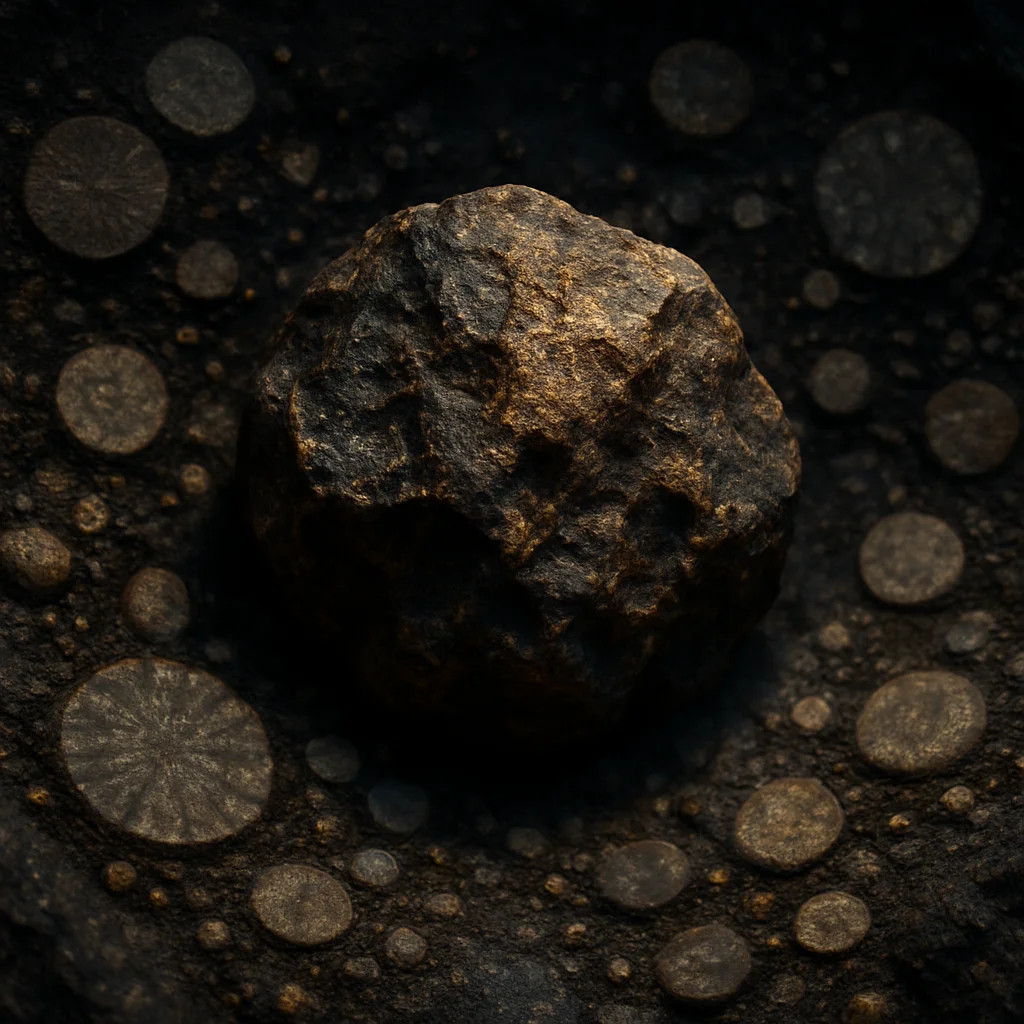
Visualization
The celestial bullet that spelled the doom for the dinosaurs at the end of the Cretaceous period has always loomed as a cosmic mystery. While geochemical markers in the thin, global layer of iridium-rich clay hinted at an extraterrestrial origin, the identity of the impactor itself—its composition, provenance, and rarity—remained obscure. Now, a synthesis of high-precision isotopic analyses points to a startling conclusion: the 10–15 km object that excavated the Chicxulub crater and precipitated Earth’s last mass extinction was not a commonplace asteroid, but an exceptionally scarce carbonaceous chondrite—specifically of the Ornans (CO) subgroup—representing some of the most primordial matter in the Solar System.
This insight arises from painstaking analyses conducted by an international team led by Philippe Claeys at Vrije Universiteit and the University of British Columbia. The researchers focused their attention on nickel isotopic signatures within the globally distributed Cretaceous–Paleogene (K–Pg) boundary clay, a record of the microdebris produced and globally dispersed in the aftermath of the impact. While only a minuscule fraction of the original projectile survived the cataclysmic vaporization and subsequent thermochemical transformations—ironically, the mere atomic “fingerprint” within the KT clay—the isotopic ratios would persist, providing a forensic clue to the impactor’s identity.
Their methodology deployed state-of-the-art mass spectrometry to resolve subtle differences in the relative abundance of nickel isotopes (^58Ni, ^60Ni, ^61Ni, ^62Ni, ^64Ni). The diagnostic parameter, δ^60Ni, measures deviations in the ^60Ni/^58Ni ratio compared to a terrestrial standard. Appraising δ^60Ni alongside trace element geochemistry and volatile inventories in the boundary deposits, the researchers found an isotopic convergence with CO chondrites—among the most primitive and unaltered carbonaceous chondrites—rather than the more common meteoritic classes such as LL, L, or H chondrites. Statistically, carbonaceous chondrites comprise a mere 5% of all meteorites sampled on Earth; CO chondrites constitute a mere fraction of that, rendering the Chicxulub impactor an extraordinary outlier.
The geochemical austerity of CO chondrites is notable: they are characteristically depleted in volatile elements, including carbon, zinc, water, and—critically—sulfur (total S ~1 wt%, among the lowest in meteorites). As Professor Claeys remarks, "A CO contains much less volatile elements—like carbon, zinc, water and particularly sulfur—than other classes of meteorites we’ve discovered so far on Earth." This compositional anomaly mandates a reevaluation of the extinction’s kill mechanism; the low sulfur content in the projectile itself suggests that the cataclysmic atmospheric perturbation and global cooling more likely arose from the sulfur-rich Yucatán crust it struck, while ejecta dust may have played the primary role in precipitating the planetary blackout.
The Chicxulub impact—tracked to a velocity of approximately 64,000 km/h—delivered an energy on the order of 10^23 joules, forming a crater exceeding 180 km in diameter, now buried beneath the limestone of the Yucatán Peninsula. Its aftermath blanketed the Earth in ejecta, fostered acid rain, ignited global wildfires, and occluded sunlight for months to years. The identification of the impactor as a CO chondrite compounds the event’s improbability: not only was the dinosaur-killing asteroid a statistical rarity, but its source region is likely to be distant and dynamically unstable, potentially the outer Solar System or a perturbed fragment from the margins of the asteroid belt near Jupiter.
For planetary scientists, this forensic breakthrough underscores the contingent and stochastic nature of Earth’s biological history, reliant not just on the dynamical choreography of the Solar System but on the rare composition of a single, catastrophic visitor. The study, published in *Science Advances*, not only deepens our understanding of the end-Cretaceous catastrophe but also reframes the narrative: even among the planet’s countless brushes with space debris, it was a collision with an “oddball” fragment of primal cosmic matter—uncommonly rich in the isotopic lexicon of the early Solar System—that ended the reign of the dinosaurs and paved the way for the subsequent evolution of mammals and, eventually, humankind.
Reference:
Makhatadze, G. V. et al. (2026). The origin of Cretaceous–Palaeogene impactor revealed by nickel isotopes. Science Advances, 12(29). doi:10.1126/sciadv.aef4858