Field: Technology
Fluorescent Glow Reveals Hidden Glaze on Chauvet Cave’s Ancient Art
Published | Technical Staff
Visualization
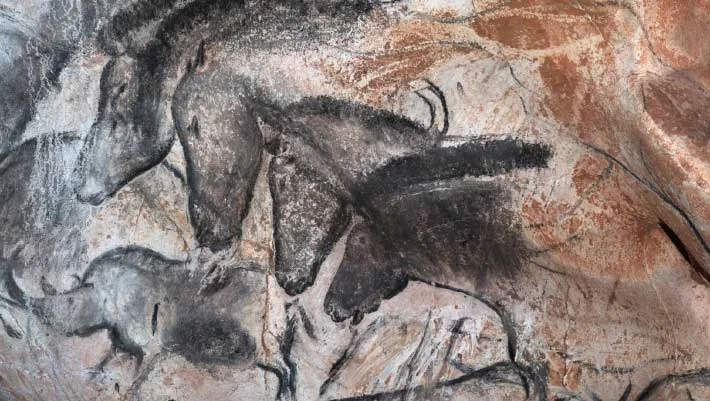
Amidst the ancient limestone formations of the Chauvet Cave, nestled in the heart of southern France, lie some of the earliest expressions of human creativity, dating back approximately 37,000 years. The cave, a UNESCO World Heritage site, harbors an extraordinary collection of paintings and engravings depicting majestic fauna such as rhinoceroses, mammoths, lions, horses, and bison, preserved in remarkable detail due to geological events that sealed the cave from external elements during the Upper Paleolithic epoch. Recent investigations by a collaborative team from Sorbonne Université and the French National Center for Scientific Research (CNRS) have unraveled a hidden layer atop these ancient artworks—a translucent film of calcite that evades the naked eye but holds essential clues for understanding the artists’ techniques and the preservation of their stunning creations.
Employing a methodology that mirrors forensic science, the researchers embarked on a quest to decode the layers of history embedded within the cave walls. Lead author Dr. Philippe Walter articulated the investigative approach, emphasizing the need to analyze every piece of evidence meticulously, much like a detective piecing together a historical narrative. Utilizing advanced techniques such as ultraviolet (UV) fluorescence spectroscopy, the team developed a non-invasive method to probe the cave’s intricate surfaces without the risk of damaging these fragile works of art.
In an environment characterized by high humidity and ambient temperatures around 13 degrees Celsius, accessing and analyzing the cave wall paintings posed significant challenges. The traditional analytical instruments, necessitated close proximity, which was hindered by a labyrinth of well-preserved animal tracks and human footprints along the cave’s floor. Innovative thinking led the researchers to create a bespoke spectroscopy apparatus, incorporating a 3-meter fiber-optic bundle mounted onto a lightweight carbon-fiber pole. This system, powered by a 365-nanometer UV LED and a portable battery pack, allowed the team to capture spectral data from more than 2.5 meters away, thereby circumventing the constraints imposed by the cave’s architecture.
The significance of the technique lies in its ability to detect subtle differences in fluorescence that arise from the disparate chemical compositions of the cave’s bedrock limestone and the overlay of calcite deposits, which are similarly composed but exhibit distinct spectral fingerprints due to organic impurities. The charcoal pigment employed by the prehistoric artists absorbs UV light and consequently does not fluoresce. Thus, when the UV light hit the painted surfaces of the iconic Horses Panel, any emitted fluorescence predominantly pointed to the calcitic layer that rests above the charcoal lines. This discovery indicates not only the presence of a previously undetected film but also potentially reflects its role as a natural varnish protecting the artistry beneath—a duality that could both enhance preservation and, under certain conditions, obscure these remarkable works.
In the Alcove of the Lions, the researchers made further exciting observations. Here, the influence of tectonic shifts and the water infiltration post-occupation resulted in cascading calcite flows that altered the surfaces in intricate forms. The juxtaposition of calcite formations against the charcoal lines revealed intriguing interactions where the mineral crystals grew selectively, suggesting that the artworks may have played an integral part in shaping the mineral deposition process.
One particularly striking finding was the unexpected orange luminescence detected beneath some of the charcoal marks and around torched smears. In laboratory settings, only heated limestone and calcite were observed to emit a similar orange glow, thus suggesting a novel hypothesis: some prehistoric artists may have employed heated or even burning charcoal to create their iconic images, leading to alterations not only in color but also in the geological structure beneath.
Collectively, these revelations illuminate the intricate interplay between human ingenuity and geological processes, a relationship that has facilitated the preservation of Chauvet's masterpieces across millennia. The application of this advanced technology extends beyond the realm of archaeology, with implications for fields ranging from forensic analysis to astrobiology, where monitoring biofilms on the International Space Station could benefit from similar methodologies.
This pioneering research, documented in an article published in ACS Omega, opens new avenues for understanding not only the artistry of early humans but also the environmental conditions that have historically shaped their legacy. As the study of Chauvet Cave and its monumental artworks continues, it reinforces the relevance of interdisciplinary approaches in unveiling the complexities of our prehistoric past.