Field: Technology
Exploring the Boundaries of Spacetime and the Possibilities of Time Travel
Published | Technical Staff
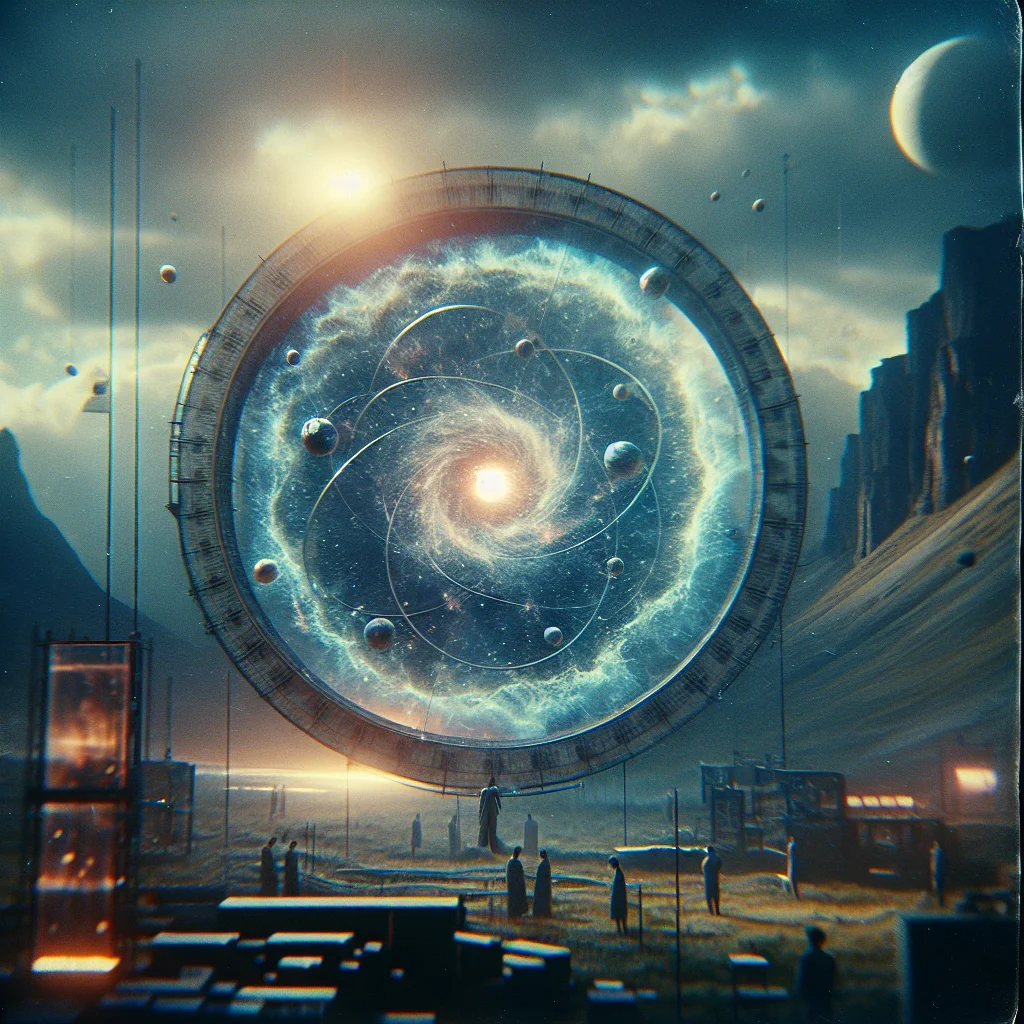
Visualization
In the realm of theoretical physics, the concept of time travel has perennially tickled the intellectual fancies of scientists and non-scientists alike. At the forefront of this speculative exploration, recent advancements suggest a more nuanced understanding of time manipulation through what is known as the Alcubierre "warp" drive, first proposed over three decades ago by physicist Miguel Alcubierre. This concept, rooted deeply in the geometric foundations of general relativity, posits a mechanism by which spacetime itself can be warped—theoretically allowing for travel at velocities surpassing the luminal speed dictated by the cosmic speed limit, the speed of light.
The recent elaboration on Alcubierre's framework by Tim C. Ralph and Achintya Sajeendran from the University of Queensland, as published in APS Physical Review D, merges these historical insights with the speculative geometrical properties of "closed timelike curves" (CTCs), a notion introduced by Kurt Gödel in 1949. Gödel’s CTCs offer mathematical solutions where time loops back on itself, theoretically permitting travel back in time. Within this context, Ralph and Sajeendran have innovatively introduced the concept of "closed timelike geodesics" (CTGs), these being complex trajectories in spacetime along which an object (or information) could return to its original spacetime coordinates, thereby interacting with its past states.
The utility of the closed timelike geodesics Ralph and Sajeendran propose lies fundamentally in their potential to offer new experimental setups wherein the paradoxes and peculiar implications of time travel—and indeed, the very structure of time itself—can be probed. Specifically, these geodesics might facilitate the emulation of conditions where entities such as particles could encounter earlier versions of themselves, an idea reminiscent of speculative problems like the "billiard ball" problem in quantum mechanics. This problem ponders scenarios wherein objects following a trajectory in spacetime might collide with earlier versions of themselves due to the peculiar topology of CTCs, creating situations with no easy prediction in classical physics.
While the modifications proposed to the Alcubierre drive and the stabilization of spacetime through these CTGs are founded on rigorous mathematical formalism, they spark debates around the physical and philosophical implications of manipulating spacetime. The researchers themselves highlight that despite the elegance of the structures they describe, the physical realizability remains under question.
Moreover, these theoretical advancements underscore an intriguing way to challenge our understanding of classical and quantum models, providing a structured setting to consider extreme cases in general relativity and potentially offering insights into the quantum properties of gravity—a theoretically fertile yet stubbornly elusive domain in physics.
Ultimately, this line of inquiry into the warp drives, coupled with closed timelike curves and geodesics, not only stretches our imagination but also pushes the boundaries of established physics. It invites a broader discourse on what is possible within our current theoretical constructs and what might remain tantalizingly beyond our reach. These investigations also act as stepping stones towards newer, perhaps even revolutionary, paradigms in understanding the fabric of the universe. As such, even as these theories verge on the speculative fringes of science, their role in catalyzing progress in theoretical physics remains undeniably potent.
Thus, the full implications and applications of these avenues remain largely speculative but vibrantly indicative of the audacious scope of modern physics. As with many ventures into new scientific territories, the journey itself often proves as revelatory as any eventual destinations, offering profound insights into the nature of time, space, and the universe itself.