Field: Technology
Exploring the Anti-Universe: An Innovative Model for Understanding Cosmic Expansion
Published | Technical Staff
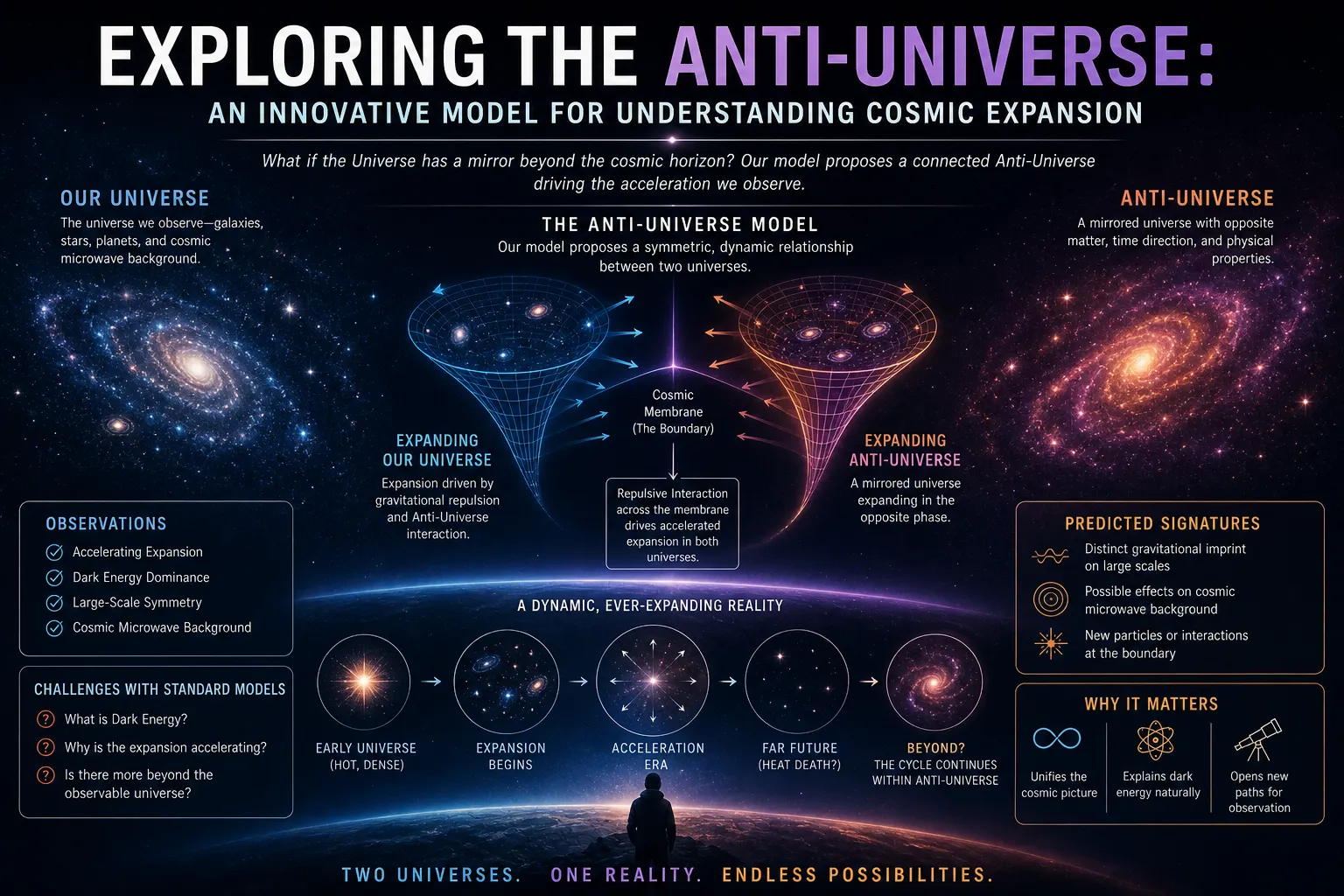
Visualization
The prevailing Lambda-Cold Dark Matter (ΛCDM) model, integral to our understanding of the universe’s expansion post-Big Bang, operates under assumptions surrounding the elusive dark matter and dark energy. However, the lack of direct observational evidence for these components has stimulated alternative theoretical explorations. A noteworthy diversion is presented by Naman Kumar from the Indian Institute of Technology. Published in the "Gravitation and Cosmology" journal, Kumar's research delves into a model where our universe could be one half of a paired existence with an anti-universe, potentially eliminating the need to rely on dark matter and dark energy in explaining cosmic acceleration.
The ΛCDM model situates dark matter and dark energy at the core of the cosmic narrative, attributing to them the roles of agents driving the universe's accelerated expansion. Despite its widespread acceptance, the model's reliance on these unobserved elements forms foundational "plot holes". Such gaps have prompted the reconsideration of early universe phenomena through alternative theoretical frameworks.
One of the radical alternatives previously proposed includes the concept of the universe being a mirror image of another, with time flowing backward, as suggested by researchers at the Perimeter Institute of Theoretical Physics in Ontario in 2018. They hypothesized that such a configuration could naturally account for observations mistakenly attributed to dark matter, using "sterile" neutrinos as a theoretical placeholder.
Levering on this backdrop, Kumar’s hypothesis asserts that our universe and its corresponding anti-universe, each flowing in opposite temporal directions, could encapsulate the need for dark matter and energy. Here, the utilitarian concept of relative entropy and the null energy condition, pillars underpinned by quantum theory and general relativity respectively, play pivotal roles. Specifically, Kumar's framework hinges on the relative entropy between the universe and its anti-universe counterpart to naturally lead to an accelerated cosmic expansion, as suggested by the null energy condition - a proposition where the quantum state's energy in the spacetime neighborhood remains non-negative.
This theory not only revises our traditional understanding but retains adherence to fundamental physical principles, notably the CPT (Charge, Parity, and Time) symmetry. The CPT symmetry maintains that the equations describing the laws of physics should hold invariant if three fundamental symmetries (charge conjugation, parity transformation, and time reversal) are simultaneously applied. Kumar’s model, therefore, navigates around potential theoretical violations by fostering a symmetrical time-related conceptual pair.
While Kumar's deductions contribute innovatively to the cosmological discourse, the absence of empirical corroboration remains a significant challenge. The concepts of relative entropy and the null energy condition, although robust within theoretical constructs, necessitate experimental validation through observational astronomy and related disciplines.
In essence, Kumar's work epitomizes a shift in cosmological paradigms underscored by the indispensability and relevance of theoretical pluralism in understanding our universe. As cosmologists continue to explore the fabric of cosmic reality through both observational technology and speculative theories, the domain remains vibrant with intellectual curiosity and rich with ontological exploration. Whether Kumar's anti-universe holds empirical veracity may lie within the grasp of future cosmic observation techniques or perhaps, in an unforeseen theoretical breakthrough. For now, the anti-universe model stands as a testament to the dynamically evolving landscape of cosmological theory, offering a fresh perspective on the fundamental structure and evolution of everything we comprehend about the universe.