Field: Technology
**Exploring Cosmological Models: The Hypothesis of a Connected Anti-Universe**
Published | Technical Staff
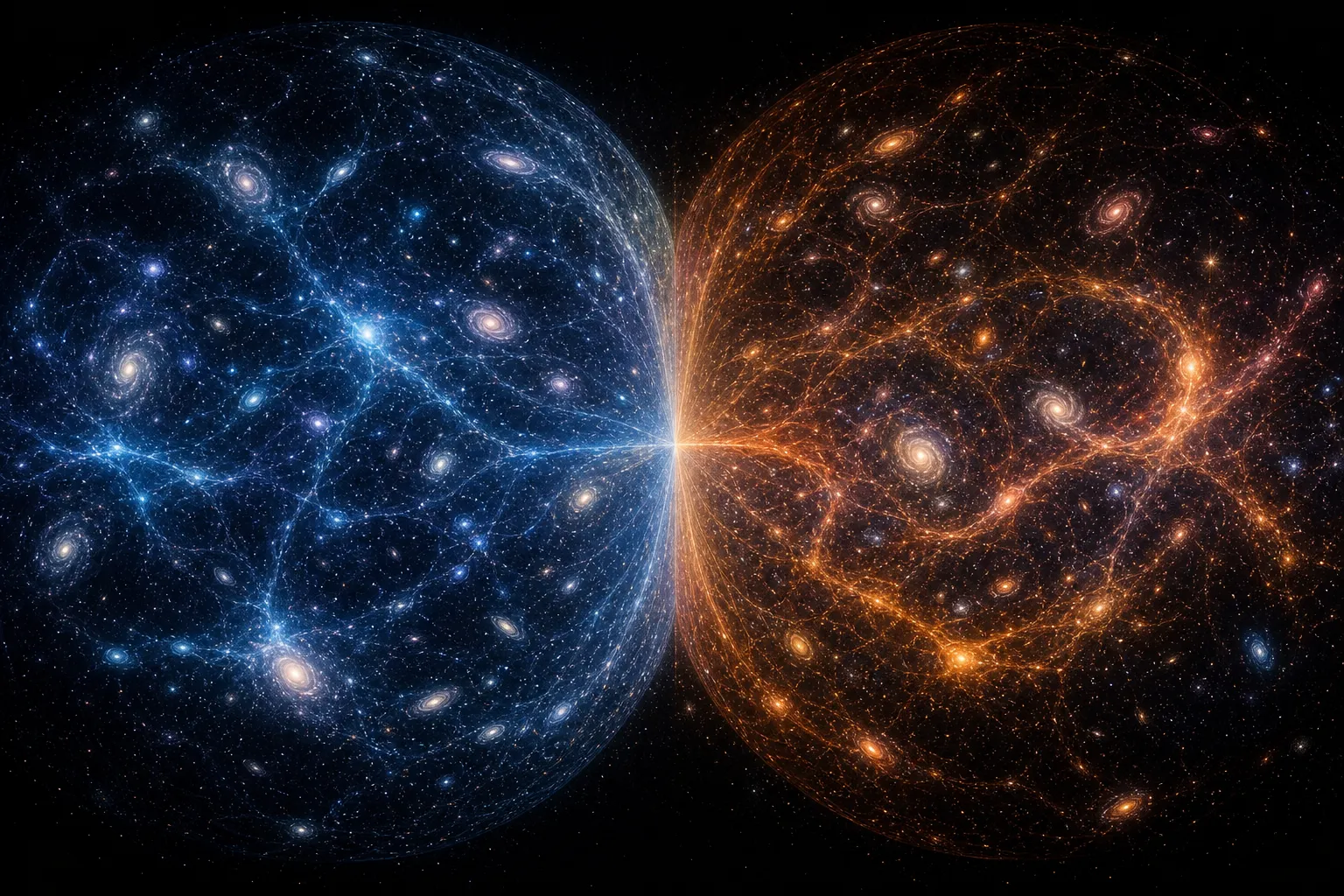
Visualization
Understanding the intricacies of the Big Bang and its subsequent universal expansion has long stood as one of the cosmos' most perplexing puzzles. At the forefront, the Lambda Cold Dark Matter (ΛCDM) model, steeped in its reliance on the undetected entities known as dark matter and dark energy, theorizes why our universe is expanding and accelerating but simultaneously garners skepticism owing to its reliance on these unseen forces.
A notable shift in perspective is offered by Naman Kumar from the Indian Institute of Technology, as articulated in his recent publication in "Gravitation and Cosmology." Kumar's theory is audacious; it postulates that our known universe may be joined in an entangled quantum state with an anti-universe. According to Kumar, this pairing supplements a compelling alternative to the existing models dependent on dark energy or modifications to gravity.
This innovative proposal does not emerge in isolation. Indeed, in 2018, researchers from the Perimeter Institute of Theoretical Physics introduced a concept suggesting our universe mirrors another universe progressing backwards through time. They highlighted how this model might present a natural candidate for dark matter in the form of "sterile" neutrinos, with the advantage of maintaining consistency with CPT (Charge Parity Time) symmetry—a fundamental principle in physics asserting that the equations governing the laws of physics should remain unchanged even when transformed under charge, parity, and time reversal.
Kumar’s framework builds upon this doctrine by integrating quantum theory (particularly the concept of relative entropy) and general relativity's null energy condition. The systemic approach suggests that the paired universe scenario is not only plausible but results in a natural explanation for the observable accelerated expansion. Here, relative entropy is applied as a metric for disorder between the two paired states—our universe and the proposed anti-universe. This treatment aligns naturally with the null energy condition, which generally prohibits negative energy densities, leading to the interpretation that the expansion is a consequential rather than a forced phenomenon.
Moreover, this inquiry into a potential cosmic partnership opens a broader discourse about the underlying mechanics of our universe. It challenges long-established theories posited by luminaries such as Isaac Newton and Albert Einstein, stretching the fabric of our understanding towards potentially novel physics.
The approach takes cues from both the quantum realm of subatomic particles and the gravitational scales of universe expansion, providing a crossover rarely attempted with such bold hypotheses. As these theoretical proposals continue to be refined, they offer a complementary narrative to the mainstream dark matter and dark energy dialogues, encouraging investigators to probe the foundations of cosmology through alternative and perhaps uncharted lenses.
In an era where the dogmatic pursuits of science are continually tested against observations and innovative thinking, hypotheses such as Kumar's offer refreshing insights into our grand cosmic story. While his model awaits rigorous empirical tests and observational backing, it stirs the scientific community to rethink and possibly expand the boundaries of what we perceive as the cosmos. In an ongoing quest peppered with both enigmas and insights, such alternative explanations stand as testaments to the fluid and ever-evolving nature of scientific understanding, leaving the door ajar for profound shifts in our understanding of everything.