Field: Technology
Exotic Physics Behind Mars’ Colossal Arsia Mons Elongated Cloud: Evidence of Homogeneous Nucleation in a Planetary Atmosphere
Published | Technical Staff
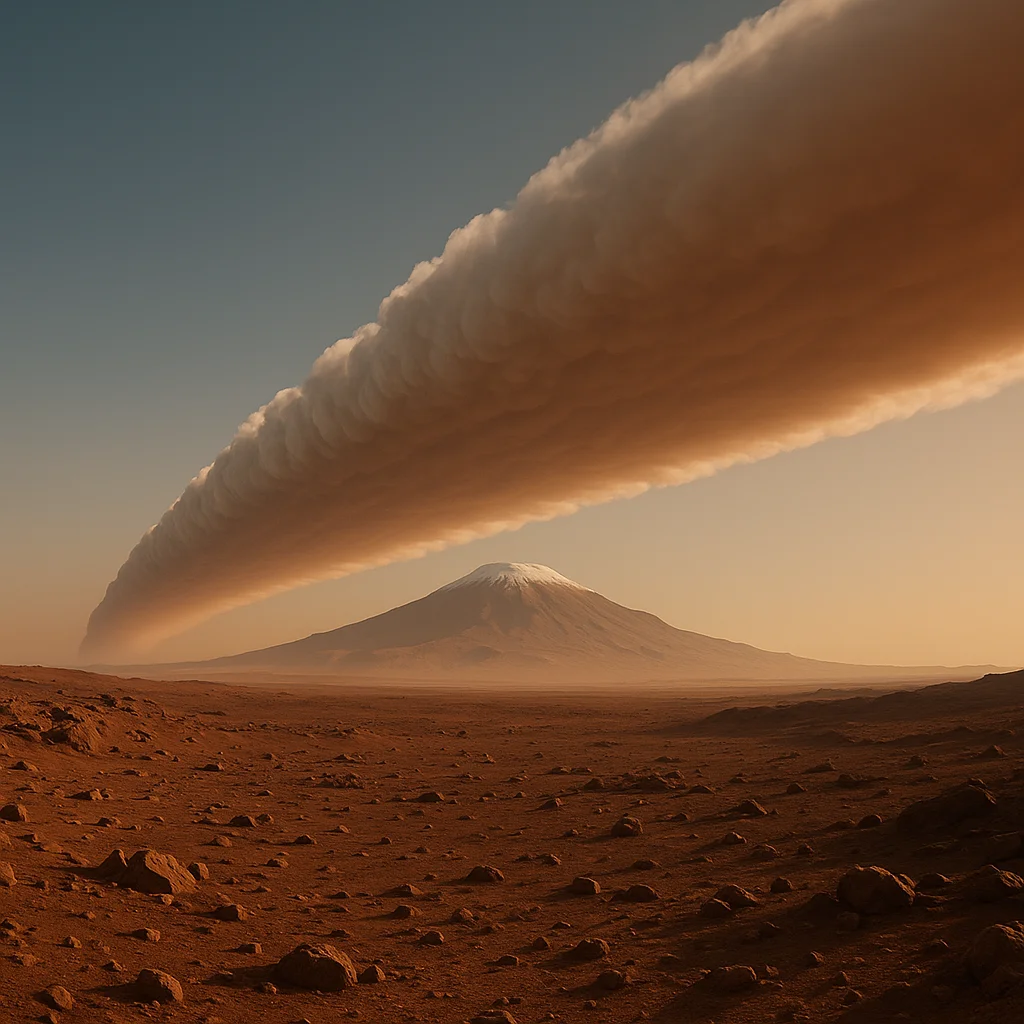
Visualization
Across the seasonally shifting southern hemisphere of Mars, a ghostly streamer of cloud draws itself out each morning from the flanks of Arsia Mons — the tallest southern sentinel of the Tharsis Montes volcanic triad — only to fade completely by afternoon. Known as the Arsia Mons Elongated Cloud (AMEC), this ephemeral phenomenon made headlines following its initial high-resolution imaging in 2018 by ESA’s Mars Express orbiter. The persistence, scale, and dynamical behavior of AMEC have bewildered planetary scientists: stretching as much as 1,800 kilometers in length, the cloud appears, elongates, and disperses on a diurnal rhythm that repeats for months during the martian spring and summer.
Traditionally, AMEC was classified as a species of orographic cloud, a staple of terrestrial meteorology that arises as wind-blown air masses are forced over mountain ranges, promoting condensation. On Earth, orographic clouds are the result of heterogeneous nucleation, wherein water vapor condenses onto aerosols—be they mineral dust, sea salt, or biological fragments such as pollen or soot. This process relies on the abundant presence of such nucleating agents for the cloud droplets or ice crystals to form. Mars, too, is cloaked in a notoriously dusty atmosphere, so the same paradigm was applied to its orographic cloud formation.
However, as Dr. Jorge Hernández-Bernal and collaborators at Sorbonne Université and CNRS revealed in their recent study published in *Nature Geoscience*, attempts to numerically model AMEC using conventional microphysical schemes consistently failed to reproduce the vivid, fast-evolving structure captured by Mars Express. This impasse forced the team to revisit the very fundamentals of atmospheric nucleation physics.
The breakthrough came only when the modelers incorporated the theoretical framework for homogeneous nucleation — a process often referenced in atmospheric science textbooks, but long considered relegated to extreme laboratory settings, not real planetary environments. Homogeneous nucleation circumvents the need for aerosols altogether. Instead, it posits that at sufficiently high supersaturation, water vapor can spontaneously crystallize, with molecules directly assembling into ice without using a foreign nucleus. The governing criterion for this phenomenon requires an environmental relative humidity (\(RH\)) vastly in excess of terrestrial norms; for water vapor to condense homogeneously, calculations show \(RH\) must approach or even exceed 1000%, i.e., supersaturation levels surpassing 100,000% of “normal” Earth values.
To investigate whether such conditions could possibly arise above Arsia Mons, Hernández-Bernal’s team coupled mesoscale dynamical models of Martian airflows with microphysical equations governing condensation and nucleation rates. As eolian winds impinge upon the volcanic massif, the simulations show that “gravity waves” — upward-propagating oscillations in air density — lift saturated air parcels rapidly to higher, colder altitudes. Within a span of about 10 minutes, these air pockets can ascend several kilometers, during which adiabatic cooling drives the temperature down by approximately 30 degrees Kelvin. The vapor-laden air does not have time to equilibrate with the extremely dry Martian background atmosphere, resulting in a spike in local humidity that, according to Clausius-Clapeyron relations, becomes orders of magnitude higher than what would support heterogeneous nucleation alone.
Mathematically, the nucleation rate \(J\) for homogeneous freezing of water vapor is given by
\[ J = J_0 \exp \left( -\frac{16\pi\sigma_{iv}^3}{3kT (\ln S)^2 \rho_i^2} \right) \]
where \(\sigma_{iv}\) is the surface tension between ice and vapor, \(S\) is the saturation ratio (\(S = P_{\text{H}_2\text{O}} / P_{\text{sat}}(T)\)), \(\rho_i\) is ice density, \(k\) is Boltzmann’s constant, and \(T\) is absolute temperature. Under the extreme cooling and rapid uplift simulated at Arsia Mons, the model parameters conspire to elevate \(J\) to observable levels, and condensation occurs in the absence of dust grains or other nucleating substrates.
The resulting cloud — forming “out of thin air,” as Hernández-Bernal’s group puts it — is a textbook case of homogeneous nucleation in an open planetary atmosphere, something previously theorized for the mesospheres of Earth or Venus, but never empirically documented. Observations and models converge to suggest that, at least in the unique microclimate above Arsia Mons during certain seasons, Mars exhibits regions where its atmosphere’s relative humidity dramatically exceeds those on Earth, fostering physics once thought to be academic curiosities.
This finding reframes our understanding of Martian atmospheric dynamics and cloud microphysics, highlighting a planet where transient, extreme microenvironments can produce macroscopic phenomena distinct from anything yet observed in Earth’s more robustly mixed atmosphere. AMEC, with its daily disappearance and enigmatic reemergence, stands as a ghostly testament to the untapped complexity of condensation processes possible on planetary bodies — and signals that the final word on atmospheric cloud formation may still be unwritten.