Field: Technology
Euclid discovers ancient cosmic beacons from the dawn of time, shining like a trillion suns
Published | Technical Staff
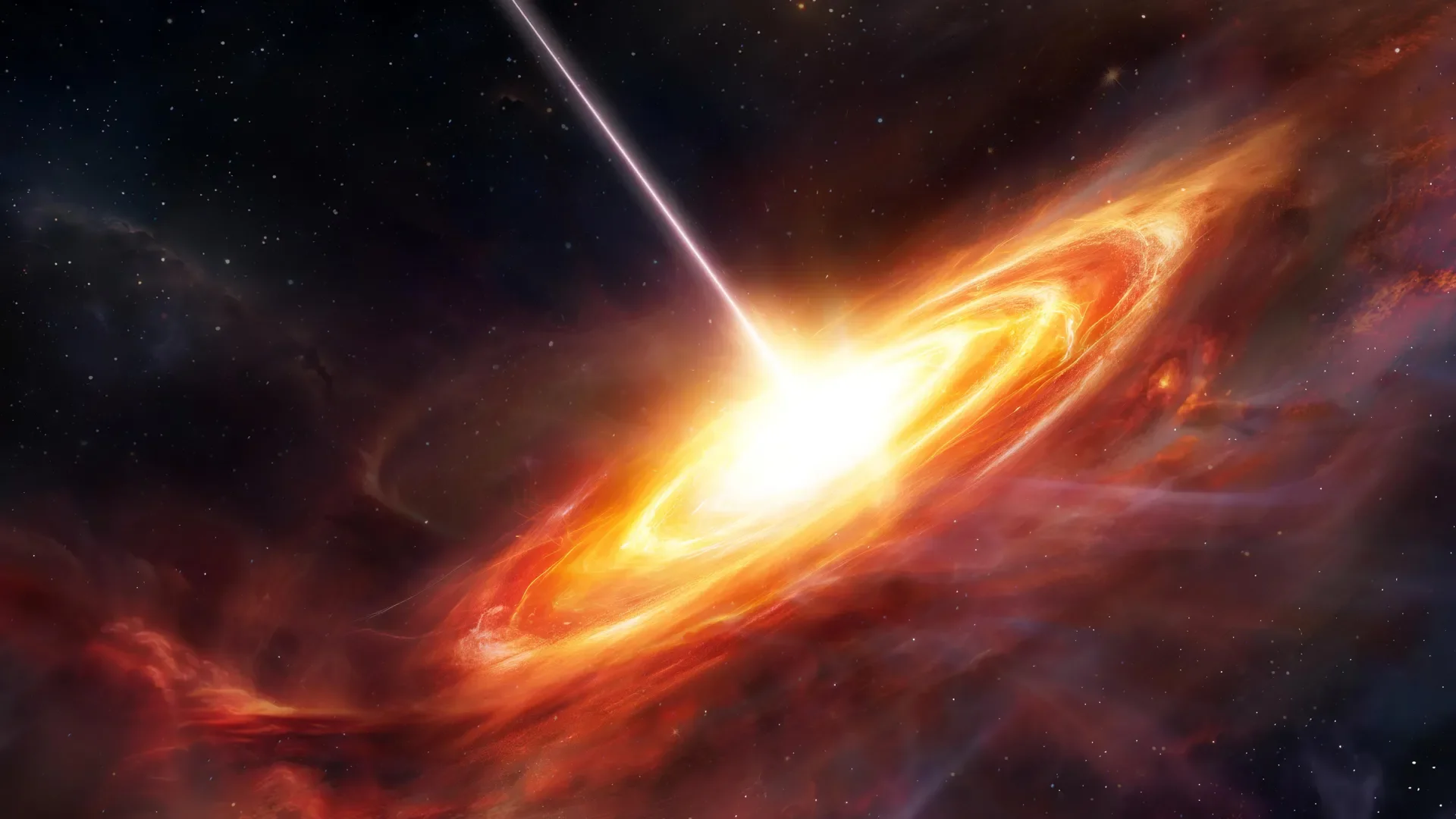
Visualization
In a groundbreaking revelation, the European Space Agency's Euclid space telescope has unveiled an astonishing trove of ancient quasars, a discovery that propels our understanding of the early universe into uncharted territories. The telescope has identified 31 quasars dating from an epoch when the cosmos was merely 670 million years old—about 5% of its current age—some of which shine with the remarkable luminosity of a trillion suns. This illumination signifies the active processes occurring within these galactic centers, which are powered by supermassive black holes.
Quasars serve as cosmic lighthouses, appearing during a fleeting yet intense phase in which enormous quantities of gas and dust spiral towards a black hole, a phenomenon characterized by a release of immense energy. The remarkable brightness of quasars, which can be hundreds to thousands of times that of entire galaxies, makes them indispensable beacons for probing the complexities of galaxy formation and the development of supermassive black holes. Despite their potential revelations, the quest to identify quasars from the universe's infancy has been rife with challenges. Until recently, astronomers had only mapped a limited collection of these objects—mostly those of exceptional luminosity—leaving a vast knowledge gap relative to the forms and distributions of these early cosmic entities.
Launched in 2023, Euclid radically transforms this endeavor through its unique survey capabilities, allowing for the exploration of broad sky regions while retaining the sensitivity to detect even the faintest light from nascent quasars. As highlighted by Daming Yang from Leiden University and the lead author of the discovery paper, the implications are profound: "By finding and studying them, we can better understand how these enormous systems formed and grew so quickly—one of the greatest mysteries in astrophysics."
Among the 31 newly identified quasars, 12 exhibit redshifts of 7 or greater, a crucial metric indicating their distance and the epoch to which they belong. A redshift value of 7 corresponds to light emitted during the first 770 million years after the Big Bang, situating these quasars within the nascent universe's timeline.
What sets two particular quasars apart are their record-setting redshifts of 7.77 and 7.69, corresponding to the designations EUCL J172902.75+641018.1 and EUCL J125308.55+705432.3, respectively. Residing over 13 billion light-years away from Earth, they are not only illuminating celestial bodies but also serve as crucial indicators of the evolving dynamics of the universe at its earliest stages. Prior to these discoveries, the oldest known quasar, recorded in 2021, bore a redshift of 7.64—a testament to the exponential acceleration of discovery facilitated by Euclid, which has outpaced previous efforts that took over a decade to document just a handful of quasars.
Antonio La Marca, an ESA Research Fellow on the Euclid team, characterized this achievement as establishing a foundational census of ancient quasars. This expansive approach enriches the dataset astronomers rely on for understanding the intricacies of cosmic evolution.
Particularly compelling is the insight gleaned from the environment surrounding one of the newfound quasars. Research conducted by Silvia Belladitta and colleagues indicates that the second-most ancient quasar is embedded within a host galaxy brimming with gas and dust where star formation is occurring at a prodigious rate. This observation unveils critical details about the conditions that prevailed during the formation of the first massive galaxies, concurrently evolving with the black holes that anchor them.
These quasars are also critical witnesses to the epoch of reionization, a transitional phase following the “cosmic dark ages,” characterized by the ionization of hydrogen by energetic radiation. Understanding this phase is essential to reconstructing the thermal and structural evolution of the early universe. As ESA Euclid Project Scientist Valeria Pettorino articulates, "Ancient quasars are rare discoveries. They're interesting in themselves, but also time machines that enable us to explore the early Universe."
Euclid’s remarkable capabilities stem from its ability to simultaneously analyze large swaths of sky while capturing detailed images and faint infrared emissions from vastly distant sources. Such unique features, paired with the collaborative efforts of thousands of scientists and engineers from the Euclid Consortium, facilitate a more refined approach to quasar discovery compared to previous surveys.
The Euclid Wide Survey, the courageous undertaking that aims to survey more than one-third of the night sky, has yielded unprecedented results in less than a year. As the telescope continues to process vast datasets, the potential for further discoveries remains tantalizingly high.
With each quasar detected, the narrative of our universe becomes richer and more complex, revealing not just structures, but the intricate web of interactions and processes that shaped cosmic history. As researchers sift through the cosmos's deepest enigmas, it becomes increasingly clear that the case of ancient quasars is far from closed; rather, it serves as a vivid reminder of the cosmos's historical depth and the relentless pursuit of knowledge that drives astrophysical inquiry.