Field: Technology
ESA’s Hera spacecraft is flying rectangles around NASA’s asteroid crash site
Published | Technical Staff
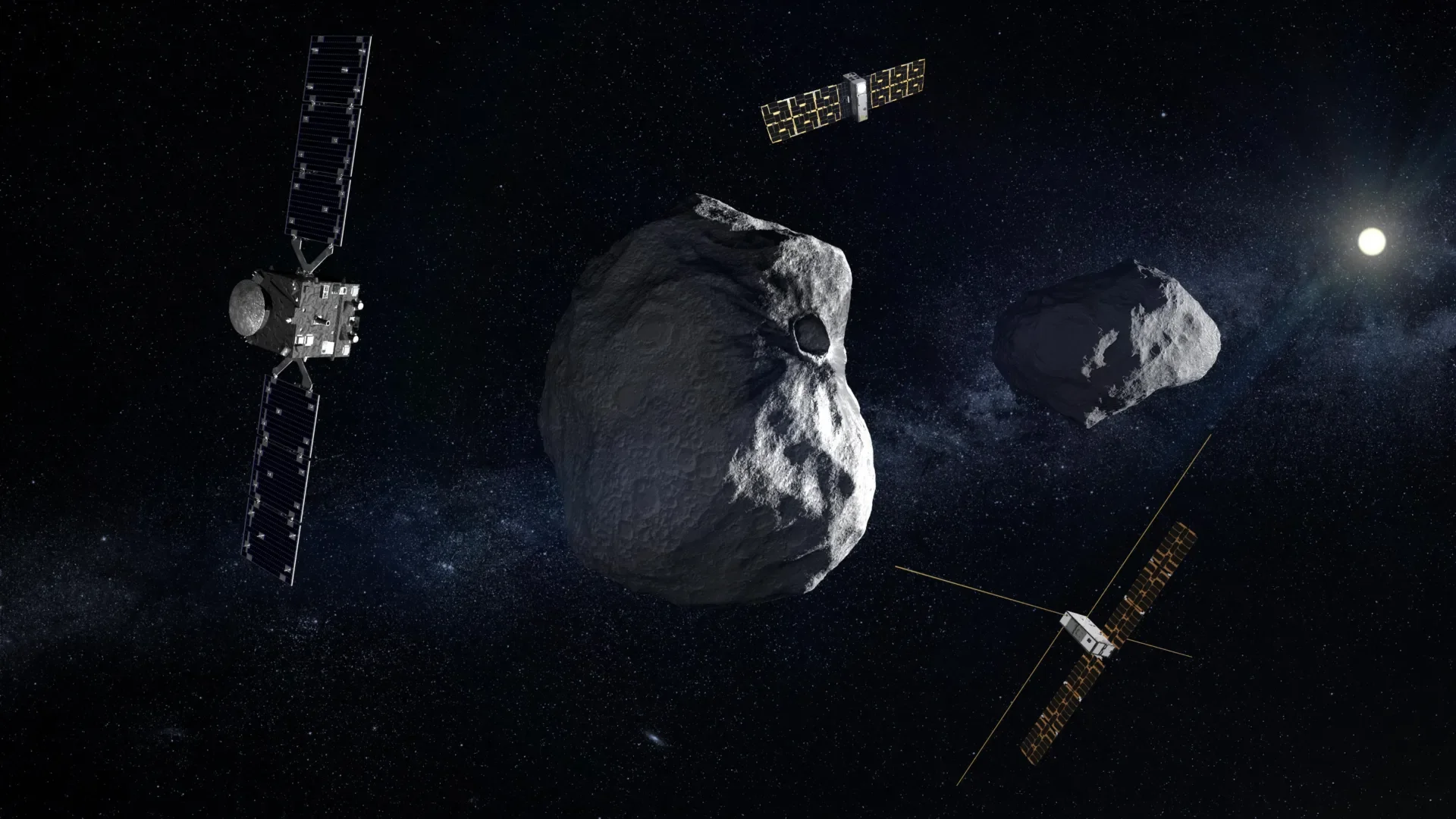
Visualization
Orbiting a distant cosmic tableau, the European Space Agency's Hera spacecraft has arrived at the Didymos binary asteroid system, precisely where NASA's pioneering DART mission made history by impacting the smaller asteroid, Dimorphos, in a bold attempt to alter its orbital mechanics. The insights gleaned from Hera's extensive close-up investigation could fundamentally enhance our understanding of such celestial bodies and offer vital information for future planetary defense strategies against potentially hazardous asteroids.
A marvel of engineering akin in dimensions to a compact automobile, Hera now navigates this asteroid system from a distance of about 25 to 30 kilometers, embarking on what is characterized as the "early characterization phase." During this critical stage, Hera, supported by two CubeSats named Juventas and Milani, aims to provide foundational observations that will inform ongoing planetary defense efforts. The CubeSats, innovative technological platforms in their own right, will not only undertake scientific measurements but will also demonstrate advanced deep space inter-satellite communication techniques.
Mission scientist Michael Kueppers emphasizes Hera's role in decoding Dimorphos’s response to an intense hypervelocity impact, which occurred when DART collided with the asteroid at speeds exceeding 6.1 kilometers per second on September 26, 2022. The DART mission, which effectively shortened Dimorphos' orbital period around Didymos by approximately 33 minutes, raised important scientific questions regarding the physical alterations induced by such impacts. Kueppers illuminates this predicament: "Our images will reveal for the first time what a small asteroid looks like globally, having experienced a hypervelocity impact in the context of the first asteroid deflection test."
Navigating the tenuous gravity of the Didymos system presents unique challenges, as Didymos spans roughly 780 meters and Dimorphos a mere 151 meters, with gravitational forces infinitely weaker than Earth's. Conventional orbital mechanics are rendered impractical under such conditions; thus, Hera adopts an inventive navigation regime featuring "rectangular orbits." These orbits consist of nearly linear flight trajectories punctuated by deliberate 90-degree thruster firings that propel Hera beyond the shadow of the asteroid pair. This strategy, while seemingly unconventional, enhances mission safety—if a thruster malfunction occurs, Hera will drift away from potential collision courses instead of veering dangerously close.
Following a successful "early characterization phase," Hera is poised to transition into a "detailed characterization phase." This next stage will enhance proximity to Didymos and Dimorphos, illustrating more intricate orbit trajectories shaped like bowties. Meanwhile, the mission control team at the European Space Operations Centre (ESOC) in Darmstadt, Germany, employs advanced data transmission technology, maintaining vital communications over immense distances. They utilize four Deep Space Antennas, each with a diameter of 35 meters, distributed across locations in Argentina, Spain, and Australia, ensuring that Hera remains on course as it journeys approximately 196.5 million kilometers from Earth.
Through this imminent investigative phase, Hera will delve into Dimorphos's composition and structure, providing insights yet unrevealed by the DART mission. Preliminary findings indicate the creation of an extensive debris field with a reach over 10,000 kilometers following the DART impact, yet the questions linger—did the collision yield a substantial crater, or did it induce widespread reshaping of the asteroid?
As Hera's advanced observational instruments prepare to examine this historic collision site, the mission stands at the forefront of astrobiology and planetary defense. The collective findings, enriched by data from the CubeSats, are expected to elucidate the mechanisms governing Dimorphos's response to kinetic impacts. This understanding is critical in fine-tuning the kinetic impactor technique for potential use in deflecting threatening asteroids, emphasizing a strategic path to planetary defense.
As we venture deeper into the exploration of our solar neighborhood, Hera symbolizes humanity's quest not only to understand but also to protect our home from the caprices of space. The stakes have never been higher, and the legacy of Hera may very well illuminate the path forged by DART, potentially safeguarding Earth from celestial impacts in the future. The slow, methodical journey of Hera reflects a new era in space exploration—one that embodies both scientific inquiry and the pragmatic necessity of planetary defense, echoing the timeless wisdom that knowledge is our best shield against the unknown.