Field: Technology
Elusive Asteroid Unveiled as Active Comet After Surprising Close Encounter
Published | Technical Staff
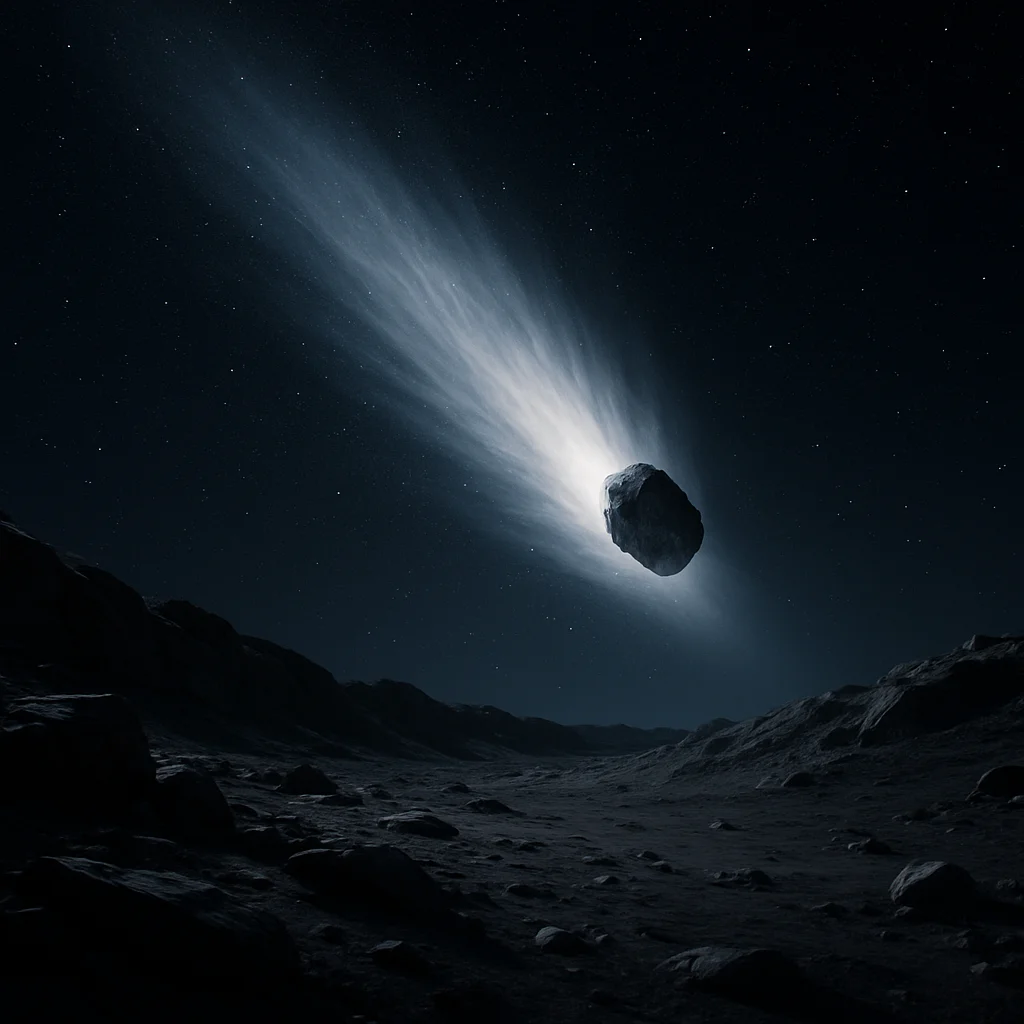
Visualization
In August 2025, as Earth and the enigmatic near-Earth object (875163) 1998 SH2 crossed paths at a cosmic proximity of 3 million kilometers, an astronomical intrigue began to unfold—one that would recalibrate our understanding of how dormant cometary activity can masquerade as a mundane asteroid. The object, long cataloged as an asteroid by virtue of its asteroidal orbit and lack of visible coma or tail, became the fulcrum of an international investigation that illustrates how modern dynamic analyses can expose subtle cometary behaviors previously lost within the vastness of observational data.
The first anomaly arose not from the object’s physical appearance, but from its motion through space. Dr. Davide Farnocchia and the Planetary Defense Group at NASA’s Jet Propulsion Laboratory, anticipating a straightforward encounter, scheduled tracking of 1998 SH2 with the Deep Space Network’s state-of-the-art planetary radar. Despite the object’s orbit, with a period of approximately 4.5 years and a history stretching back to its discovery in 1998, 1998 SH2 failed to appear at the predicted coordinates. Such a deviation prompted a critical reevaluation: was a non-gravitational force subtly redirecting its trajectory through the Solar System?
The culprit, determined through a rigorous analysis of accumulated astrometric data, was so-called non-gravitational acceleration, typically modeled by the vector equation:
\[ \mathbf{a}_{\text{NG}} = A_1\hat{\mathbf{r}} + A_2\hat{\mathbf{t}} + A_3\hat{\mathbf{n}} \]
where \( \hat{\mathbf{r}} \), \( \hat{\mathbf{t}} \), and \( \hat{\mathbf{n}} \) denote local radial, tangential, and normal vectors to the object's orbit, and \( A_1, A_2, A_3 \) are empirically fitted parameters. In active comets, sublimation of volatile ices results in anisotropic outgassing, producing jets that act as minuscule thrusters, incrementally but measurably accelerating the nucleus. The team’s calculations revealed perturbations incompatible with a purely gravitational model—evidence that the object was slowly but steadily altered by outflowing gas.
Archival searches, including photometric imaging from the ATLAS-Chile telescope on September 3 and 4, 2025, yielded little hint of characteristic cometary features: neither a discernible tail nor coma appeared in stacked exposures. However, these negative visual results juxtaposed against the dynamic clues suggested outgassing below classical detection limits for most observatories—an unusually ‘quiet’ but non-negligible activity level.
The rare opportunity afforded by the August 2025 flyby catalyzed a coordinated global observing campaign. High-sensitivity instruments—the Canada-France-Hawaii Telescope, ESO's Danish 1.54-meter Telescope, and the Very Large Telescope array—were tasked to resolve the issue. Through carefully stacked and processed imagery, a faint yet unmistakable tail was detected, its photometric profile contrasting against star-field background. The detection confirmed that even objects with subdued physical signatures can indeed be outgassing comets.
With its status recast, 1998 SH2 received the new provisional tag P/1998 SH2, reflecting its newly affirmed cometary nature. The distinction is more than academic: accurate physical modeling of such bodies is critical for planetary defense. Outgassing imparts unpredictable forces, complicating collision risk predictions; recognition of such behavior can enhance our predictive capabilities for near-Earth object (NEO) threats. As Dr. Farnocchia emphasized, non-gravitational perturbations serve as a diagnostic tool, not only to distinguish between asteroids and camouflaged comets but to refine the assessment of their evolving orbits under solar influence.
The comprehensive study, detailed in *Nature Astronomy* (Farnocchia et al., 2026; doi: 10.1038/s41550-026-02913-7), underscores the necessity of unwavering vigilance in the continuous tracking and multifaceted characterization of NEOs. It is a paradigm shift that highlights the dynamic, ever-evolving nature of small Solar System bodies, where the boundary between asteroid and comet is far more porous than once thought—a lesson written not in the dust of a comet’s tail, but in the subtle mathematics of orbital mechanics.