Field: Technology
Einstein's equations reveal how gravity could break, reconnect, and release energy.
Published | Technical Staff
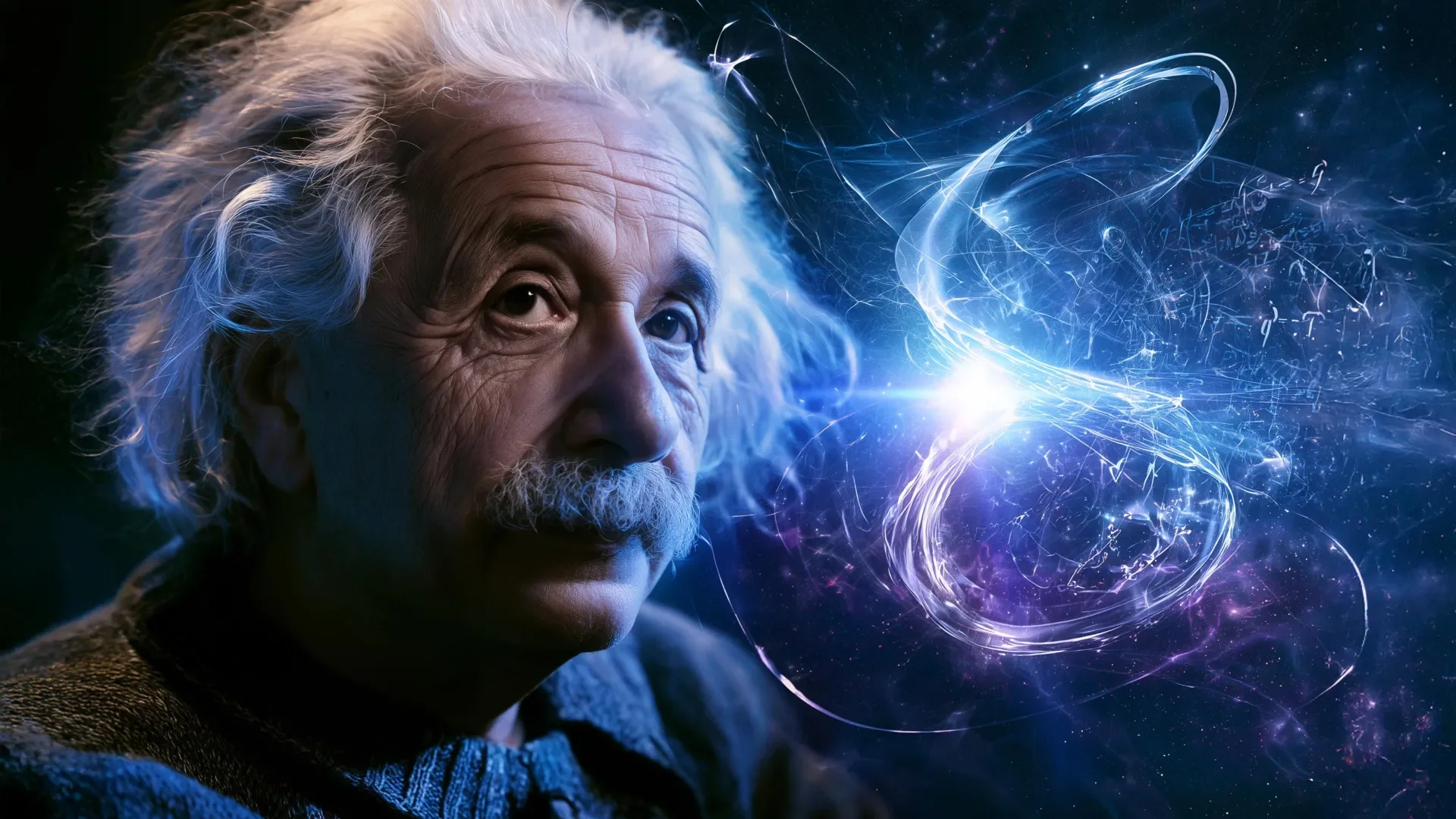
Visualization
More than a century after the revolutionary contributions of Albert Einstein to our understanding of gravity, contemporary physicists have unearthed profound implications hidden within his original equations. Recent work from researchers at Columbia University and Universidad Adolfo Ibáñez introduces a groundbreaking theoretical concept termed "gravitational reconnection." This phenomenon posits that the structures inherent within gravitational fields may not only break apart but also reconnect, thereby facilitating a transfer of energy into matter—an idea that could reshape our comprehension of extreme astrophysical events, including the violent interactions occurring during black hole collisions.
Luca Comisso, an associate research scientist at Columbia University, alongside Felipe A. Asenjo from Universidad Adolfo Ibáñez, engaged with Einstein's equations through an innovative mathematical lens. Their pioneering analysis reveals a striking parallel between gravity and the behavior of plasmas—ionized gases consisting of charged particles, which exhibit complex dynamics in the presence of magnetic fields. Such insights may yield significant advancements in our understanding of how gravitational mechanisms operate under highly chaotic conditions.
At the heart of gravitational reconnection lies an analogy to the well-established concept of magnetic reconnection. This process occurs in a plasma when magnetic fields, represented by curved lines, dramatically rearrange due to specific configurations. As these magnetic field lines are manipulated—twisted and stretched—they can suddenly sever their connections and re-attach, resulting in the release of stored magnetic energy that significantly influences surrounding particles. The energetic releases involved in magnetic reconnection are responsible for some of the solar system's most formidable phenomena, including solar flares. Comisso elucidates this connection: "When they break and reconnect, they release energy," indicating that gravitational fields may undergo a similar transformative process within the confines of four-dimensional spacetime.
The intricate behavior of gravity emerges through a richer mathematical structure, distinct from the relatively simpler three-dimensional configurations of magnetic fields. Instead of traditional field lines, gravity can be conceived as comprising field "sheets." In this context, the expansion from lines to sheets evokes the conceptual shift from two dimensions to three—a mathematical framework in which gravity manifests as interconnected sheets whose connections may effectively break and reform under certain conditions. Such transformations do not imply literal tearing of spacetime; rather, they encapsulate the dynamic ways in which gravity can channel energy into matter.
Challenging previous understandings, the researchers unearthed inherent constraints within Einstein's equations that delineate how spacetime can evolve yet had previously gone unnoticed in classical interpretations. Their findings, detailed in "Reconnection of Gravitational Fields" published in *Physical Review D*, build on earlier work that exposed significant limitations regarding the permissible alterations within the curvature of spacetime. These limitations, intrinsic to Einstein's theoretical framework, were unveiled through careful examination of the equations' structure.
Notably, Comisso and Asenjo's exploration hinges on a reformulation of Einstein's equations—a mathematical endeavor that employs different variables while remaining fundamentally equivalent to the original descriptions. The parallel this alternative formulation draws with equations governing plasmas affords remarkable insights into gravitational behavior, allowing physicists to extrapolate essential patterns and restrictions governing spacetime without necessitating exhaustive solutions of every segment of the equations. "It helps us predict some patterns of the spacetime," Comisso notes, underlining a methodological shift that emphasizes the underlying rules, thereby refining our predictive capabilities for complex gravitational systems.
The implications of exploring gravitational reconnection are especially resonant in the context of black hole mergers, which rank among the universe's most cataclysmic events. As two black holes converge, their formidable gravitational fields interact in unprecedented ways, potentially leading to intense energy releases through processes akin to the newly identified gravitational reconnection. This duality hints not only at new astrophysical phenomena but also at yet-to-be-explored mechanisms that may govern energy dynamics in extreme gravitational environments.
As this research matures, the convergence of gravitational study with principles drawn from plasma physics may initiate a new chapter in theoretical astrophysics. The techniques employed here signal a continuous quest to decipher the complexities of spacetime, bridging long-standing theories with contemporary mathematical insights. The implications for black hole physics, the nature of gravitational waves, and our broader understanding of cosmic phenomena are substantial and serve as a testament to Einstein's enduring legacy, offering tantalizing glimpses into the deep-seated rules that orchestrate the universe's most formidable forces.