Field: Technology
Earth's fiery birth may have created hundreds of oceans' worth of water
Published | Technical Staff
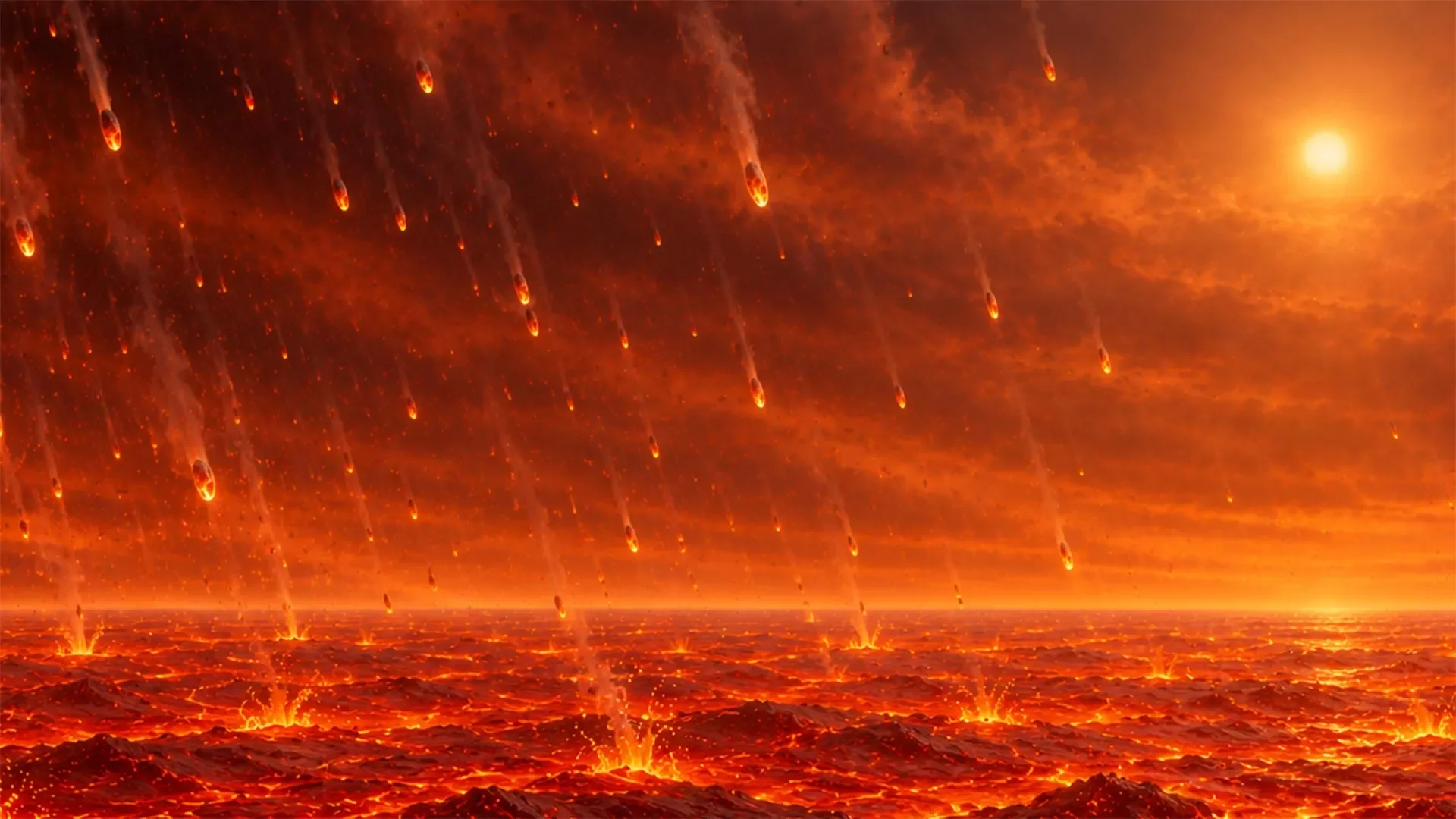
Visualization
In an epoch when the universe was but a cradle of chaos, Earth emerged from a tumultuous birth, obscured in the fiery gases of a primordial atmosphere. Recent research from The University of New Mexico has illuminated a groundbreaking perspective on this formative period, suggesting that the water essential for life on our planet may not have been imported by icy cometary bodies from the far reaches of the solar system, but rather synthesized in situ through extraordinary geochemical reactions.
The conventional dogma posits that Earth's hydrosphere owes its abundance to deliveries from distant, frigid bodies. These icy entities, composed of a concoction of volatiles including water, would have embarked on long journeys into the hotter inner solar system, eventually contributing to the oceans we know today. However, this paradigm circumvents vital questions about the logistics of such deliveries and fails to fully account for the chemical dichotomy found in Earth’s composition. The new study challenges this narrative, proposing that water formation could have been an intrinsic process during Earth’s accretion phase.
Led by graduate student Susmita Garai and supported by Professor Zachary Sharp and Peter Olson, the team centered their research on the possibility of water production through reaction processes involving hydrogen-rich gases and the iron-rich silicates that composed the nascent planet. The experiments aimed to replicate conditions thought to mirror those present in the atmosphere of early Earth—extremely high temperatures (ranging between 1,200 and 1,400 degrees Celsius) coupled with a hydrogen-rich environment.
Garai crafted an experimental apparatus where silicate rock samples were subjected to flowing hydrogen gas. The resulting chemical milieu fostered reactions that converted substantial amounts of iron oxide into metallic iron while releasing water vapor in mere minutes. Specifically, a staggering 80% of the iron oxide was reduced, demonstrating the efficiency and rapidity of this novel reaction process.
In stark contrast, when these experiments were paralleled using helium as a reactive gas, the anticipated reduction did not transpire, thereby underscoring hydrogen's essential role in the water-generating mechanism. The unexpected productivity of these reactions was particularly revelatory; projections drawn from the experimental data suggest that the early Earth may have produced hundreds of oceans' worth of water through this process alone, an assertion that compels deeper reflection on the origins of this vital resource. As Professor Sharp noted, "it is hard to imagine that this water may have been produced 4 ½ billion years ago in a hell-like atmosphere, but it very well may have."
These findings signal a paradigm shift not only in our understanding of Earth’s hydrosphere but also in our conception of planetary formation at large. The hypothesis of "pebble accretion," the process wherein little fragments of rock coalesce under gravitational influences to form larger planetary bodies, dovetails with the notion that they might concurrently produce water as they gather mass. This suggests that early atmospheres of rocky planets around other stars—if enriched with hydrogen during their formative stages—could likewise facilitate the production of substantial hydrostatic resources.
The implications are profound. If numerous exoplanets exhibit similar geological and atmospheric conditions, the universe may host a greater frequency of habitable worlds than previously inferred. Such alien terrains could also potentially harbor life, nurtured by endogenous processes that render them more Earth-like than mere chance would suggest.
Nevertheless, despite these promising revelations, uncertainties linger. The current experiments beautifully illustrate the water-generating potential of reactive processes under extreme conditions but fall short of quantifying the precise contribution of this mechanism to Earth's present-day water inventory. This represents a fertile avenue for further investigative endeavors as we seek to decode the complexities surrounding our planet's hydrological history and the broader cosmic relevance of these findings.
The study not only reshapes our understanding of the Earth’s origins but also serves as a beacon for future investigations into the fundamentals of planetary development. As we venture further into the cosmos, the prospect that life-sustaining water may arise through intrinsic geological processes opens an exciting frontier in exoplanetary research and astrobiology. In a universe where life may have more genesis points than previously thought, the potential for habitable worlds springs anew, beholden to the revelations descending from the fiery heralds of Earth's illustrious past.