Field: Technology
Discovery of *Nagatitan chaiyaphumensis* Sheds Light on the Cretaceous Behemoths of Southeast Asia
Published | Technical Staff
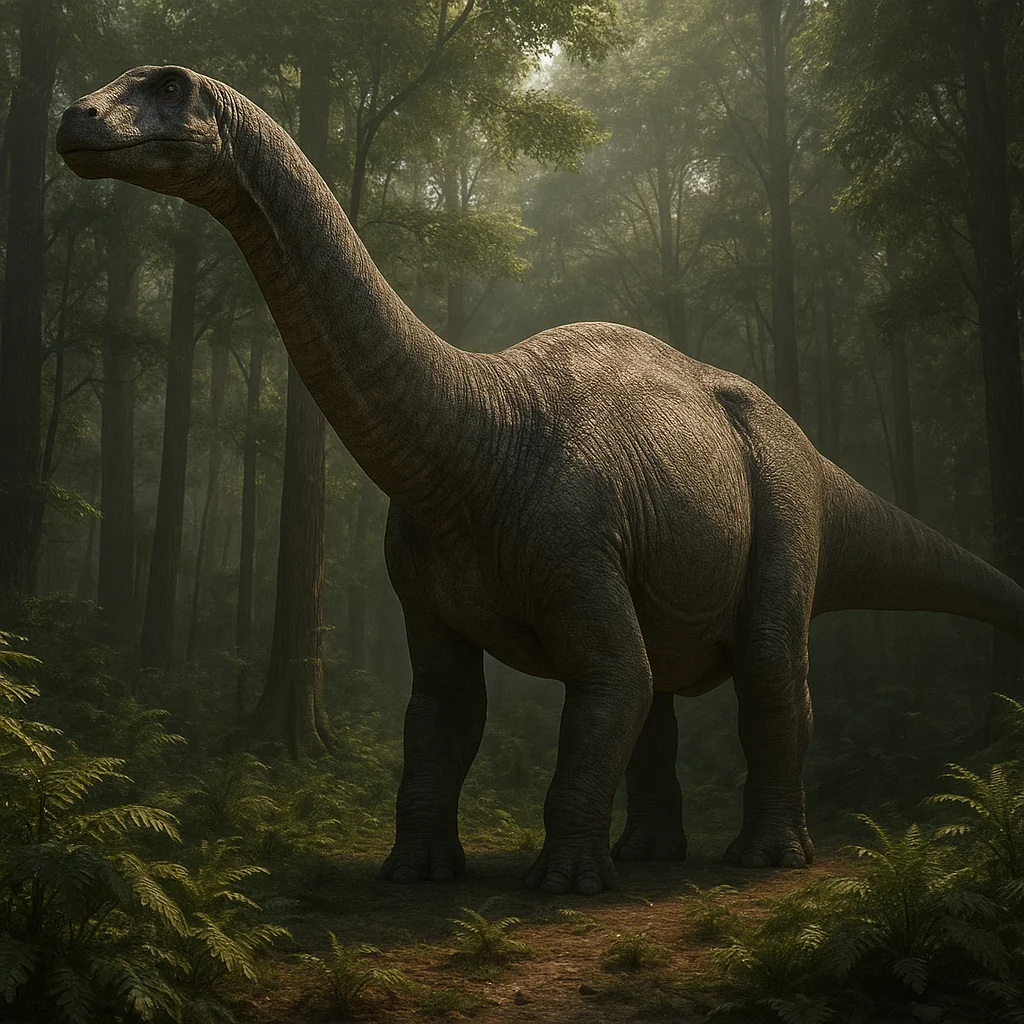
Visualization
The recent unearthing and identification of a colossal new dinosaur species from the Early Cretaceous of northeastern Thailand has transformed our understanding of the biogeography and evolutionary diversification of Asian sauropods. The taxon, *Nagatitan chaiyaphumensis*, emerges from the fossil troves of the Khok Kruat Formation in Chaiyaphum province, dramatically expanding the known diversity of titanosauriform dinosaurs in Southeast Asia and providing a window into the region’s mid-Cretaceous megafauna.
The paleontological team, led by Thitiwoot (Perth) Sethapanichsakul of University College London, excavated a partial skeleton representing the largest dinosaur yet reported from Southeast Asia. Stratigraphically constrained to the Aptian-Albian stages (~113 Ma), *Nagatitan chaiyaphumensis* inhabited an arid floodplain ecosystem, coexisting with a diverse vertebrate fauna including iguanodontians, early ceratopsians, carcharodontosaurian and spinosaurid theropods, as well as non-dinosaurian representatives such as hybodont sharks, bothremydid turtles, neosuchian crocodyliforms, and pterosaurs.
Morphometric analysis based on the recovered remains yields an estimated total body length of 27 meters (approximately 89 feet), and a mass calculated within the range of 25–28 metric tons. These estimates were derived through allometric scaling equations for limb bone circumference and inferred proportional similarities with better-preserved titanosauriforms (see Campione & Evans, 2012: mass ≈ 0.00016 × [femur circumference + humerus circumference]^2.73). While surpassing the mass of *Diplodocus carnegii* (“Dippy,” ~18 tons), *Nagatitan* is still less massive than South America’s ultra-giants such as *Patagotitan* (ca. 60 tons) and China’s *Ruyangosaurus* (ca. 50 tons), underscoring the body size disparity even among the planet’s largest terrestrial herbivores.
Crucially, anatomical comparison with an extensive dataset encompassing more than 150 sauropod species enabled the research team to position *Nagatitan* phylogenetically within the Euhelopodidae, a clade of somphospondylan titanosauriforms characterized by their distinctive vertebral and limb morphologies. Euhelopodids, previously exemplified in Asia by *Phuwiangosaurus sirindhornae* (also from Thailand) and *Tangvayosaurus hoffeti* (from Laos), display derived somphospondylan features such as camellate (air-filled, honeycomb-like) vertebrae and robust limb bones adapted for graviportal locomotion.
The geochronological context of *Nagatitan* deepens its significance. The Khok Kruat Formation stands as the youngest Mesozoic rock unit in Thailand yielding dinosaur remains. By the close of the Cretaceous, the encroachment of a shallow epicontinental sea across the region rendered subsequent strata largely devoid of terrestrial vertebrate fossils. Consequently, *Nagatitan* may represent the final large sauropod lineage of the area—aptly described by the authors as “the last titan” of Thailand.
From a macroevolutionary perspective, the sheer size of *Nagatitan* suggests its involvement in a mid-Cretaceous pulse of body size augmentation within Asian titanosauriforms. Such gigantism may have been facilitated by regional paleoenvironmental changes: paleoclimatic evidence implies mean annual temperatures and precipitation rates conducive to the expansion of primary productivity and suitable habitats, thereby enabling the success of enormous herbivorous dinosaurs within increasingly open landscapes.
The ramifications of this discovery are manifold. Not only does *Nagatitan chaiyaphumensis* fill a geographic and temporal lacuna in the paleobiogeography of Sauropoda, but it also underscores Southeast Asia’s status as a crucible of sauropod evolution and endemism. Moreover, the persistence of euhelopodid lineages in the region reveals complex patterns of faunal interchange and provinciality during the Cretaceous, challenging previous conceptions of both continental isolation and dinosaurian dispersal routes across Laurasia.
The detailed findings, now published in *Scientific Reports* (Sethapanichsakul et al., 2026, doi: 10.1038/s41598-026-47482-x), mark a seminal advance in the field, highlighting the latent paleontological richness of Southeast Asia and foreshadowing further revelations as fieldwork and analytical methodologies continue apace. *Nagatitan* is, simultaneously, a monument to the vanished ecosystems of Cretaceous Thailand and an emblem of the hidden diversity that still awaits discovery in the world’s unexplored fossil beds.